
Zener Cards Exposed: How Schoolkids Became Psychic Guinea Pigs for the Government
DISCLOSURESPARAPSYCHOLOGY & CONSCIOUSNESS STUDIES
Debbie Edwards
5/2/20264 min read
Parapsychology gained a foothold in American academia at Duke University during the early 1930s. Psychologist Joseph Banks Rhine, known as J.B. Rhine, along with his wife Louisa E. Rhine, joined the faculty with support from department chair William McDougall. The Parapsychology Laboratory officially formed in 1935 as part of the psychology department. The Rhines sought to test psychic claims with statistical rigor and controlled conditions, distinguishing their approach from earlier spiritualist traditions.
J.B. Rhine retired from Duke in 1965. The laboratory then became an independent nonprofit called the Foundation for Research on the Nature of Man. In 1995, the organization adopted its current name, the Rhine Research Center. It now functions as a small nonprofit in Durham, focusing on research, public outreach, and community activities related to consciousness and exceptional experiences.
Zener Cards and Standardized ESP Experiments
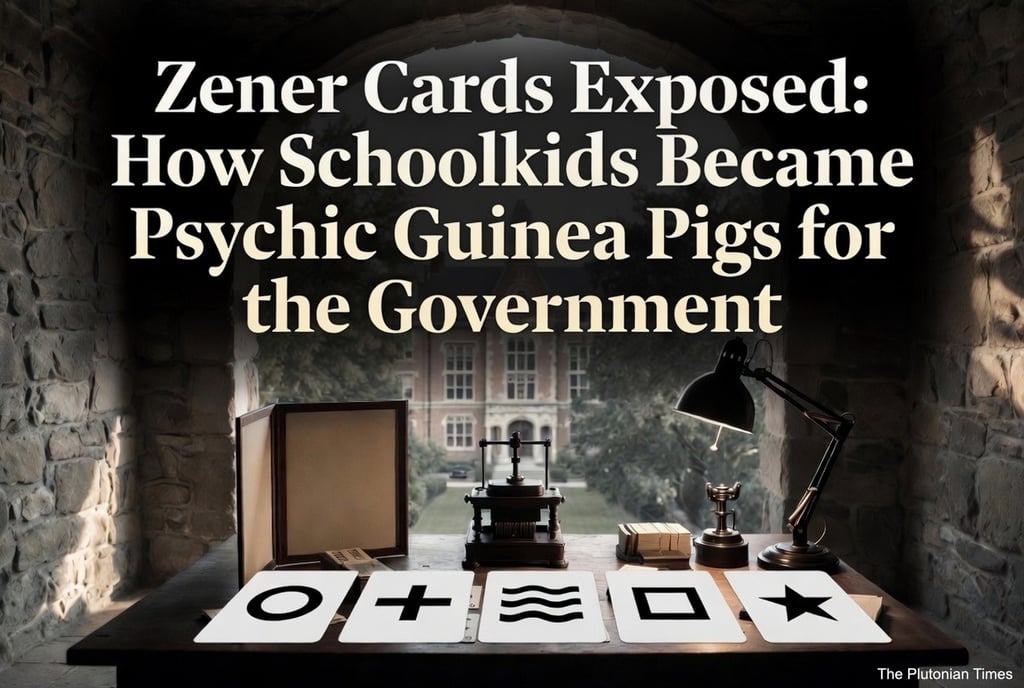
The laboratory’s most recognizable contribution involves Zener cards. Perceptual psychologist Karl Zener designed the deck in the early 1930s specifically for Rhine’s studies. Each 25-card deck features five repeating symbols: a circle, cross, three wavy lines, a square, and a star.
In classic trials, participants attempted to identify the symbol on a card concealed from view, sometimes in a separate room. Researchers conducted extensive series of tests exploring telepathy, clairvoyance, and precognition. Rhine detailed many of these results in his 1934 book Extra-Sensory Perception, which introduced the term ESP to a wider audience. Some participants scored significantly above chance levels, though later analyses highlighted potential issues such as sensory cues or randomization problems in initial setups. Rhine introduced mechanical shuffling and other safeguards in response.
The cards remain available through the center and continue to appear in both historical reviews and modern parapsychological work.
Studies Involving Children
Researchers connected to the Duke laboratory explored ESP with younger participants in several contexts. Early on, J.B. Rhine tested children at local summer camps using simple numbered cards. Louisa Rhine also conducted informal trials with neighborhood children using Zener cards at home.
Published studies in the Journal of Parapsychology examined relationships such as teacher-pupil dynamics and scoring patterns in school settings. One 1943 project by A.A. Foster involved about 50 Indigenous children, ranging in age from 6 to 20, at a residential school in Brandon, Manitoba, Canada. The study used card-guessing methods to assess potential ESP abilities and develop scoring approaches, without documented parental consent. It reflected the era’s interest in cultural differences in psychic performance and maintained ties to the Duke laboratory.
Louisa Rhine’s large collection of spontaneous psychic reports also included numerous accounts from children, providing qualitative balance to the quantitative card experiments.
Prominent Individuals
J.B. Rhine (1895-1980) drove the establishment of laboratory-based parapsychology and stressed repeatable, statistical methods. Louisa E. Rhine (1891-1983) collaborated closely and specialized in documenting everyday spontaneous experiences. Karl Zener contributed the symbol designs that became central to the testing protocol. Their daughter Sally Rhine Feather, a clinical psychologist, later played a key leadership role as executive director emerita. Other contributors included researchers like Gaither Pratt. Modern staff and board members, such as John G. Kruth and Loyd Auerbach, sustain the center’s activities.
Funding and Operational Scale
Support for the work has come almost entirely from private sources rather than government or large institutional grants. During the Duke period, the university provided basic resources alongside gifts from individuals. After 1965, donors including Chester F. Carlson (Xerox inventor) supplied important funding and endowments that aided the transition. Charles E. Ozanne offered ongoing support for research and publications.
As a modest nonprofit, the center typically reports annual revenues in the $200,000 to $300,000 range in recent years, drawn primarily from contributions, program fees, and small investments. It maintains an extensive parapsychology library and delivers online courses through its education program.
Government Interest and Connections to Other Programs
During the Cold War, U.S. intelligence agencies monitored global parapsychology developments, partly in response to Soviet efforts. Declassified CIA materials acknowledge Rhine’s early card experiments as foundational to the field and note that the agency acquired some Zener cards for internal evaluation.
Programs such as the Stargate Project (active from the 1970s to 1995) focused on remote viewing for intelligence purposes and operated primarily through Stanford Research Institute and related military units. It received around $20 million over its lifespan but had no direct operational link to the Rhine organization.
The Monroe Institute’s Gateway Process, which uses audio techniques for altered states, received analytical attention from the CIA in the 1980s. This initiative, however, developed separately in the 1970s and shares no documented direct connection to Rhine’s card-based studies or the center.
The Rhine effort helped shape the broader landscape of psi research but remained focused on independent, academic-style inquiry.
Present-Day Activities and Enduring Impact
The center today pursues projects on bioenergy, mind-matter interactions, and qualitative case studies. It offers community discussion groups, publishes the long-running Journal of Parapsychology, and provides educational certificates and courses. While funding remains limited compared to conventional psychological research, the organization upholds a commitment to methodical exploration of consciousness frontiers.
The Rhine Research Center represents a persistent attempt to apply scientific standards to exceptional human experiences. Its history highlights both the challenges and the curiosity that continue to surround parapsychology.
References
Official Rhine Research Center website (rhineonline.org).
Wikipedia: Rhine Research Center and Zener cards entries.
Duke University Libraries Parapsychology exhibit.
Washington Post coverage of the 1943 Canadian study.
Declassified CIA documents available via the CIA Reading Room.
ProPublica Nonprofit Explorer data on Rhine Research Center finances.
J.B. Rhine, Extra-Sensory Perception (1934).
Additional summaries from Psi Encyclopedia and historical archives.