
Wrongful Arrests, Secret Databases, And Your Daily Commute: What They’re Not Telling You
TECHNOLOGYUNSOLVED MYSTERIES & CRIME
Debbie Edwards
7/14/20264 min read
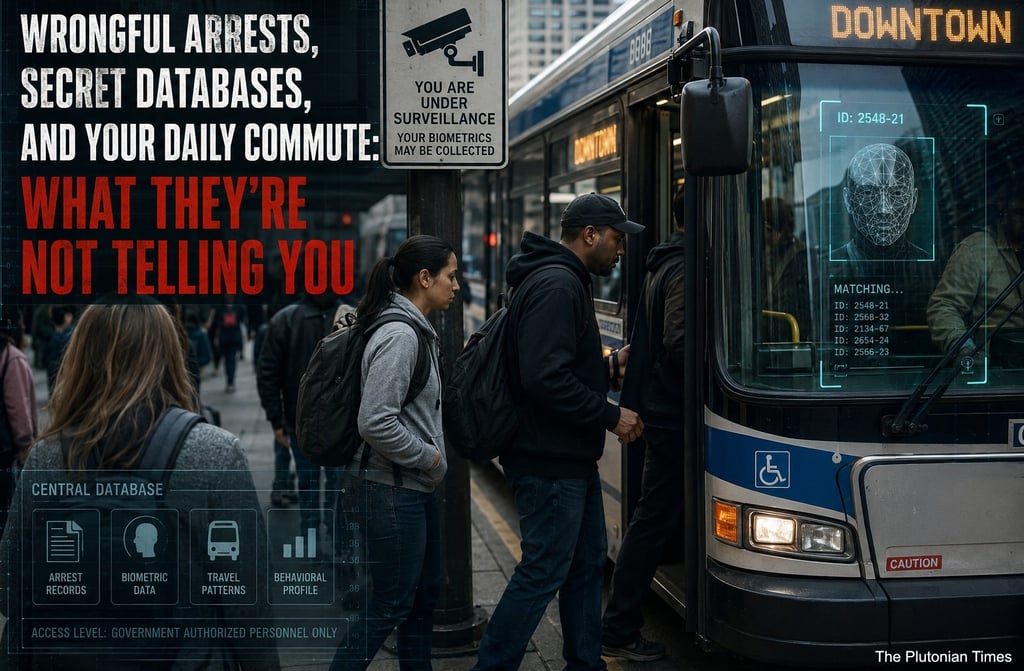
The Rising Tide of Biometric Data Collection: Mapping Its Expansion in Tech Access and Public Transportation
Biometric technologies, including facial recognition, palm vein scanning, and fingerprint systems, have seen rapid adoption for identity verification in smartphones, computers, airports, subways, buses, and rail networks. This trend promises convenience and security but raises significant privacy, surveillance, and civil liberties concerns. Below is a mapping of this increase, supported by facts, dates, examples, legal cases, and implications.
Early Foundations and Acceleration in the 2010s–Early 2020s
Biometric collection began gaining traction with consumer tech. Smartphones incorporated fingerprint sensors (e.g., Apple's Touch ID in 2013) and later facial recognition (Face ID in 2017). Public sector use expanded for border control and law enforcement.
In public transportation, early pilots focused on efficiency. By the mid-2010s, systems like London's Oyster card and contactless payments laid groundwork for more invasive biometrics. The COVID-19 pandemic accelerated contactless solutions, boosting adoption.
Key growth statistics include:
Digital travel credentials (DTCs) projected to grow from 105.4 million users in 2027 to over 1.2 billion by 2035, a more than 1,000% increase, relying heavily on biometrics for verification.
Facial recognition market projected to reach USD 20.68 billion by 2031, with strong applications in transportation.
Biometrics in Public Transportation: Global Rollouts
Cities and countries have deployed facial and palm recognition for ticketing, access, and security.
Brazil (2024): Billingpay and Cognitec implemented facial recognition in the Jaé app for public transport in a major city (second-largest in Brazil). Over four million daily users enroll facial images for ticketless boarding and fraud prevention on subsidized tickets.
Uzbekistan (2024): Tashkent Metro launched MyID palm vein payments across 12 stations on the Chilanzar line, with plans for full expansion. Users link to ATTO cards via kiosks.
Moscow (2023–2025): Facial recognition payments handle over 170,000 journeys daily, with half a million registered users. Goal: equip all turnstiles by end of 2025.
India: Digi Yatra facial authentication enabled 85 million journeys for 21 million users across 41 airports by early 2026, reducing processing to under 10 minutes. Rail and metro systems also deploy it for security and ticketing.
Asia (Ongoing): Osaka Metro installed facial gates at 130 of 134 stations. Indonesia uses it in 22 stations. Vietnam trials chip-ID linked biometrics at Hanoi station (2025).
United States (2025): Kansas City Area Transportation Authority (KCATA) equipped buses with AI-powered facial recognition cameras ahead of the 2026 FIFA World Cup for threat detection.
Airports and borders lead integration. TSA and CBP expanded facial recognition, with calls for it to become mandatory at more U.S. airports.
Tech Access and Broader Surveillance
Biometrics extend beyond transport to device unlocking, workplace access (e.g., in-cab truck cameras), and smart city infrastructure. In-cab systems from providers like Lytx and Samsara scan driver faces for safety monitoring.
Private tools like Amazon's Ring "Familiar Faces" feature scan passersby, leading to lawsuits. Law enforcement uses tools like Clearview AI (database of over 70 billion images) in arrests and surveillance.
Legal Cases and Regulatory Pushback
Biometric privacy laws and lawsuits highlight risks. Illinois' Biometric Information Privacy Act (BIPA, 2008) is among the strictest, requiring notice, consent, and retention policies.
BNSF Railway (2019–2023): Truck drivers sued over fingerprint scanning at facilities. Jury found liability for 45,600 violations; initial $228 million award led to a new damages trial.
Lytx (2025): Settled for $4.25 million over in-cab camera facial scans without proper consent under BIPA.
Clearview AI: Multiple class actions for scraping images without consent. A 2024 settlement faced appeals; ongoing transparency demands in cases like a 2026 D.C. shooting arrest.
São Paulo Metro (2018–2024): Court blocked facial recognition cameras, protecting 350,000 daily users and fining the operator for unconsented data collection and emotion/gender inference.
EU GDPR Opinion (2024): European Data Protection Board ruled certain airport biometric scenarios non-compliant unless passenger-controlled, emphasizing data minimization and security.
U.S. Wrongful Arrests: Cases like Robert Dillon (Florida, FACES system) highlight false positives, with at least 15 known instances.
Texas (CUBI, 2009) and Washington (2017) have similar laws. Federal efforts include PCLOB recommendations for voluntary use at airports.
Implications
Convenience and Efficiency: Faster boarding, reduced fraud, and better flow (e.g., 3–5 second verifications in Vietnam).
Privacy and Surveillance Risks: Persistent tracking erodes anonymity. Data can reveal travel patterns, associations, and more, often retained for years (e.g., DHS 15 years).
Accuracy and Bias: False matches disproportionately affect certain groups, leading to wrongful arrests or denials of service.
Security Vulnerabilities: Biometric data is immutable; breaches (unlike passwords) are permanent. Centralized storage raises hacking risks.
Legal and Societal: Class actions and regulations push for consent and transparency. Without oversight, normalization risks mission creep into broader surveillance.
Equity: Cash or anonymous options diminish, burdening unbanked or privacy-conscious users.
Conclusion
Biometric collection for tech and transport has surged since the 2010s, driven by efficiency gains and security needs, with explosive projections through 2035. While offering tangible benefits, cases like BNSF, Clearview AI, and EU rulings underscore the need for robust consent, data minimization, transparency, and alternatives. As adoption accelerates, balancing innovation with civil liberties remains critical for public trust. Independent oversight, updated laws, and public awareness will shape whether this technology serves or surveils society.
References (selected; full sourcing available via linked reports and news):
Juniper Research on DTCs (2026).
Biometric Update articles (2024–2026).
Court records on BIPA cases (e.g., BNSF, 2023).
EDPB Opinion 11/2024.
Access Now on São Paulo ruling (2024).