
Vatican Secret Archives Opened: The Dark Truths, Pius XII, and Holocaust Controversy
DISCLOSURESHISTORY
Debbie Edwards
5/20/20264 min read
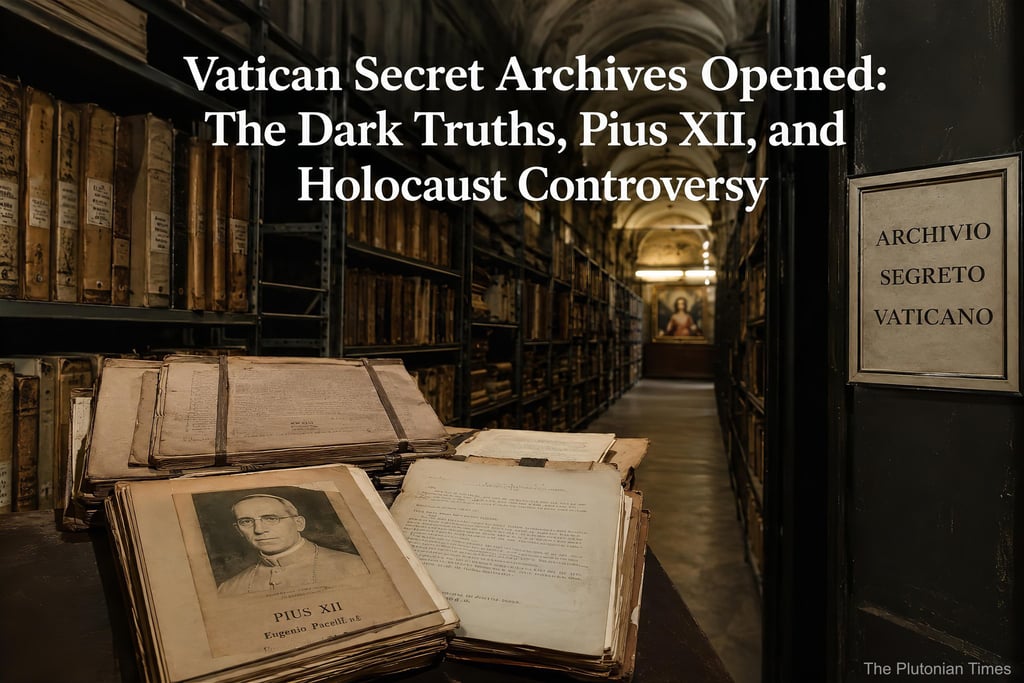
The Vatican Apostolic Archives (formerly known as the Vatican Secret Archives) serves as the central repository for the Holy See’s official acts, papal correspondence, state papers, account books, and other documents spanning roughly 12 centuries (from the 8th century onward). The collection includes over 600 archival fonds stored on more than 85 linear kilometers of shelving, with some housed in a two-story underground bunker beneath the Cortile della Pigna in the Vatican Museums.
Pope Paul V established it as a distinct entity in the early 17th century, separating it from the Vatican Library.
Historical Impact
The archives have shaped and preserved key chapters of Church and world history by documenting papal diplomacy, doctrinal decisions, trials, and international relations. Notable holdings include records of the trial of Galileo, Henry VIII’s annulment request (which contributed to the English Reformation), Martin Luther’s excommunication, and extensive diplomatic correspondence.
These documents have influenced historical interpretations of events such as the Crusades, the Inquisition, the Knights Templar, European monarchies, and 20th-century conflicts. Access to them has allowed scholars to contextualize or challenge narratives about Church actions, providing primary sources that affected historiography, legal precedents, and even geopolitical understandings. For instance, materials related to papal responses during wars or schisms have informed broader views on power, faith, and governance.
Disclosure
For centuries, the archives remained closed to outsiders. Pope Leo XIII opened them to qualified scholars in 1881, declaring that “the Church needs the truth,” allowing over a thousand researchers annually to study materials (with strict rules: no browsing shelves, documents requested by specific reference, no photography or pens in some areas).
In 2019, Pope Francis opened files from Pope Pius XII’s pontificate (1939-1958) ahead of schedule in 2020, enabling study of World War II-era actions. Materials are generally released 75 years after a pontificate ends, though exceptions occur, and post-1958 or certain private cardinal records remain restricted.
Controversy and Scandal
Limited access and sealed sections have fueled speculation about suppressed information, including alleged hidden prophecies, alternative biblical texts, UFO-related documents, or evidence of scandals.
Major controversies center on Pius XII and the Holocaust: critics accuse the Church of insufficient action against Nazi atrocities, with some claiming the archives hold evidence of silence or complicity (e.g., ratlines aiding Nazi fugitives). The 2020 opening allowed scrutiny but did not fully resolve debates, as interpretations vary.
Main Accusations of Silence and Complicity
Critics, including historians like David Kertzer and Susan Zuccotti, argue that Pius XII failed to issue a clear, explicit public condemnation of the Nazi extermination of Jews despite receiving detailed reports of atrocities as early as 1942. His strongest statement came in the 1942 Christmas radio address, where he referred vaguely to “hundreds of thousands” who were “doomed to die” due to their “nationality or race,” without naming Jews or Nazis directly.
Knowledge of the Holocaust: Newly released archives show Pius XII received credible information about mass killings early on. A 1942 letter and other reports from diplomats and clergy detailed Nazi death camps and killings in Poland. Some documents contain anti-Semitic language within Vatican circles, and the Pope reportedly prioritized Vatican neutrality and protection of the Church over direct confrontation.
Rome 1943 Deportations: When Nazis rounded up over 1,000 Roman Jews in October 1943 (many sent to Auschwitz), Pius XII did not publicly protest, despite the events occurring near the Vatican. He reportedly feared German occupation of the Vatican and reprisals against Catholics. Vatican officials did help hide thousands of Jews in Roman monasteries and convents (estimates range from 4,000–5,000 sheltered in Rome alone).
Secret Back Channels: Archives reveal Pius XII engaged in secret negotiations with Hitler via a personal envoy shortly after his election in 1939, aiming to maintain relations and protect Catholic interests in Germany.
Critics claim this approach amounted to moral failure or passive complicity, prioritizing institutional survival over humanitarian imperative. The play The Deputy (1963) by Rolf Hochhuth popularized the “Hitler’s Pope” narrative, accusing Pius of indifference.
Defenses and Counterarguments
Supporters, including some historians who studied earlier released documents, emphasize that Pius XII worked behind the scenes:
He directed the Church to provide discreet aid, sheltering Jews and others.
Public denunciations risked worsening persecution (e.g., after earlier protests in the Netherlands led to more arrests).
Vatican Radio and L’Osservatore Romano reported on Nazi crimes, and the Church is credited with helping save hundreds of thousands of Jews through diplomatic and humanitarian channels.
Defenders argue the “silence” was strategic caution, not indifference, and note that Nazis viewed Pius as pro-Allied.
Ratlines and Post-War Cover-Up Allegations
A major post-war scandal involves “ratlines”; escape routes that helped Nazi war criminals flee to South America (especially Argentina), often with Vatican-linked assistance.
Key Figures: Austrian Bishop Alois Hudal (a Nazi sympathizer) and others provided false identity papers, visas, and shelter. Croatian priest Krunoslav Draganovic and others facilitated escapes. Some operations had ties to Vatican emigration offices.
Scale and Vatican Role: Thousands of fugitives, including high-ranking Nazis like Adolf Eichmann and Franz Stangl, used these networks. While not all were directly sponsored by the top Vatican hierarchy, documents suggest awareness and limited cooperation for “Catholic refugees,” sometimes extending to war criminals. Anti-communism played a role, as the Church saw some ex-Nazis as allies against Soviet influence.
Controversy: Critics see this as a deliberate cover-up or moral failure to bring perpetrators to justice. The Vatican has faced calls for fuller accountability, though official involvement remains debated and not all ratlines were centrally coordinated by Pius XII.
Other issues include the Church’s handling of sexual abuse cases (with archives cited as containing relevant records shielded by sovereignty), financial scandals tied to the Vatican Bank, and historical events like the Inquisition or Templar suppression. Some view restricted access as protecting institutional reputation rather than purely preserving fragile documents.
References:
Vatican Apostolic Archive official site and Wikipedia entries.
Public Medievalist analysis of the archives.
PBS and AP reports on Pius XII files.
Books such as “Vatican Secret Archives: Unknown Pages of Church History” by Grzegorz Gorny and Janusz Rosikon.
Scholarly discussions from historians on access policies and historical holdings.