
U.S. Government Funding of Parapsychology: The 1973 UC Berkeley Conference and the Rise of Federal Psi Research
DISCLOSURESPARAPSYCHOLOGY & CONSCIOUSNESS STUDIES
Debbie Edwards
3/31/20262 min read
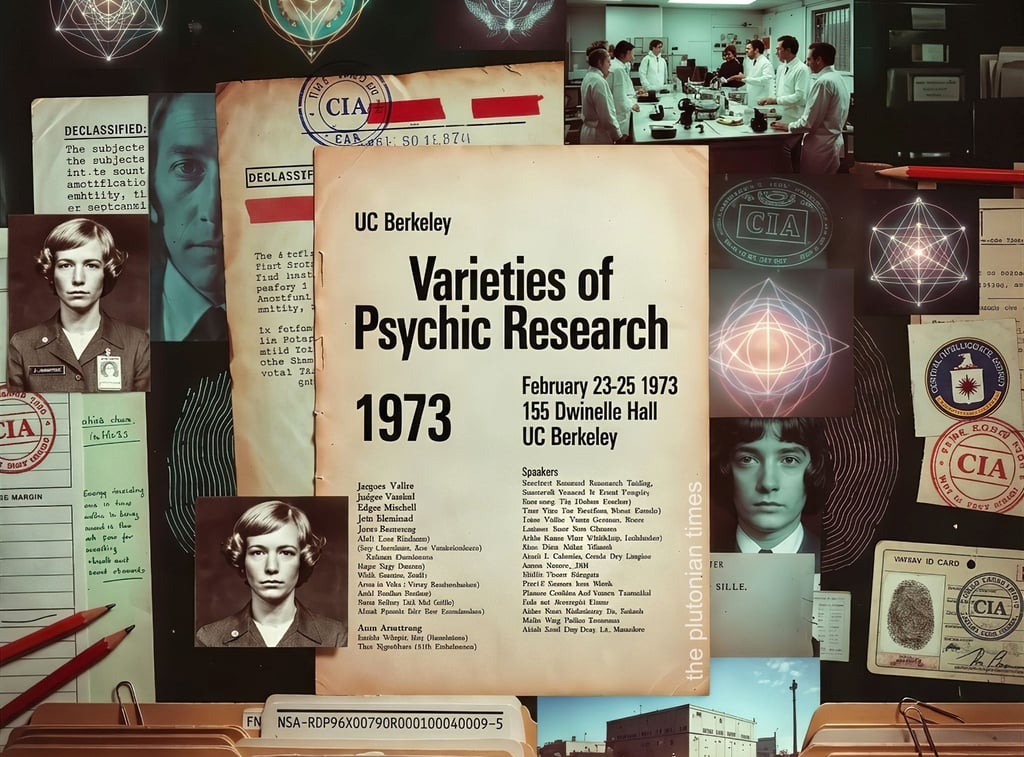
In the early 1970s, as Cold War fears grew over Soviet advances in psychic research, the United States government began committing federal funds to parapsychology programs. One declassified document from the CIA’s STARGATE collection, Approved For Release 2008/04/01 : NSA-RDP96X00790R000100040009-5, captures this moment perfectly. It is the official program announcement for a public academic conference titled “Varieties of Psychic Research,” held at the University of California, Berkeley.
Organized by University Extension, the conference took place February 23 to 25, 1973, at 155 Dwinelle Hall on the Berkeley campus. The single-page flyer details a full-weekend program designed as a serious interdisciplinary exploration of psychic phenomena. Registration was required for the entire event, with no single-lecture options available.
Highlights from the 1973 Berkeley Conference Document
The conference brought together notable figures in the field, including:
Astrophysicist and UFO researcher Jacques Vallee, Ph.D., affiliated with Stanford University’s Institute for Plasma Research
Apollo 14 astronaut Edgar D. Mitchell, founder of the Institute of Noetic Sciences, who spoke on topics related to “Awareness in Depth”
Psychiatrist Jule Eisenbud, M.D., known for his research on psychic photography with Ted Serios
Psychic counselor Anne Armstrong, who presented on “My Role as a Psychic”
Sessions covered key areas of parapsychology such as telepathy, clairvoyance, precognition, psychokinesis, psychic healing, and the relationship between consciousness, science, philosophy, and medicine. The document presents the event as a thoughtful academic gathering, blending scientific inquiry with personal experience.
Although the Berkeley conference received no direct federal funding, its preservation in the STARGATE files shows how closely U.S. intelligence agencies monitored open civilian and academic activity in parapsychology during the very period they were investing taxpayer money in classified programs.
Direct Federal Funding of Parapsychology Programs
At the same time the Berkeley conference was taking place, the CIA was already providing direct funding for parapsychology research. In 1972, the agency contracted physicists Russell Targ and Harold Puthoff at Stanford Research Institute (SRI International) to study remote viewing. Early participants included psychics Ingo Swann and Pat Price. Some experiments reportedly yielded accurate descriptions of distant Soviet targets under strict controls.
This funding rapidly expanded into a larger effort involving multiple agencies and code names, including SCANATE, Grill Flame, Center Lane, Sun Streak, and eventually STARGATE. The programs combined laboratory research with operational remote viewing sessions aimed at real intelligence objectives, such as locating hostages and describing hidden military sites.
Over two decades, from 1972 to 1995, the U.S. government spent an estimated 20 million dollars on these initiatives. Funding came through CIA contracts, Army and Defense Intelligence Agency budgets, and occasional congressional appropriations. The programs operated primarily out of Fort Meade, Maryland, with contractors at SRI and later SAIC.
Why the Government Archived the Berkeley Conference Flyer
The 1973 UC Berkeley event occurred right as federal parapsychology programs were gaining momentum. Intelligence analysts collected the conference announcement alongside internal SRI reports and session transcripts. This suggests they used open-source materials to track prominent researchers, evaluate new ideas, identify potential talent, and better understand the overall landscape of psychic research in the United States.
The declassified document itself, from the NSA, contains no evidence of direct federal funding for the Berkeley event. Instead, it illustrates the ecosystem in which government-sponsored parapsychology operated: a mix of secret contracts at research institutes and open forums where ideas about psychic phenomena were openly debated.