
Unexplained Death of the Ninth Scientist with Deep Ties to America’s Space and Nuclear Programs
UNSOLVED MYSTERIES & CRIME
Debbie Edwards
4/9/20264 min read
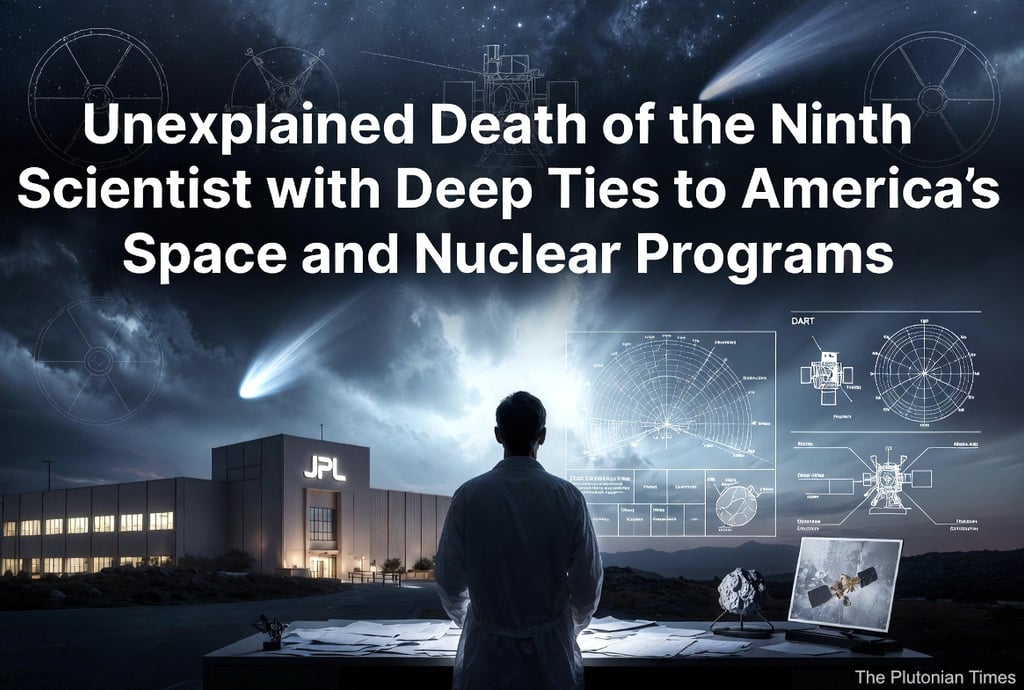
In spring 2026, attention has returned to the 2023 death of Michael David Hicks, a longtime research scientist at NASA’s Jet Propulsion Laboratory. He died on July 30, 2023, at age 59. Obituaries portrayed him as an astronomer, artist, and devoted father. His case has been linked to a series of unexplained deaths and disappearances involving experts in the United States’ space and nuclear programs. No public cause of death was released for Hicks, and no autopsy record has been found. Authorities report no evidence of foul play, yet the timing and context continue to prompt scrutiny.
Who Was Michael David Hicks?
Hicks worked at the Jet Propulsion Laboratory in Pasadena, California, from 1998 until his retirement in 2022. Born February 7, 1964, in Dayton, Ohio, he earned degrees from Boston University and a PhD in lunar and planetary science from the University of Arizona in 1997. His doctoral dissertation focused on a spectrophotometric survey of comets and Earth-approaching asteroids. He began at JPL as a postdoctoral researcher and advanced to research scientist. His focus was on the physical properties of comets and asteroids, objects that reveal clues about solar system formation and planetary threats.
His Scientific Contributions
Hicks published more than 80 peer-reviewed scientific papers and made significant contributions to understanding the size, shape, rotation, albedo, and composition of comets and asteroids through detailed observational data analysis and mission planning. He served on the science teams for several landmark NASA missions. These included the Double Asteroid Redirection Test (DART), NASA’s first successful demonstration of spacecraft deflection of a hazardous asteroid. He also supported the Near Earth Asteroid Tracking (NEAT) project, the Dawn mission to the asteroid belt, and the Deep Space 1 mission, which in 2001 flew past Comet Borrelly while testing advanced ion propulsion technology. His work translated raw telescope and spacecraft observations into actionable insights that advanced planetary defense strategies and deepened knowledge of the solar system’s early history. Colleagues noted his expertise in spectrophotometry, which allowed precise characterization of these distant bodies’ surface materials and behavior.
The Broader Pattern: Nine Cases
Hicks is now viewed as the ninth person with ties to America’s space or nuclear programs to die or vanish under unclear circumstances in recent years. Notably, he maintained direct professional connections to several individuals on this list through shared JPL projects and overlapping research networks. These ties have drawn particular attention.
Other cases include his long-time JPL coworker Frank Maiwald, a principal scientist who died July 4, 2024, at age 61 with no public cause of death or autopsy record released. Maiwald had worked on advanced instrumentation for future missions searching for signs of life on distant moons. Monica Reza, who briefly served as JPL’s director of the materials processing group after a distinguished career in advanced rocket propulsion, disappeared without a trace while hiking in the Angeles National Forest in June 2025. Astrophysicist Carl Grillmair, whose work on infrared telescopes and asteroid tracking received substantial JPL support, was shot and killed on the front porch of his Southern California home in February 2026.
Beyond California, retired Air Force Major General William Neil McCasland, linked to missile and space technology, vanished from his Albuquerque home in late February 2026. At Los Alamos National Laboratory, nuclear researcher Anthony Chavez and Melissa Casias, both with high-level security clearances, disappeared in separate 2025 incidents, leaving belongings behind. In Massachusetts, MIT plasma physicist Nuno Loureiro, a nuclear fusion leader, was fatally shot at home in December 2025. Pharmaceutical researcher Jason Thomas was found dead in a lake months after vanishing in late 2025.
Differences in the Cases
The incidents vary significantly. Some are confirmed homicides with identified perpetrators, while others involve unexplained deaths or disappearances. No law enforcement agency has identified a common thread or coordinated targeting. However, the shared expertise in asteroid deflection, rocket propulsion, nuclear fusion, and classified satellite systems has drawn notice, especially given Hicks’ close JPL connections to at least three of the cases.
Official and Expert Reactions
Former senior intelligence officials and members of Congress have raised concerns. Tennessee Congressman Tim Burchett noted that the numbers in these specialized fields seem unusually high and warrant attention. Former FBI Assistant Director Chris Swecker called the pattern suspicious given the critical technologies involved.
Why This Matters: National Security and Human Cost
Experts highlight the strategic importance of the knowledge these individuals possessed. Rocket materials, asteroid tracking (which overlaps with missile defense), and fusion research bridge civilian science and classified defense work. In a time of intense international competition with China and Russia, such losses raise questions about possible espionage or disruption. Scientists in demanding fields also face routine risks like health problems or crime. The absence of clear information in several cases heightens speculation.
What stands clear is the human toll: each loss represents decades of training and dedication to space exploration. Hicks’ direct ties to colleagues like Maiwald underscore how tightly knit this community was, making the pattern feel even more personal and pressing.
A Call for Transparency
As details about Michael David Hicks spread online, the story underscores the need for openness. Families deserve answers, the scientific community benefits from full recognition of its members, and the public, which supports this work, merits basic facts. Until more information emerges, the death of this comet hunter remains one unresolved chapter in an ongoing narrative that calls for careful review rather than rushed judgments. The universe Hicks studied holds many mysteries. So, too, do some events unfolding here on Earth.
Key References (drawn from public reporting and official notices):
Daily Mail coverage on the pattern and Hicks’ background.
American Astronomical Society / Division for Planetary Sciences obituary.
University of Arizona Lunar and Planetary Laboratory memoriam.
Forest Lawn obituary for personal and family details.
Additional reporting from Newsweek, Times of India, and NewsNation on related cases and expert comments.