
The Vatican War Machine: The Untold Story of Papal Guns, Gold, and Global Conflict
HISTORY
Debbie Edwards
5/20/20263 min read
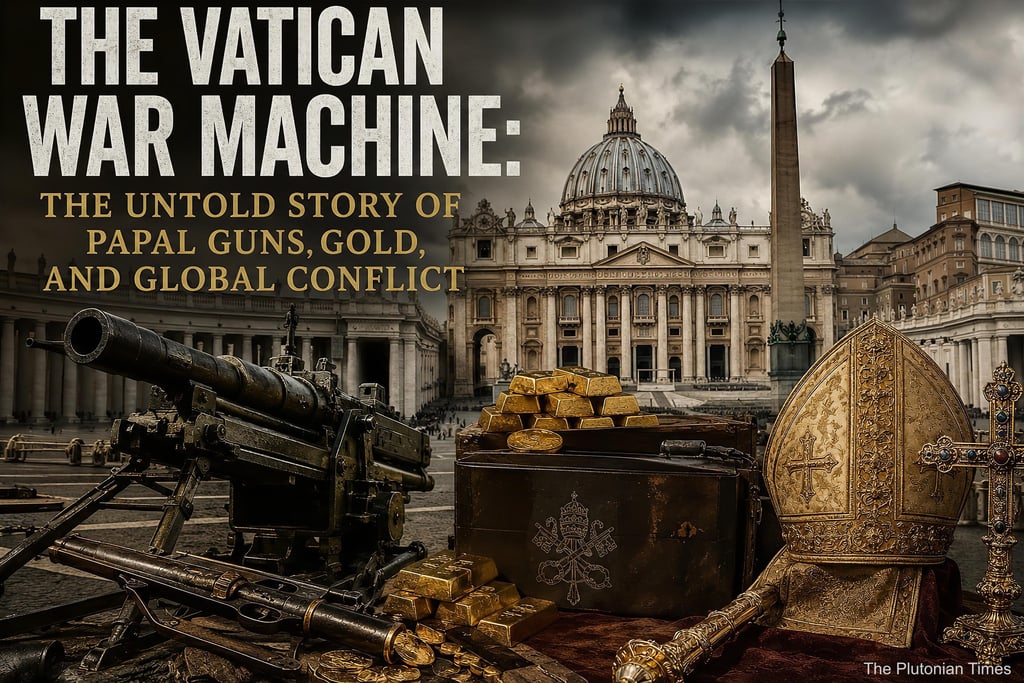
The Vatican, through the papacy and the Papal States, engaged directly in military interventions and provided substantial support to armed campaigns. Popes acted as temporal rulers who raised armies, financed wars, procured weapons, and led forces in battle to defend or expand territory and advance religious and political objectives.
The Crusades: Papal Leadership and Systematic Financing of Holy Wars
Beginning in 1095, successive popes initiated and sustained the Crusades as military expeditions to reclaim the Holy Land. Popes served as primary organizers, issuing calls to arms, granting indulgences that motivated thousands of participants, and imposing special taxes to fund the campaigns.
Financing came through several targeted mechanisms. Popes levied extraordinary crusade taxes directly on clerical income across Europe, often at rates like 2.5 percent or higher for multiple years. They introduced the Saladin Tithe and similar levies on laity incomes and movable goods. Indulgences allowed individuals unable to fight to contribute financially in exchange for spiritual rewards. Papal bulls authorized these collections, with funds channeled through military orders such as the Knights Templar and Knights Hospitaller, which handled procurement of arms, ships, provisions, and troop payments. Additional revenue flowed from seized treasures and lands in conquered territories, as well as loans from emerging Christian bankers backed by Church assets.
These financial strategies mobilized vast resources, enabling the coordination of large armies, transport fleets, and sustained warfare over decades. The motivation combined religious zeal to secure Christian control of Jerusalem with the assertion of papal authority over Christendom.
Warrior Popes and the Italian Wars: Personal Command and Diverse Revenue Streams
In the Renaissance era, several popes took direct military command. Pope Julius II, known as the Warrior Pope, personally led papal troops in armor during campaigns in the Italian Wars. He fought to reclaim territories in Romagna and Bologna, forming the League of Cambrai against Venice in 1508 and later the Holy League against French forces. Julius organized the Swiss Guard in 1506 and commanded forces at the Siege of Mirandola in 1511.
Financing for these campaigns relied on papal revenues from the Papal States, including rents, fees, and indirect taxes. Julius and other popes supplemented this with sales of Church offices, heavy borrowing through public debt instruments known as monti, and appeals to Catholic allies. They also diverted offerings and jubilee donations toward military needs. These funds paid for mercenaries, artillery, fortifications, and supplies, allowing the papacy to project power against rival Italian states and foreign invaders while preserving territorial independence.
The Papal States: Standing Armies, Weapon Procurement, and Debt-Fueled Defense
As rulers of the Papal States until 1870, popes maintained standing armies, including infantry, cavalry, artillery, and international volunteers. In the 19th century, under Pope Pius IX, the Papal Army acquired thousands of modern Remington Rolling Block rifles and carbines, along with millions of cartridges. These weapons, sourced through Catholic networks in Belgium, France, and England, armed papal troops and Zouaves defending against Italian unification forces.
Financing involved a mix of internal revenues from indirect taxation (which generated the bulk of income), direct taxes, and substantial public borrowing. The Papal States issued bonds and took loans, including from international bankers like the Rothschilds, to cover military expenditures. Peter’s Pence donations from the global Catholic community provided critical external support in later years. Debt servicing often consumed a large portion of the budget, with military and police costs accounting for nearly 27 percent of spending in some periods. These resources sustained defensive wars and alliances aimed at preserving temporal sovereignty against nationalist threats.
Support in the Spanish Civil War: Moral, Diplomatic, and Indirect Backing
During the Spanish Civil War of 1936 to 1939, the Vatican provided moral and diplomatic backing to General Francisco Franco’s Nationalist forces. Viewing the conflict as a defense against anticlerical Republican elements, the Church offered public support, with Pope Pius XII later congratulating Franco upon victory. Catholic networks aligned with the Nationalists, framing the uprising in part as a crusade.
While direct arms provision from the Vatican itself remained limited and indirect, financing flowed through broader Catholic alignment, including potential support via donations and institutional networks that bolstered the Nationalist side. This stemmed from concerns over persecution of clergy and the protection of Catholic institutions in Spain.
References
Cambridge History of the Papacy sections on papal finances and the military papacy.
Historical accounts of crusade taxation and indulgences.
Archival records of Papal States armaments, Remington acquisitions, and public debt.
Studies on Church relations during the Italian Wars and Spanish Civil War.
Analyses of monti bonds and Peter’s Pence in wartime funding.