
The Shadow Science: Inside the Soviet Union's Secret Parapsychology Program – A Deep Dive into Declassified CIA Documents
DISCLOSURESPARAPSYCHOLOGY & CONSCIOUSNESS STUDIES
Debbie Edwards
3/31/20264 min read
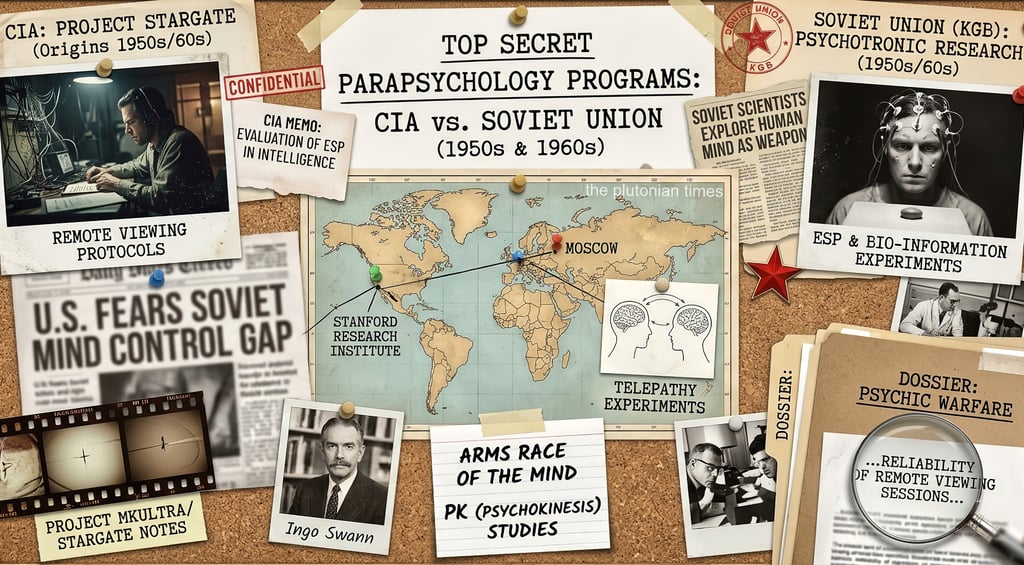
In the shadowy corridors of Cold War espionage, where nuclear arsenals and spy satellites dominated headlines, a quieter arms race unfolded. This one involved the human mind itself. Declassified CIA documents reveal that the Soviet Union poured resources into parapsychology research for decades. They explored telepathy, psychokinesis (PK), and other “psi” phenomena with potential military applications. One particularly revealing 4-page assessment, CIA-RDP96-00791R000100180001-8 (titled “An Assessment of Russian Parapsychological R&D”), offers a rare insider’s view from a CIA officer who had worked in the U.S. government’s own psychic spying program, Stargate. Released to the public via the CIA Reading Room, this document (approved for release in 2003) provides a post-Cold War snapshot of the program’s status while echoing decades of U.S. intelligence concern.
This post draws directly from that assessment and contextualizes it with the broader history of Soviet experiments, as documented in related declassified materials. We will examine the program’s origins, standout experiments, military ambitions, and ultimate decline as judged by the CIA itself. We also offer a critical analysis of what it all meant (and did not mean) for science and security.
The Origins and Scale of the Soviet Parapsychology Machine
Soviet interest in parapsychology did not begin in the Cold War but accelerated dramatically in the 1950s and 1960s. Early roots trace back to the 1920s and 1930s with researchers like Leonid Vasiliev, who pioneered studies in “mental suggestion” and telepathy under hypnosis. By the post-WWII era, the program had become a sprawling, state-backed enterprise involving dozens of institutes, military funding, and KGB oversight. Estimates suggest up to 40 research centers were involved at its peak. These blended academic labs with classified defense work.
The driving force? A fear of falling behind the West, or perhaps a belief that psi could provide asymmetric advantages. Telepathy, for instance, was eyed as a potential “non-jammable” communication method immune to electronic interference. Psychokinesis raised the specter of mind-over-matter weapons. The CIA’s monitoring (detailed in multiple declassified files) reflected genuine alarm about a “psi gap,” much like the earlier missile gap fears.
The 1995-era CIA assessment in the linked document confirms this scale but notes a sharp pivot: “Russian government evidently has cut back significantly its support for parapsychology R&D.” Written by a Stargate veteran (the U.S. remote-viewing program that ran from the 1970s to 1995), it frames the Russian effort as substantial in historical terms yet diminished in the post-Soviet economic chaos. The author recommends continued Directorate of Intelligence (DI) monitoring. This underscores that even a scaled-back program warranted vigilance.
Landmark Experiments: Claims, Controls, and Controversy
The Soviet program was not abstract theorizing. It produced (or at least claimed) dramatic laboratory results, often under seemingly rigorous conditions. Here are some of the most documented cases, frequently cited in Western intelligence summaries and referenced in the broader context of the CIA’s assessments:
Nina Kulagina (Ninel Mikhailova): The program’s poster child. A Leningrad housewife turned psychic celebrity in the 1960s and 1980s, Kulagina was tested by dozens of Soviet scientists (and some Western observers). Her demonstrations included:
Moving small non-magnetic objects (matches, cigarettes, compasses, pens) across tables without touch.
Influencing the direction of compass needles.
More ambitious feats: levitating or rotating larger items like bowls or clocks.
The pièce de résistance: In a 1970 experiment at the Ukhtomskii Institute of Physiology, she allegedly stopped the heart of a frog in a saline solution purely through mental concentration. The frog’s heart was isolated but still beating; her “PK” reportedly halted it.
Physiological monitoring was intense. During sessions, Kulagina’s heart rate, breathing, and brain waves spiked dramatically. Electromagnetic fields around her pulsed, and she sometimes suffered nosebleeds or exhaustion. Researchers like Edward Naumov and V. N. Pushkin documented these under controlled conditions, ruling out obvious fraud in some setups (for example, no hidden magnets or threads). Yet skeptics later pointed to possible static electricity, micro-movements, or confirmation bias.
Telepathy and Mental Suggestion (Vasiliev’s Legacy): Building on 1930s work, labs explored long-distance telepathy. Subjects in shielded rooms allegedly transmitted emotions, images, or commands across hundreds of miles. One series involved “hypnotic suggestion at a distance,” with agents reportedly influencing targets’ behavior without verbal cues. These were framed as tools for interrogation or covert influence.
Bio-PK and Subtle Energy Effects: Beyond macro-PK, researchers claimed influence on biological systems, altering plant growth rates, changing pH levels in water, or affecting cellular activity. Some experiments involved “distant healing” or harming via focused intention. Physicist Viktor Gurtovoy and others quantified “bio-fields” using Kirlian photography (aura imaging) and other instrumentation.
Psychotronic Weapons Research: Deeper military angles included “psychotronic” devices allegedly amplifying human psi or weaponizing it. Reports (monitored by CIA/DIA) described remote mind control, inducing illness, or disrupting electronics via focused mental energy.
These experiments were often conducted in elite facilities like the Institute of Psychology in Moscow or military labs in Siberia. Funding flowed from the Defense Ministry and Academy of Sciences, with results sometimes classified. The CIA’s Stargate-linked assessor in the document implicitly acknowledges this history when evaluating ongoing R&D potential, yet stops short of endorsing efficacy.
Critical Analysis: Threat, Hoax, or Something In-Between?
The declassified assessment strikes a measured tone: impressive on paper, but no longer a priority for the cash-strapped Russian state. This aligns with the U.S. experience. Stargate itself was shuttered in 1995 after mixed results and lack of operational value. Several analytical lenses emerge:
Scientific Rigor vs. Replication Crisis: Soviet labs emphasized multi-witness protocols and instrumentation, but Western replications were rare and inconsistent. Kulagina’s feats, for example, faltered under stricter double-blind conditions or when fraud-prevention measures (like Faraday cages) were tightened. Parapsychology’s core issue, statistical anomalies vanishing under scrutiny, haunts the entire field. The CIA document’s author, drawing from Stargate experience, likely viewed Russian claims through this lens: intriguing but unproven.
Military Utility and Intelligence Reaction: Cold War paranoia amplified the program. The post-1991 funding cut (noted explicitly in the document) suggests even Russian leaders grew skeptical amid economic collapse.
Broader Implications for Consciousness Research: Optimists see these experiments as early probes into mind-matter interactions, precursor to quantum biology or non-local consciousness theories. Critics label it pseudoscience subsidized by ideology. Truth-seeking analysis lands in the middle: anecdotal data merits study, but extraordinary claims require extraordinary evidence, which repeatable, peer-reviewed psi effects have never provided at scale. They however, have been repeatedly demonstrated with great success at smaller scales.
The Human Factor: Many researchers were genuine scientists (physiologists, physicists) pushed into fringe work by state pressure.
Decades later, echoes persist. Russia’s occasional mentions of “psychotronic” tech in modern military contexts, or renewed U.S. interest via programs like AATIP. The declassified document reminds us that intelligence agencies must weigh fringe science against strategic risks. For civilians, it highlights the allure (and pitfalls) of exploring human potential beyond materialism.