
The Science of Violet: Light Frequency, Dielectric Resonance, and Vibrational Ecology
SCIENCE
Debbie Edwards
6/4/20263 min read
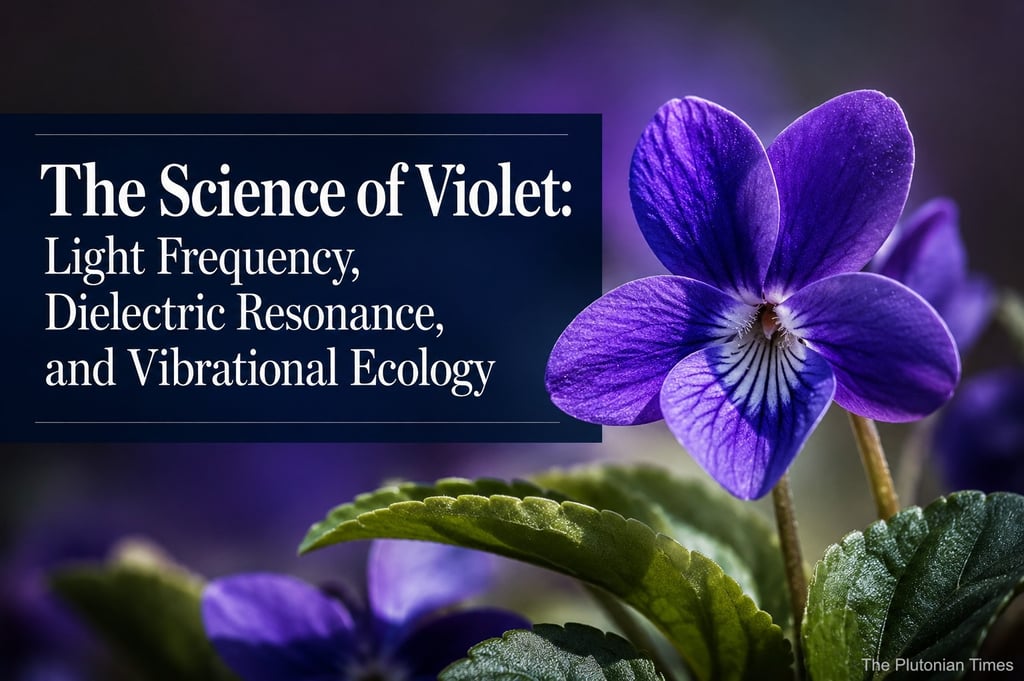
The delicate violet flower, with its soft petals in shades of deep purple and lavender, has captivated humanity for centuries. Beyond its visual beauty lies a profound interplay of science and ecology. The violet embodies the highest frequencies of visible light and electromagnetic resonance within the natural world.
The Frequency of Violet Light
Violet light occupies the upper end of the visible electromagnetic spectrum. Its wavelengths range from approximately 380 to 435 nanometers (a nanometer is one billionth of a meter), corresponding to frequencies between 690 and 790 terahertz (a terahertz is one trillion cycles per second). This makes violet the highest frequency color humans can perceive, carrying more energy per photon than any other hue in the rainbow.
When sunlight interacts with the violet flower, its pigments, primarily anthocyanins (water-soluble flavonoid pigments responsible for many red, purple, and blue flower colors), selectively absorb longer wavelengths while reflecting and scattering the shorter violet and blue waves. This creates the characteristic hue that inspires its name, drawn from the Viola genus. The flower's structure enhances this effect through microscopic surface patterns that cause iridescence and precise light diffusion.
Higher frequency means greater vibrational energy. Violet photons oscillate rapidly, enabling interactions at the quantum level with biological tissues. This rapid oscillation underpins the flower's ability to thrive in varied light conditions and contributes to its ecological success as an early-season bloomer in temperate forests, woodlands, and meadows.
Electromagnetic Resonance in the Violet Flower
Plants function as dielectric resonators for electromagnetic fields. A dielectric is a material that does not conduct electricity well but can store and transmit electric fields, allowing interaction with electromagnetic waves. Geometric features in flower buds and ovaries align precisely with patterns predicted by electromagnetic resonant modes (specific frequencies at which waves reinforce themselves), where specific shapes support standing waves of electric and magnetic fields.
The violet flower possesses symmetrical petals and central reproductive structures that tune naturally to these frequencies. The flower's tissues, with their water content and cellular organization, possess dielectric properties that interact with ambient electromagnetic radiation. Plants demonstrate clear sensitivity to electromagnetic fields, which directly influence growth, gene expression (the process by which information from a gene is used to create functional products like proteins), and stress responses. Natural resonance with Earth's geomagnetic (Earth's magnetic field) and cosmic radiations supports the violet's vitality and development.
Ecological Role and Vibrational Harmony
Violets play a vital role in their ecosystems as early spring wildflowers that provide essential nectar and pollen for bees, butterflies, and other pollinators when few other food sources are available. Their presence supports biodiversity by sustaining specialist insects, including certain fritillary butterflies whose larvae feed exclusively on violet leaves.
The high-frequency violet light and electromagnetic resonance of these flowers actively amplify vibrational harmony within the surrounding ecosystem. The rapid oscillation of violet photons and the dielectric resonance of the flower structures create localized coherence in electromagnetic fields. This coherence extends beyond the individual plant, influencing nearby vegetation and soil microorganisms through subtle bioelectric signaling and enhanced light diffusion patterns.
In ecological terms, this resonance contributes to greater stability in the micro-environment. The violet flower’s electromagnetic signature promotes field coherence that supports synchronized growth patterns among neighboring plants, improves nutrient cycling in the soil, and strengthens overall community resilience. By reflecting and interacting with high-frequency light, violets help regulate light availability in the understory, creating balanced microclimates that benefit shade-tolerant species and foster healthy succession in forest ecosystems.
The collective resonance of violet populations in meadows and woodlands generates a harmonious vibrational network. This network enhances communication between plants via mycorrhizal fungal connections and electromagnetic cues, leading to improved stress resistance across the plant community. The result is a more balanced and vibrant ecosystem where energy flows efficiently from light capture to biomass production and pollinator support.
Harmony in Nature: Light, Resonance, and Ecology
The violet flower illustrates perfect harmony between frequency, resonance, and ecological function. Its light properties demonstrate the pinnacle of visible electromagnetic energy, while its structure serves as a natural resonator attuned to the universe’s subtle rhythms. Through these mechanisms, the violet actively amplifies vibrational harmony, supporting biodiversity, pollination networks, and ecosystem stability.
In practical terms, incorporating violets into gardens, restoration projects, and natural landscapes leverages their resonant properties to create thriving ecological communities. Whether in a woodland edge or a backyard meadow, the violet flower stands as a model of how high-frequency light and electromagnetic interactions contribute to the greater health and balance of the living world.
References
Wikipedia contributors. Violet (color).
Pietak, A.M. Structural evidence for electromagnetic resonance in plant morphogenesis. Biosystems, September 2012.
NASA Science. Visible Light. 2010 (updated).
Learn.Genetics Utah. The Chemistry of Flower Color.
Peer-reviewed insights on plant electromagnetic interactions, including Pietak 2012.
Ecological studies on Viola species and their role in temperate ecosystems.