
The People Are Winning: How Small Towns Are Shutting Down Big Tech’s Data Center Invasion
TECHNOLOGY
Debbie Edwards
6/2/20264 min read
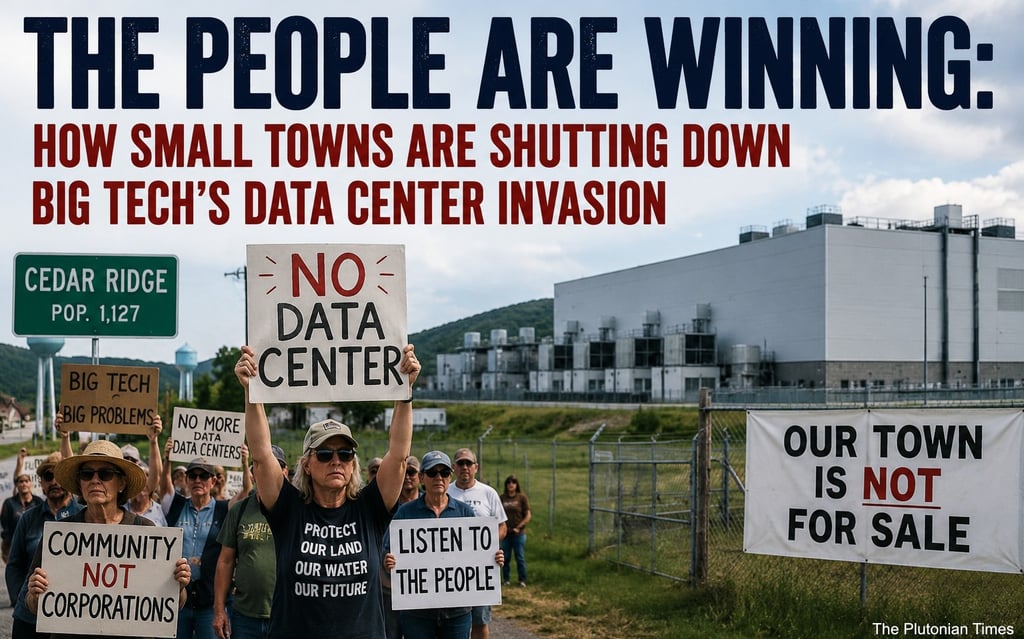
Data centers once faced mainly technical hurdles such as power supply and cooling efficiency. Today the biggest obstacle is local resistance from residents and townships concerned about impacts on their communities. Across the United States organized citizens have achieved remarkable success in blocking or delaying projects. This shift marks a growing recognition that data centers often bring higher electricity rates, massive water consumption, noise pollution, and limited long term jobs relative to their scale.
Between May 2024 and March 2025 local opposition blocked or delayed projects worth 64 billion dollars. In the second quarter of 2025 alone that figure reached 98 billion dollars across 20 projects in 11 states. Project cancellations quadrupled from six in 2024 to 25 in 2025 compared with just two in 2023. At least 188 organized opposition groups now operate nationwide spanning 40 states.
These victories demonstrate that determined citizens can protect their towns from unwanted industrial scale development.
Notable Wins by Communities and Leaders
In Warrenton Virginia residents mounted a strong campaign against an Amazon proposed data center. Over 500 people attended a 2023 Town Council meeting with nearly 130 speaking in opposition. Oscar winner Robert Duvall joined the effort. Citizens for Fauquier County led by activists including Eric Gagnon filed multiple legal challenges. Every council member who supported the project lost re election starting in 2023 with the remaining supporters losing seats in November 2024. Legal actions stalled aspects of the project.
In Hazle Township Pennsylvania the Board of Supervisors unanimously denied NorthPoint Developments Project Hazelnut in November 2025. The proposal called for 15 data centers. More than 200 residents packed a supervisors meeting standing room only. Their voices led to the rejection despite significant developer momentum.
Burns Harbor Indiana saw Provident Realty Advisors withdraw its data center petition in 2024 after sustained grassroots opposition during public hearings. The company cited plans to modify the proposal but the project stalled.
In Saline Township Michigan residents protested a proposed Stargate data center project backed by OpenAI and Oracle. Over 100 people rallied at the state Capitol on December 16 2025 raising concerns about transparency and local impacts.
Other successes include moratoria in places such as Tulsa Oklahoma where the City Council voted unanimously for a nine month halt on new data centers in March 2026. Communities in Missouri Maryland and elsewhere have passed restrictions or blocked projects through zoning fights and public pressure.
Why Communities Are Saying No
Data centers consume enormous resources. A single large facility can use electricity equivalent to thousands of homes and up to millions of gallons of water daily for cooling. Residents report rising utility bills noise from cooling fans and strain on local infrastructure with few permanent high paying jobs created. Many projects receive tax incentives that shift costs to existing ratepayers while offering limited economic benefits.
Opposition crosses party lines with roughly 55 percent Republican and 45 percent Democrat among opposing politicians. This bipartisan nature strengthens the movement and leads to tangible policy changes including proposed moratoria in multiple states.
How Citizens Can Advocate to Protect Their Communities
Successful groups follow proven steps that any township can adapt.
First educate and organize. Form neighborhood groups or partner with existing civic organizations. Attend planning commission and town council meetings in large numbers. Public comment periods provide critical opportunities to voice concerns about water use energy demands traffic and noise.
Second demand transparency. Request all planning documents environmental impact studies and proposed tax agreements. Push for public hearings and oppose nondisclosure agreements that hide details from residents.
Third focus on local government accountability. Support candidates who prioritize community protection. Track voting records on development issues. In Warrenton Virginia voter action changed the council composition and shifted project momentum.
Fourth pursue policy tools. Advocate for zoning reforms stricter permitting requirements or temporary moratoria to allow time for study. Support community benefits agreements that enforce limits on water and energy use noise mitigation and local hiring guarantees if any project moves forward.
Fifth connect with broader networks. Groups such as the Virginia Data Center Reform Coalition and national organizations like the NAACP and Food and Water Watch offer toolkits resources and shared strategies. Learn from wins in other states to strengthen arguments with facts and precedents.
A Positive Momentum for Local Control
The surge in successful opposition signals a healthy assertion of community rights. Citizens are not against technology or progress. They demand development that respects local needs rather than imposing heavy burdens. By highlighting resource strains limited benefits and lack of input residents have slowed the unchecked expansion of data centers.
Townships that organize early and speak with unified voices can shape outcomes or prevent projects altogether. The message from recent years is clear. When people mobilize facts in hand and committed to their neighborhoods they win. Communities across the country continue to prove that local advocacy remains one of the most effective tools for protecting quality of life and future generations.
This growing movement empowers everyday residents to safeguard their towns. The positive traction shows what determined citizens can achieve when they stand together.
References
Data Center Watch Report on 64 billion dollars blocked or delayed May 2024 March 2025.
Heatmap Pro review January 12 2026 on 25 cancellations in 2025.
Construction Dive April 22 2026 on quadrupled cancellations and 188 opposition groups.
FauquierNow February 14 2023 on Robert Duvall and Warrenton meeting.
Food and Water Watch November 18 2025 on Hazle Township rejection.
Michigan Advance December 16 2025 on Saline Township rally.
KTUL March 26 2026 on Tulsa moratorium.
Piedmont Environmental Council on Virginia Data Center Reform Coalition.