
The New Age Senator: Claiborne Pell’s Push for Psychic Research and Near-Death Studies
DISCLOSURESPARAPSYCHOLOGY & CONSCIOUSNESS STUDIES
Debbie Edwards
4/1/20264 min read
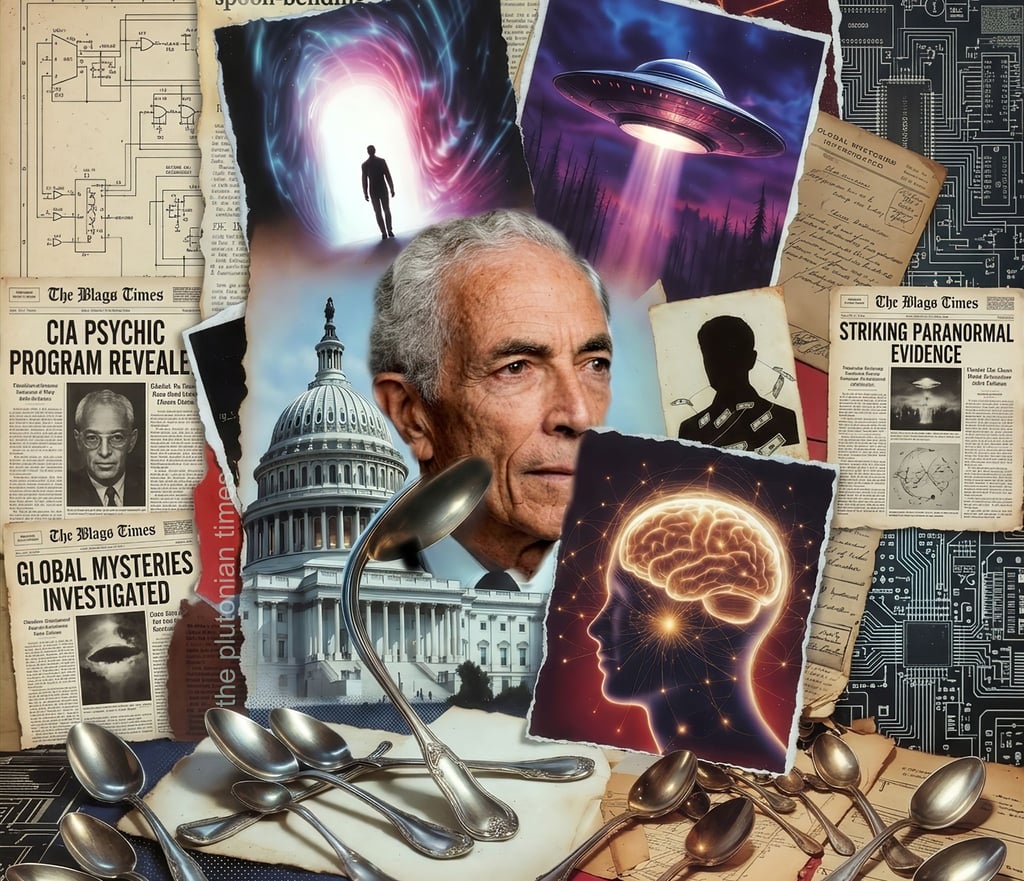
Long before his name became synonymous with college financial aid through the Pell Grants, U.S. Senator Claiborne Pell (D-Rhode Island) pursued interests that extended far beyond conventional politics. As a senior member of the Senate Foreign Relations Committee and a key figure in appropriations, Pell used his influence to explore the frontiers of human consciousness, parapsychology, and phenomena once dismissed as fringe science. While his involvement in classified remote viewing programs like Stargate has drawn significant attention, Pell’s broader curiosity led him into near-death experiences, UFO abductions, and efforts to legitimize research into extraordinary human abilities.
The “Spoon-Bending Bill” of 1988
In 1988, Pell co-sponsored legislation that aimed to establish a National Commission on Human Resources. The bill sought to bring together experts in “extraordinary performance results,” a phrase many interpreted as a subtle nod to parapsychological phenomena such as telepathy, psychokinesis, and other psi abilities. Supporters, including Pell, argued that a 1988 National Academy of Sciences report on enhancing human performance had been too dismissive of these fields and failed to give them fair consideration for federal research funding.
Critics quickly dubbed the proposal the “spoon-bending bill,” a mocking reference to demonstrations of psychokinesis popularized by figures like Uri Geller. The nickname stuck, and the measure faced widespread ridicule in Congress and the media. It never advanced out of committee and ultimately died. Despite the failure, the episode revealed Pell’s determination to normalize parapsychology by framing it under the broader banner of human potential and national security competitiveness, particularly concerns about a perceived “ESP gap” with the Soviet Union.
Pell’s personal engagement with these ideas was evident in smaller gestures. He reportedly hosted closed-door demonstrations, including spoon-bending sessions on Capitol Hill, and maintained an office collection of bent spoons and other mementos from psychic researchers.
Service on the Advisory Board of the International Association for Near-Death Studies
Pell also lent his name and support to the International Association for Near-Death Studies (IANDS), the leading organization dedicated to scientific examination of near-death experiences (NDEs). These accounts, often involving out-of-body sensations, tunnels of light, life reviews, and encounters with deceased loved ones, were treated by IANDS as potential insights into consciousness and what may lie beyond physical death.
The senator served on the group’s advisory board and played an active role in its early development. In 1986, he helped organize a major symposium on near-death experiences in Washington, D.C., building on his participation in an earlier IANDS conference at Yale in 1981. Through these efforts, Pell connected with researchers such as Dr. Kenneth Ring and assisted in fundraising, including meetings with international patrons interested in the field.
As he aged, Pell spoke more openly about his fascination with the possibility of life after death and the apparent consistency of NDE reports across cultures. His special assistant, C.B. “Scott” Jones, further bridged the senator’s office with ongoing NDE research.
Attendance at UFO Abduction Symposia
In 1987, Pell attended a national symposium focused on the UFO abduction phenomenon. These gatherings brought together researchers, individuals reporting encounters, and investigators to examine patterns such as missing time and alleged medical examinations. For a sitting U.S. senator to participate in such an event was highly unusual and lent a measure of institutional credibility to a topic still widely regarded as taboo in mainstream circles.
Much of the operational support for Pell’s paranormal portfolio came from Jones, a retired naval intelligence officer hired in 1985. Jones functioned as a dedicated aide, traveling on Senate business to conferences and meetings on telepathy, unconventional healing, near-death experiences, and UFO-related topics. He maintained a top-secret security clearance throughout his tenure and provided regular briefings to the senator.
After leaving Pell’s staff in 1991, Jones co-founded the Human Potential Foundation with the senator’s involvement. The organization continued exploring consciousness, human potential, and related subjects.
Primary Funding Sources
The main financial backer of the Human Potential Foundation was Laurance S. Rockefeller (1910–2004), the philanthropist, conservationist, and member of the prominent Rockefeller family. Multiple sources describe Rockefeller as providing seed money and major funding for the organization.
Rockefeller’s contributions supported specific projects, including efforts related to UFO disclosure (such as preparing materials to brief the Clinton administration), a large international conference titled “When Cosmic Cultures Meet,” and studies on the societal impacts of potential extraterrestrial contact.
He channeled funds through the foundation for various initiatives, including grants passed on to other researchers (for example, support linked to Harvard psychiatrist Dr. John E. Mack’s work on alien abductions).
A Persistent, Low-Profile Approach
Pell never sought the spotlight for these pursuits. His strategy relied on quiet persistence: inserting supportive language into legislation where possible, leveraging appropriations influence, and building networks through advisory roles and symposia. He viewed rigorous study of these areas as a legitimate scientific endeavor, one that could expand understanding of human capabilities and perhaps address deeper questions about mind, consciousness, and survival beyond death.
While the “spoon-bending bill” became a punchline and many of his initiatives faced skepticism or outright dismissal, Pell’s efforts highlighted a rare willingness among high-level policymakers to treat parapsychology and anomalous phenomena as worthy of serious inquiry. In an era when such topics carried significant professional risk, his seniority allowed him to push boundaries that few others in Congress dared to approach.
Today, Pell is remembered primarily for education reform and foreign policy leadership. Yet his behind-the-scenes advocacy for the exploration of extraordinary human abilities remains a fascinating footnote in the history of government engagement with the unexplained.