
The Mother Teresa Scandal They Tried to Bury: Illegal Adoptions, Millions in Dirty Money, and Maxwell Connections
DISCLOSURESUNSOLVED MYSTERIES & CRIME
Debbie Edwards
5/29/20263 min read
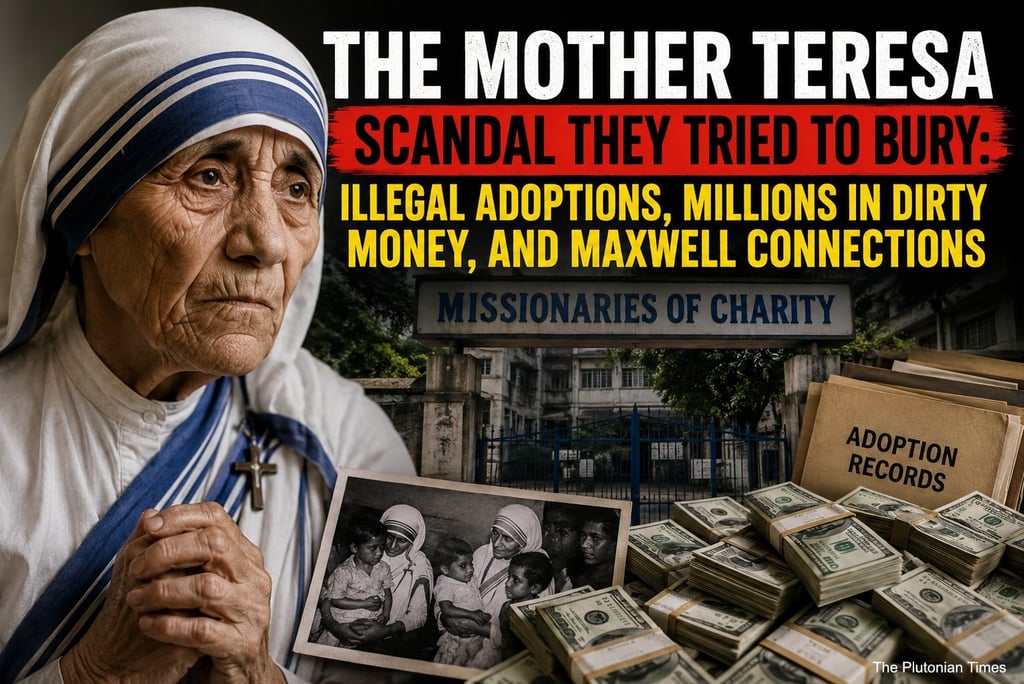
Mother Teresa, born Anjezë Gonxhe Bojaxhiu, founded the Missionaries of Charity in 1950 in Kolkata, India. The organization focused on serving the poorest of the poor through homes for the dying, orphanages, and other care facilities. While celebrated for her humanitarian efforts and canonized as a saint in 2016, both she and the organization have faced substantial criticism. These include substandard conditions in facilities, financial opacity, acceptance of donations from controversial figures, and documented cases of illegal activities involving children after her death in 1997. The Missionaries of Charity remains in operation as of 2026, with thousands of sisters serving in multiple countries, though it faces challenges such as declining new vocations leading to some home closures.
Broader criticisms of orphanage conditions during Mother Teresa’s era include overcrowding, limited medical care, and basic hygiene standards, based on volunteer and researcher accounts.
Child-Related Allegations: Trafficking and Illegal Adoptions
In July 2018, authorities in Ranchi, Jharkhand, arrested a nun, Sister Koncilia, and a staff member, Anima Indwar, from a Missionaries of Charity shelter for unwed mothers. They were accused of selling at least four infants, with reported payments ranging from 50,000 rupees to 120,000 rupees per child. Police recovered cash during the raid, and the facility was closed. This case led to nationwide inspections of the organization’s childcare homes by the Indian government. The Missionaries of Charity condemned the actions as contrary to its values and had stopped adoptions in India in 2015 due to regulatory disagreements.
Financial Scandals, Opacity, and Ties to Controversial Donors
The Missionaries of Charity has been criticized for limited financial transparency despite receiving large donations. Critics such as Christopher Hitchens noted that only a small portion of funds appeared directed toward direct aid, with much allocated to expansion or Vatican accounts.
Among the controversial donors was Robert Maxwell, the British media tycoon and father of Ghislaine Maxwell. Robert Maxwell donated to the Missionaries of Charity in the late 1980s. He later faced exposure for embezzling hundreds of millions of pounds from his companies’ pension funds. Robert Maxwell died in 1991. His daughter, Ghislaine Maxwell, became centrally involved in the sex trafficking operation run by financier Jeffrey Epstein. Ghislaine Maxwell was convicted in 2021 on federal charges including sex trafficking of minors.
While the Maxwell family connection raises questions about donor vetting, no direct evidence yet ties the organization’s child-related incidents to Epstein’s trafficking activities.
Jean-Claude “Baby Doc” Duvalier, the Haitian dictator who ruled from 1971 to 1986, was another notable donor. Duvalier inherited power from his father, François “Papa Doc” Duvalier. His regime was marked by widespread human rights abuses, including torture, extrajudicial killings, disappearances of political opponents, and massive corruption. The United Nations and human rights organizations documented crimes against humanity under his rule, with prisons and torture centers responsible for hundreds of deaths. Thousands of Haitians fled into exile. In 1981, Mother Teresa visited Haiti, accepted a cash donation from Duvalier and his wife Michèle, and received the Haitian Legion of Honour. She publicly praised the couple, stating she had “never seen the poor people being so familiar with their head of state” and describing Michèle Duvalier as someone who demonstrated love through “concrete and tangible actions.”
Charles Keating, a prominent American businessman and devout Catholic, donated more than one million dollars to Mother Teresa’s work. Keating was a central figure in the 1980s Savings and Loan scandal involving his Lincoln Savings and Loan Association. He was convicted in 1992 on federal charges of fraud and racketeering related to misleading investors, which contributed to one of the largest financial scandals in U.S. history at the time, costing taxpayers billions. After his conviction, Mother Teresa wrote a letter to the sentencing judge, Lance Ito, describing Keating as “kind and generous to God’s poor” and urging the judge to “do what Jesus would do” by showing leniency. Deputy District Attorney Paul Turley, a prosecutor in the case, responded to Mother Teresa. He explained the nature of the crimes and suggested that, if she believed in justice, she should return the donated money to the victims whose funds had been taken. Mother Teresa did not reply to the prosecutor’s letter.
These issues highlight the need for strong oversight in large charitable organizations handling vulnerable populations, particularly children.
References
NPR and Associated Press reports on the 2018 Ranchi arrests and investigations.
Coverage from The Guardian, Reuters, and Times of India on adoption scandals.
Christopher Hitchens writings and interviews detailing financial concerns and donors.
Court records and news reports on Robert Maxwell’s fraud and death.
Trial coverage from BBC and The New York Times on Ghislaine Maxwell’s conviction for sex trafficking.
Reports on Jean-Claude Duvalier from Amnesty International, Human Rights Watch, and UN documents.
Los Angeles Times and other outlets on Charles Keating’s case and Mother Teresa’s letter.
Recent updates from official Missionaries of Charity statements and Catholic news sources on current operations and challenges as of 2025-2026.