
The DARPA N3 Initiative: Nonsurgical Bidirectional Brain-Machine Interfaces for Military Use
TECHNOLOGY
Debbie Edwards
4/3/20264 min read
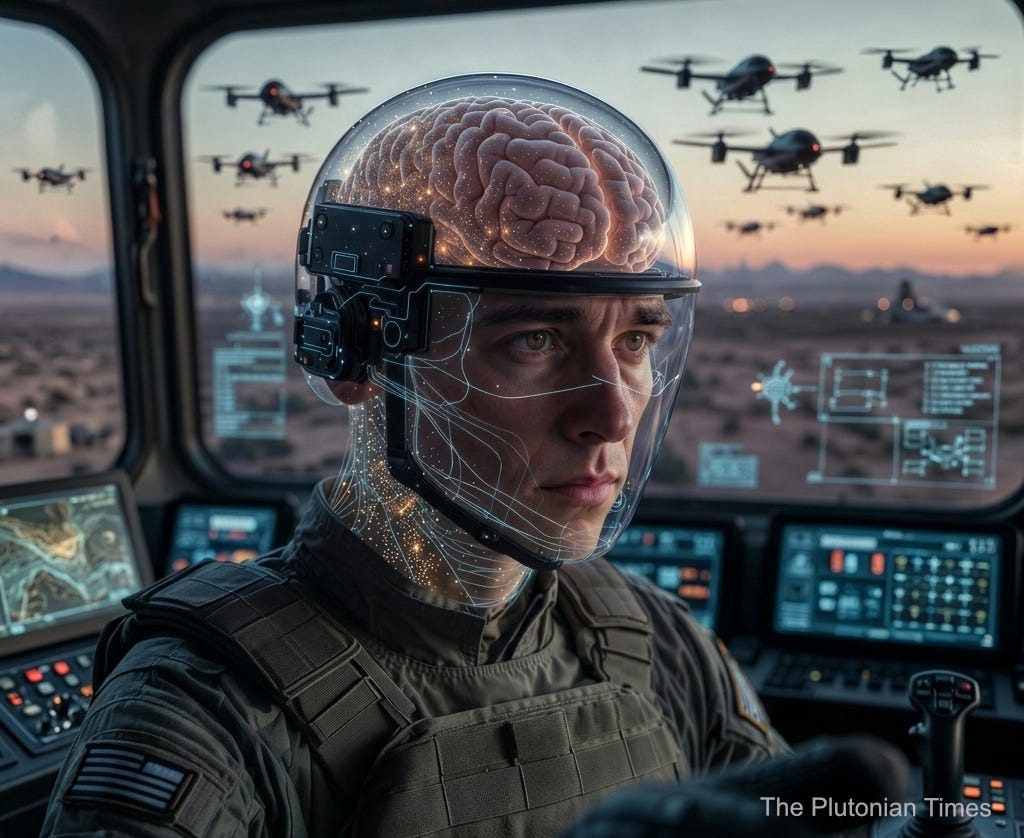
DARPA’s Next-Generation Nonsurgical Neurotechnology (N3) program was a major initiative launched by the Defense Advanced Research Projects Agency (DARPA) in 2018 under its Biological Technologies Office. It focused on creating high-performance, bidirectional brain-machine interfaces (BMIs or BCIs) that do not require surgery, making them suitable for able-bodied service members in real-world military scenarios.
Unlike earlier DARPA neural interface efforts (such as those under the Neural Engineering System Design or NESD programs, which often involved implantable devices), N3 explicitly targeted nonsurgical or minimally invasive (minutely invasive) approaches to overcome barriers like surgical risks, infection, and limited accessibility. The goal was to produce wearable, man-portable systems for rapid human-machine teaming in high-stakes environments.
Program Goals, Technical Specifications, and Requirements
N3 aimed to enable service members to control unmanned aerial vehicles (UAVs), manage active cyber defense systems, or multitask seamlessly with AI and computer systems during complex missions, potentially at the speed of thought. Program manager Dr. Al Emondi emphasized preparing for future conflicts involving unmanned systems, AI, and cyber operations that unfold too quickly for traditional human response times.
Key technical performance targets (as stated on the official DARPA program page) included:
An integrated device capable of reading from and writing to 16 independent channels within a 16 mm³ volume of neural tissue.
Latency of 50 ms or less.
Sub-millimeter spatial and temporal specificity rivaling invasive electrode implants.
Systems that could scale by combining multiple devices for broader brain coverage.
Solutions to challenges like signal scattering and weakening through skin, skull, and brain tissue; low signal-to-noise ratios; crosstalk; and the need for integrated sensing and stimulation with safe, effective decoding and encoding algorithms.
Approaches were restricted to optics, acoustics, electromagnetics, or combinations thereof (explicitly excluding incremental improvements to existing noninvasive tech like EEG or tDCS, which lacked the required precision, resolution, and portability). Systems had to demonstrate safety and efficacy in animal models before human volunteer testing in later phases. The four-year (later extended) effort culminated in a defense-relevant demonstration, such as UAV control or cyber defense tasks.
The program explicitly distinguished itself from clinical BCIs (for paralyzed patients or those with brain injuries) by prioritizing able-bodied warfighters, while also noting dual-use potential for noninvasive treatments like deep brain stimulation.
Announcement, Timeline, and Structure
DARPA announced N3 on March 16, 2018, via a Proposers Day and Broad Agency Announcement (BAA HR001118S0029). A 2018 DARPA release highlighted recent advances in biomedical engineering, neuroscience, synthetic biology, and nanotechnology as making the elusive goal attainable.
In May 2019, DARPA selected six multidisciplinary teams for funding (initial awards varied; some teams received approximately 2 to 11 million dollars or more per phase, with full contracts up to approximately 20 million dollars). The program ran in three sequential phases: a 1-year base effort, plus two 18-month option periods (total approximately four years initially, with sources indicating activity through 2025). Human trials were planned for the final phase.
As of current DARPA documentation, the program is now complete (content archived for reference; no longer actively maintained).
The Six Selected Teams and Their Approaches
DARPA funded a diverse set of modalities to explore the nonsurgical future of BMIs. Here are the teams and their core concepts (from the 2019 announcement):
Battelle Memorial Institute (lead: Dr. Gaurav Sharma; BrainSTORMS project with partners including Cellular Nanomed Inc., University of Miami, etc.): Minutely invasive system using magnetoelectric nanotransducers (MEnTs), tiny particles (thousands fit across a human hair) injected into the bloodstream and guided magnetically to neural tissue. These convert neuronal electrical signals to magnetic ones (and vice versa) for bidirectional communication with an external transceiver. The project advanced to Phase II (announced December 2020) after demonstrating core reading and writing capabilities in Phase I.
Carnegie Mellon University (lead: Dr. Pulkit Grover): Completely noninvasive acousto-optical approach using ultrasound-guided light for recording neural activity and interfering electrical fields for precise, cell-type-specific stimulation (exploiting nonlinear neuron responses). By 2023, the team reported unprecedented spatiotemporal resolution in animal stimulation and had begun human subject testing in Phase 3.
Johns Hopkins University Applied Physics Laboratory (APL) (lead: Dr. David Blodgett): Completely noninvasive coherent optical system that records by measuring optical path-length changes in neural tissue correlated with activity. It focused on demonstrations progressing from prosthetic control to UAV swarms and real-world cyber defense scenarios.
Palo Alto Research Center (PARC) (lead: Dr. Krishnan Thyagarajan): Completely noninvasive acousto-magnetic device using ultrasound waves paired with magnetic fields to generate localized electric currents for deeper neuromodulation (writing signals).
Rice University (lead: Dr. Jacob Robinson; MOANA project): Minutely invasive bidirectional system using diffuse optical tomography (light scattering) for recording and magneto-genetic methods (making neurons magnetically sensitive) for writing. It received approximately 9.8 million dollars in funding and emphasized non-surgical nano-transducers as intermediaries.
Teledyne Scientific (lead: Dr. Patrick Connolly): Completely noninvasive integrated device using micro optically pumped magnetometers to detect localized magnetic fields from neural activity and focused ultrasound for writing and stimulation.
These teams pursued a mix of fully external wearables (helmet or headset-style) and minutely invasive options (for example, injectable nanomaterials that self-localize without surgery).
Progress, Outcomes, and Current Status
Public details on later phases are limited (typical for defense programs). Several teams advanced to Phase II by late 2020, achieving early metrics like precise neuron reading and writing and safe nanotransducer delivery. Carnegie Mellon University reported dramatic advances in noninvasive stimulation resolution by 2023 and initiated human testing. A 2026 retrospective on brain-computer interfaces notes N3’s role in validating nonsurgical modalities for military use, with Phase 3 goals including closed-loop human demonstrations (some outcomes partially classified).
No comprehensive unclassified final report or public performance data (for example, exact channel counts or latency achieved across teams) appears in open sources as of 2026. DARPA’s program page confirms completion without detailing transition outcomes, suggesting potential classification or transition to follow-on efforts. Some ethical discussions highlighted dual-use concerns around communication, behavior, and privacy.