
The CIA’s Secret Prison Lab: How Vacaville State Prison Turned Inmates Into Human Guinea Pigs
DISCLOSURESPARAPSYCHOLOGY & CONSCIOUSNESS STUDIES
Debbie Edwards
6/5/20263 min read
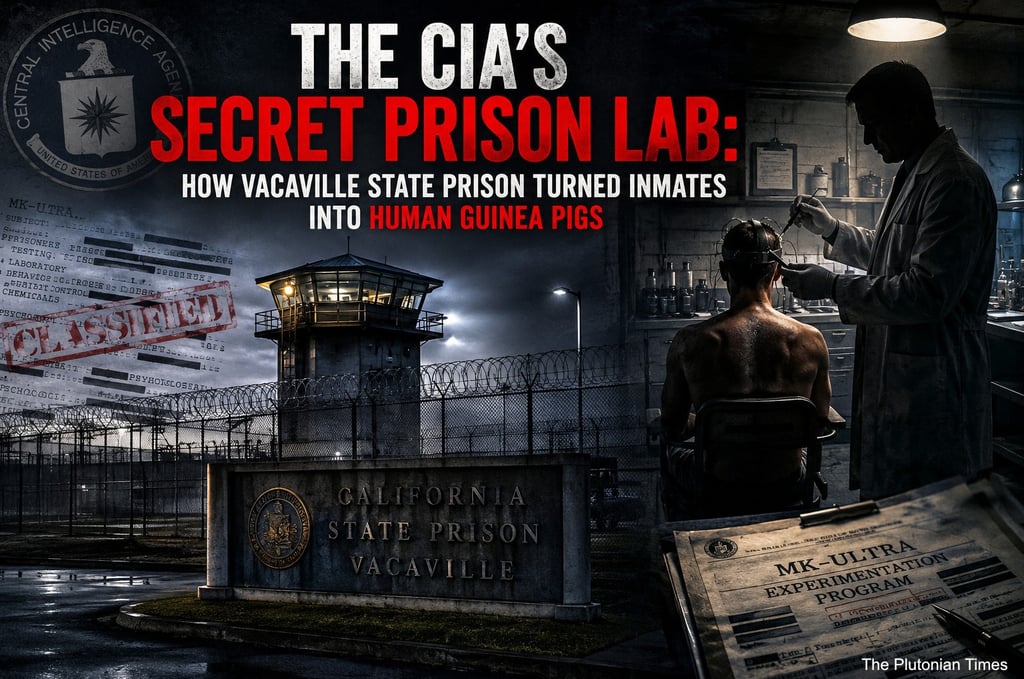
Vacaville State Prison, formally known as the California Medical Facility (CMF), opened in the mid-1950s as a specialized prison hospital in Vacaville, California, approximately 50 miles northeast of San Francisco. Designed to provide medical and psychiatric care to male inmates, it became a hub for controversial research involving prisoners during the 1960s and 1970s. While many experiments were presented as voluntary and paid, critics and later investigations highlighted ethical violations, lack of meaningful consent, and connections to broader government programs exploring mind control, behavior modification, and medical testing.
Medical Experiments on Prisoners
In the 1960s and 1970s, researchers from the University of California, San Francisco (UCSF) conducted dozens of experiments on at least 2,600 incarcerated men at CMF. Dermatologists Dr. Howard Maibach and Dr. William Epstein led much of this work. Studies included applying pesticides and herbicides to the skin, injecting them intravenously, and testing "host attractiveness" to mosquitoes by placing cages with the insects directly on participants' arms or skin.
Prisoners reportedly volunteered and received payment of about 30 dollars per month, one of the highest-paid roles available in the facility at the time. Experiments continued until halted around 1977. In December 2022, UCSF issued a formal apology for these unethical practices. Dr. Maibach remained affiliated with the university at the time of the apology, while Dr. Epstein had died in 2006.
These tests echoed broader patterns of prisoner experimentation across the United States, often justified under the guise of advancing medical knowledge but raising serious questions about coercion in a prison environment.
Connections to MKUltra and Behavior Modification
Vacaville gained notoriety for links to the CIA's MKUltra program, a covert operation running from 1953 to the early 1970s aimed at developing mind-control techniques, including through LSD and other drugs. CIA Director Allen Dulles approved MKUltra on April 13, 1953. Much documentation was destroyed in 1973 on orders from CIA Director Richard Helms, limiting full details.
Dr. James Hamilton, a psychiatrist with OSS (Office of Strategic Services) background and CIA connections, conducted psychological and behavioral research at Vacaville. He performed studies involving behavior modification and reportedly received CIA funding through front organizations for "clinical testing of behavioural control materials." Hamilton set up a lab at the facility for radioisotope studies on thyroid uptake in prisoners, framed as his own research but tied to MKUltra Subproject 140 (later MKSEARCH).
Prisoners at Vacaville, along with those in other facilities like Georgia and Tennessee penitentiaries, provided "unique research material" for these programs. Some accounts suggest reduced sentences or other incentives encouraged participation. While direct evidence of widespread LSD dosing at Vacaville is less documented than at other sites (such as the Atlanta Federal Penitentiary), the facility's role in CIA-linked narcotics and behavior research is noted in declassified materials and investigations.
MKUltra involved over 80 institutions, including prisons, and tested drugs, hypnosis, and other methods on unwitting or coerced subjects. Public revelations in the 1970s, including Senate hearings, exposed the program's scope. Admiral Stansfield Turner, CIA Director, testified in 1977 about the abhorrent nature of using humans as guinea pigs.
Psi Experiments and Broader Context
Direct public records of parapsychological ("psi") experiments, such as remote viewing or psychic phenomena testing, at Vacaville itself are limited or not prominently documented in open sources. However, the prison's involvement in behavior modification aligned with wider CIA interests in psychological control during the Cold War. Nearby institutions like Stanford Research Institute (SRI) conducted CIA-funded research into psi phenomena and mind control in the 1970s, sometimes overlapping with prison-related programming narratives in alternative accounts.
Vacaville also housed notable inmates, including Charles Manson (1976-1985) and others, during periods of experimental activity, though direct ties to their cases remain speculative.
Atrocities, Funding, and Legacy
Many experiments were tax-funded or supported through government channels, including CIA black-budget operations. Prisoners, often from vulnerable populations, faced risks including long-term health effects without adequate follow-up. The UCSF experiments alone affected thousands, and broader MKUltra efforts impacted numerous sites.
Investigations, such as those by the Advisory Committee on Human Radiation Experiments, referenced Hamilton's work and prison labs. Prison rights movements in the 1970s pushed back against such practices, contributing to reforms that largely ended large-scale prisoner experimentation by the late 1970s.
Today, CMF continues as a medical facility within the California Department of Corrections and Rehabilitation, but its history serves as a cautionary tale of ethics in incarceration and government research. UCSF's 2022 apology acknowledged past wrongs, yet full accountability for CIA-linked activities remains elusive due to destroyed records.
References:
Associated Press, "California university apologizes for prisoner experiments," December 22, 2022.
CounterPunch, "The CIA's House of Horrors: the Abominable Dr. Gottlieb," November 17, 2017.
U.S. Senate MKUltra hearings and related declassified documents, 1970s (e.g., 1977 testimony).
Advisory Committee on Human Radiation Experiments documents referencing Vacaville lab, 1990s.
Truthout and related FOIA releases on CIA narcotics research at Vacaville, 2023 context.