
Swedish Discovery Offers New Hope: Injectable Treatment Grows Healthy Cartilage in Damaged Joints
SCIENCEHEALTH
Debbie Edwards
5/29/20263 min read

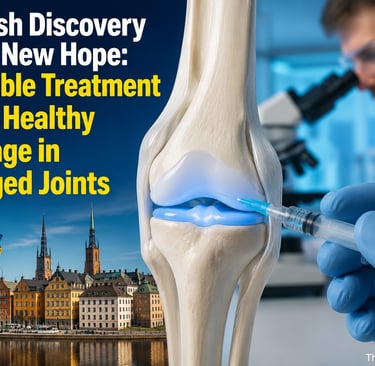
For millions suffering from osteoarthritis, the gradual breakdown of joint cartilage has long meant a path of increasing pain, limited mobility, and few effective options. Cartilage tissue lacks blood supply and possesses almost no natural ability to repair itself. Once worn away by arthritis, injury, or everyday use, it rarely regenerates. Traditional approaches have centered on pain relief medications, physical therapy, or major surgeries such as total joint replacement. For the estimated 530 million people worldwide living with osteoarthritis, this reality has felt inescapable.
Researchers have developed GelrinC, an injectable hydrogel designed to fill cartilage defects and promote the growth of new, functional tissue. This approach marks a significant departure from existing methods that often produce only temporary or inferior repairs.
How GelrinC Works
GelrinC consists of a biocompatible hydrogel scaffold made from polyethylene glycol and fibrinogen. Surgeons inject the material directly into the damaged area of the joint using arthroscopic guidance. The liquid formulation conforms precisely to the shape of the cartilage defect before solidifying into a stable gel.
Over approximately three months, the hydrogel scaffold degrades gradually. During this period, it supports the migration of the patient's own mesenchymal stem cells into the area. These cells then produce new cartilage matrix, replacing the temporary scaffold with living tissue.
Importantly, the regenerated tissue is hyaline cartilage, the smooth, resilient type found in healthy joints. This differs markedly from the fibrocartilage scar tissue typically formed after microfracture surgery, the previous standard treatment that involves drilling into bone to stimulate repair but often yields less durable results.
Promising Clinical Results
In a study involving patients with knee cartilage defects treated with GelrinC, outcomes have been encouraging. At the 24-month follow-up, a high percentage of patients showed complete or near-complete filling of their cartilage defects as confirmed by MRI scans. Pain scores and functional improvements were substantial. Many patients reported resuming physical activities they had given up years earlier due to joint pain. Some individuals who had not walked without significant discomfort for extended periods were able to move more freely after treatment.
These results suggest not only structural repair but also meaningful improvements in quality of life and function. Longer-term data indicate sustained benefits beyond two years, with tissue maturation continuing over time.
The Broader Impact on Osteoarthritis Treatment
Osteoarthritis remains a leading cause of disability globally. Current options often fail to address the underlying loss of cartilage, leaving patients to manage symptoms or undergo invasive replacements that carry risks and limited lifespans. An injectable solution like GelrinC could reduce the need for such surgeries, particularly for younger or more active patients with focal defects.
The procedure itself is minimally invasive, typically performed in a single session. This stands in contrast to more complex cell-based therapies that require harvesting and culturing patient cells over weeks.
Background and Development
GelrinC was developed as an acellular, off-the-shelf implant that harnesses the body's natural healing processes. Clinical evaluations have been conducted across multiple centers in Europe, with ongoing studies in other regions.
Looking Ahead
While larger pivotal trials continue and regulatory pathways advance in different regions, GelrinC represents a promising step toward true cartilage regeneration. Patients and clinicians alike are watching closely as further data emerges on long-term durability and broader applicability to other joints.
This development underscores the potential of biomaterials combined with the body's own regenerative capacity to transform how we treat one of the most common and debilitating conditions of aging and injury. For those living with constant joint pain, the possibility of standing up and moving freely again without major surgery offers renewed optimism.
References
Regentis Biomaterials. "Regentis' GelrinC Demonstrates Breakthrough in Regenerating Native-Like Cartilage Structure in Knee Repair." BioSpace, 20 January 2026.
Regentis Biomaterials. "Regentis' GelrinC Establishes Long-Term Durability of Cartilage Repair." Yahoo Finance, 6 January 2026.
Trattnig S, et al. Peer-reviewed data in the journal Cartilage (2026 publication on 24-month Phase II results).
Regentis Biomaterials. European Phase II clinical study results on GelrinC (follow-up data up to 4 years, reported 2026).
ClinicalTrials.gov. "Pivotal Study to Evaluate the Safety and Efficacy of GelrinC" (SAGE study, ongoing as of 2026).