
Speaking Out Against AI Could Get You Labeled a Domestic Terrorist
TECHNOLOGY
Debbie Edwards
5/29/20263 min read

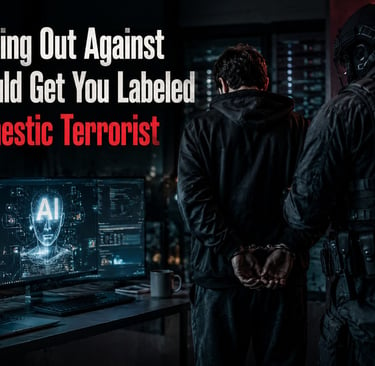
In recent months, United States law enforcement and intelligence agencies have begun focusing on a new category of potential domestic threats: individuals and groups labeled as "anti-tech extremists." This development coincides with growing public resistance to the rapid expansion of artificial intelligence infrastructure, particularly data centers. While authorities emphasize monitoring for violence, critics argue that the broad framing risks suppressing legitimate civic dissent over environmental, economic, and social impacts.
Data centers powering AI systems require enormous amounts of electricity and water. Their construction has sparked protests and organized opposition in dozens of states. According to Data Center Watch, a project tracking these efforts, hundreds of organizations across 42 states have mobilized against proposed facilities. In the second quarter of 2025 alone, opposition blocked or delayed projects worth an estimated 98 billion dollars.
Local concerns typically center on higher energy costs for residents, strain on power grids, increased water usage, noise pollution, and land use changes. Polls indicate significant skepticism. One survey found that 52 percent of Americans oppose or strongly oppose building a data center near their homes.
Government Response and the "Anti-Tech" Label
Unpublished reports from the Department of Homeland Security, Federal Bureau of Investigation, and state fusion centers, obtained by WIRED, reveal over 1,000 pages documenting this shift. Agencies now track "anti-tech violent extremism" amid fears that protests over AI job displacement and data center proliferation could escalate.
One report from the New York Intelligence and Counterterrorism Bureau states: "The chaotic atmosphere that may result from emergent AI technology in the next five years may fuel large-scale protests that devolve into civil unrest and anti-tech violent extremist activity, especially in large urban areas such as New York City."
This monitoring follows incidents including protests targeting data centers and isolated threats or attacks linked to anti-tech sentiments. Officials reference events such as CEO attacks and online calls for sabotage. However, the category encompasses a wide range of activities, from public meetings to online criticism.
In several states, including California, Illinois, Indiana, New Jersey, Oklahoma, and Wisconsin, police have removed or arrested individuals at town halls for criticizing data centers, sometimes before they could speak.
Concerns Over Free Speech and Overreach
Civil liberties advocates and observers warn that labeling peaceful critics as potential extremists could chill protected speech. Spencer Reynolds noted that such a broad category might ensnare data center protesters, AI skeptics, and others concerned about technology's societal effects.
AI security researcher and critic critiques have highlighted that while violence is unacceptable, it should not justify broad surveillance that silences debate on AI's trajectory. Community groups organizing against data centers often frame their efforts around local quality of life, resource allocation, and democratic input rather than ideology.
This occurs against a backdrop of strong federal support for AI growth, including investments and policies favoring data center expansion. Proponents argue these facilities are essential for economic competitiveness, national security, and technological leadership.
Context and Broader Implications
Public opposition to data centers reflects longstanding tensions over infrastructure projects. Similar pushback has occurred with pipelines, renewable energy installations, and other large developments. What distinguishes the current wave is the tie to AI, which amplifies debates about job automation, privacy, energy demands, and corporate influence.
Law enforcement maintains focus on preventing violence, drawing parallels to other domestic extremism categories. Reports acknowledge that most opposition remains non-violent, but highlight risks from fringe elements amplified online.
As AI infrastructure expands, balancing security needs with the right to peaceful protest and public comment will remain a key challenge. Communities continue organizing through petitions, local government actions, and moratoria on new projects in various states.
References
WIRED: "US Law Enforcement Warns of 'Anti-Tech Extremism' as AI Hatred Grows" (May 2026).
Data Center Watch reports on opposition trends (2025).
Reports from state intelligence bureaus and fusion centers, as summarized in public coverage.
Heatmap News polling on data center sentiment.
Coverage from Ars Technica, Fast Company, and local news outlets detailing town hall incidents and project delays.