
SHOCKING: Wells Fargo's Invisible Smart Dust Nanobots Will Track Your Every Move - And It's Patented
TECHNOLOGY
Debbie Edwards
4/29/20263 min read
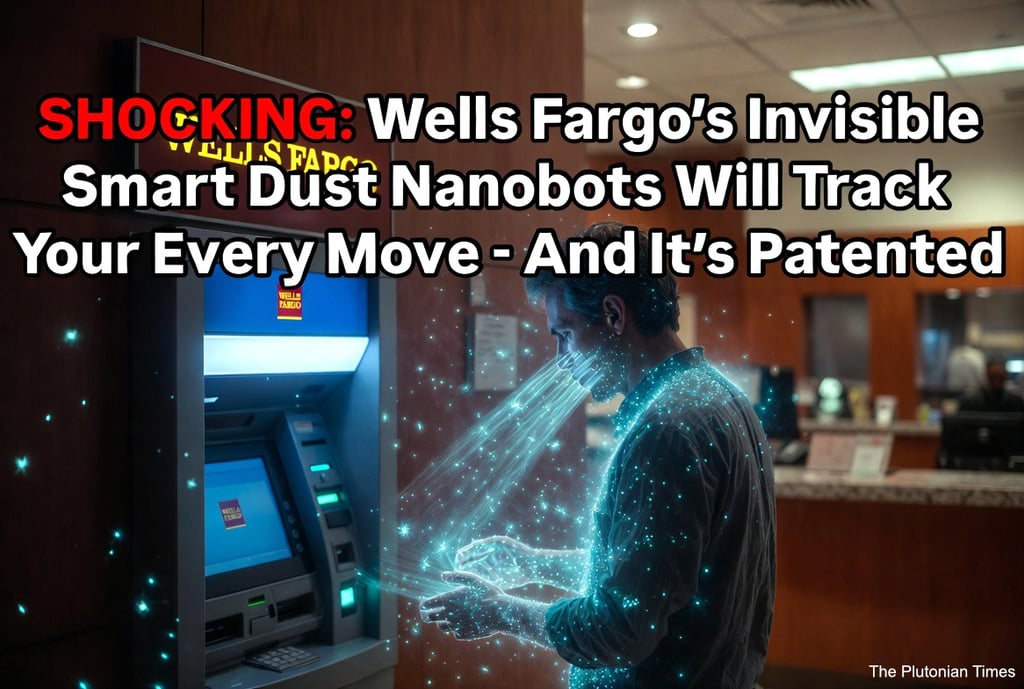

A Closer Look at Patent US11354666B1 and Its Privacy Implications
In June 2022, Wells Fargo Bank received a U.S. patent for a system that uses microscopic sensors known as smart dust to verify customer identities during financial transactions. Titled “Smart Dust Usage,” the patent (US11354666B1) outlines a method where tiny microelectromechanical systems (MEMS) devices are released into the air around a person to collect biometric and environmental data in real time. While the technology is framed as an advanced fraud-prevention tool for payments, it has sparked widespread online discussion about potential surveillance risks and privacy concerns.
What Is Smart Dust?
Smart dust refers to networks of extremely small MEMS devices, often called motes. Each mote is a miniature sensor that can detect environmental conditions or biometric signals. Originally conceptualized in the 1990s by researchers at the University of California, Berkeley, and explored by military agencies like DARPA for battlefield monitoring, smart dust has long been discussed as a futuristic sensing technology. These particles are designed to be so tiny they can float in the air, self-organize into wireless networks, and relay data to a central base station.
In everyday terms, imagine invisible specks of dust that temporarily surround you, measure your vital signs, capture images or sounds, and then disappear or become inactive once their job is done.
Details of the Wells Fargo Patent
Filed on May 26, 2016, and granted on June 7, 2022, the patent lists inventors Rameshchandra Bhaskar Ketharaju, Sarath Chava, Prasad N. Sivalanka, and Madhu V. Vempati. It is assigned to Wells Fargo Bank, N.A.
The core idea is straightforward: when a customer initiates a payment at a point-of-sale terminal, ATM, or via a mobile device, a base station activates a subset of nearby smart dust motes. These devices collect data such as:
Biometric information (heart rate, pulse, blood pressure, body temperature, height, weight estimates).
Optical data (images for facial recognition or fingerprints).
Audio data (voice patterns or heart sounds).
Environmental readings (motion, pressure, temperature).
The motes form a temporary network, relay the collected information back to the base station, and help generate a unique authentication key. This key is compared against the customer’s stored profile. If the data matches within an acceptable range, the transaction is approved. The system can even create a virtual card number or “smart key” based on the specific motes involved and the biometric readings.
Importantly, the patent describes the motes as being suspended in air, self-propelled, or carried by the user. They are dynamically selected based on factors like signal quality, ambient light, or noise levels. The goal is to provide stronger authentication than traditional PINs, signatures, or even current biometric methods on phones, making it harder for fraudsters to impersonate account holders.
Is This Surveillance?
The patent does not use the word “surveillance” anywhere in its description. It focuses exclusively on payment authentication to reduce fraud. However, the technology involves releasing invisible sensors that envelop a person, gather highly personal biometric data, and transmit it for analysis. Critics on social media and forums have labeled it as “airborne surveillance” because the motes create a temporary cloud of sensors around the individual during the transaction.
Privacy advocates point out several potential issues:
Even temporary data collection raises questions about consent. Customers might not realize microscopic devices are analyzing their bodies.
Biometric data is uniquely identifying and difficult to change if compromised.
While the patent limits use to authentication, future expansions or data retention policies could broaden its application.
The concept echoes long-standing concerns about nanotechnology and pervasive monitoring.
Wells Fargo has not publicly commented on plans to deploy this technology, and there is no evidence it is currently in use. Patents often protect ideas that may never reach the market.
Broader Context and Reactions
Smart dust has been a topic of both scientific interest and conspiracy theories for decades. Some online discussions link the patent to unrelated topics like chemtrails or government tracking, though the document itself contains no such references.
Mainstream coverage remains limited, but the patent has circulated widely on platforms like X (formerly Twitter), Instagram, and YouTube, often with dramatic headlines warning of “nanobot surveillance” or “biometric payment slave scans.” These posts highlight genuine unease about how banks and corporations might use advanced sensors in the future.
References
U.S. Patent US11354666B1 - Smart dust usage. Google Patents.
Justia Patents - Smart dust usage.
Various public discussions on X and social media referencing the patent (2022-2026), including posts highlighting biometric applications.