
Senator Claiborne Pell: The True Believer Behind the STARGATE Psychic Spies The Plutonian Times
DISCLOSURESPARAPSYCHOLOGY & CONSCIOUSNESS STUDIES
Debbie Edwards
3/31/20263 min read
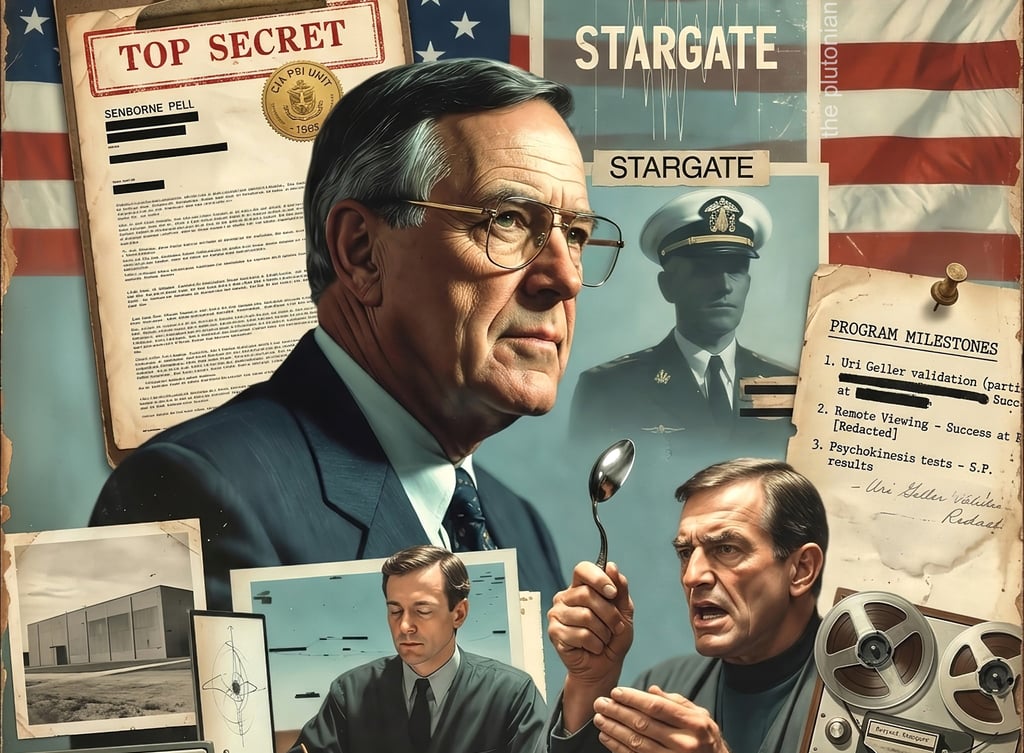
Declassified CIA records and congressional histories show that Senator Claiborne Pell (D-RI) was a key champion of the STARGATE remote viewing program. He supported it strongly from the early 1980s until his retirement at the end of 1996.
Pell served in the Senate from 1961 to 1997. He had a long personal interest in parapsychology that dated back to his college years. By the mid-1980s, he became convinced that the United States faced a possible extrasensory perception gap with the Soviet Union. To support his oversight and advocacy, he hired Cecil B. Scott Jones. Jones was a retired naval intelligence officer. Pell brought him on as a special assistant in 1985. Jones held a top secret security clearance. He earned about $50,000 a year on the public payroll. His main task was to monitor developments in parapsychology, remote viewing programs, and related topics. These included telepathy, near-death experiences, and UFO research. Jones stayed in this role until 1991. He then left to found the Human Potential Foundation. Laurance Rockefeller helped finance it. Pell served on its advisory board.
Pell received direct briefings on the Defense Intelligence Agency’s Grill Flame program and the later STARGATE effort. For example, on 29 September 1982 the DIA gave him a formal briefing on coordinate remote viewing training and its operational uses. He often urged executive branch agencies, including the Pentagon, the CIA, and the FBI, to expand or at least maintain funding for serious study of anomalous cognition. He argued that qualified researchers deserved fair access to grants. He also said that negative or inconclusive studies should not stop all further inquiry.
In 1987, Pell invited the Israeli-born psychic Uri Geller to Capitol Hill. Geller gave a private demonstration before about 30 congressional staffers, Pentagon aides, and at least one other member of Congress. The event happened in a secure, electronically shielded room. Geller performed alleged psychokinetic feats, such as spoon bending. Afterward, Pell kept a bent spoon and a framed photo of Geller in his Senate office. He also displayed drawings from an ESP experiment he had done with Geller. Pell admitted that Geller had a background as a stage magician. Still, he believed the phenomena deserved serious study. He said, “I have always been intellectually curious, and I think these things should be examined.” He called for modest government support for open-minded yet skeptical psychic research. He worried that the Soviets were pulling ahead of the United States.
Together with Representative Charles Rose (D-NC), Pell gave important behind-the-scenes political protection to the STARGATE program. Their support helped keep it alive through many budget cycles. This happened despite internal management issues, low morale, and mixed results. Their efforts continued as the program changed names, moving from Grill Flame to Center Lane and then to Sun Streak. Pell’s office served as a central point for updates on remote viewing capabilities. He pushed for independent scientific evaluations. At the same time, he resisted any early decision to shut the program down.
By June 1995, the situation had shifted. A CIA memorandum (CIA-RDP96-00791R000200190028-7) recorded a briefing for Senate Appropriations Committee staffer C. Richard D’Amato. In it, D’Amato described Pell to CIA officials as a “true believer” in the program. At that point, Pell was getting ready to retire after 36 years in the Senate. The memo noted that his departure would change the congressional dynamics around the program’s future.
Pell’s interests went beyond STARGATE. He sat on the advisory board of the International Association for Near-Death Studies. He attended UFO abduction symposia. In 1988, he co-sponsored legislation that aimed to create a national committee on human performance. The bill included experts in extraordinary abilities. Many saw this as a veiled push for parapsychology. Critics called it the “spoon bending bill.” It ultimately failed amid public ridicule. Even so, it showed Pell’s willingness to use his seniority on the Senate Foreign Relations Committee and in appropriations work to bring legitimacy to the field.
Key references include:
CIA-RDP96-00791R000200190028-7 (29 June 1995 briefing memorandum)
Federation of American Scientists STARGATE overview (irp.fas.org/program/collect/stargate.htm)
UPI Archives, 17 July 1988: “Pell keen on psychic research”
Wired, 5 January 2009: “The Senator Who Fought the ESP Gap”
Multiple declassified STARGATE files in the CIA Reading Room