
Secret Psychic Tests on Starving Indigenous Kids: The Shocking Canadian Boarding School Experiments
DISCLOSURESPARAPSYCHOLOGY & CONSCIOUSNESS STUDIES
Debbie Edwards
5/3/20262 min read
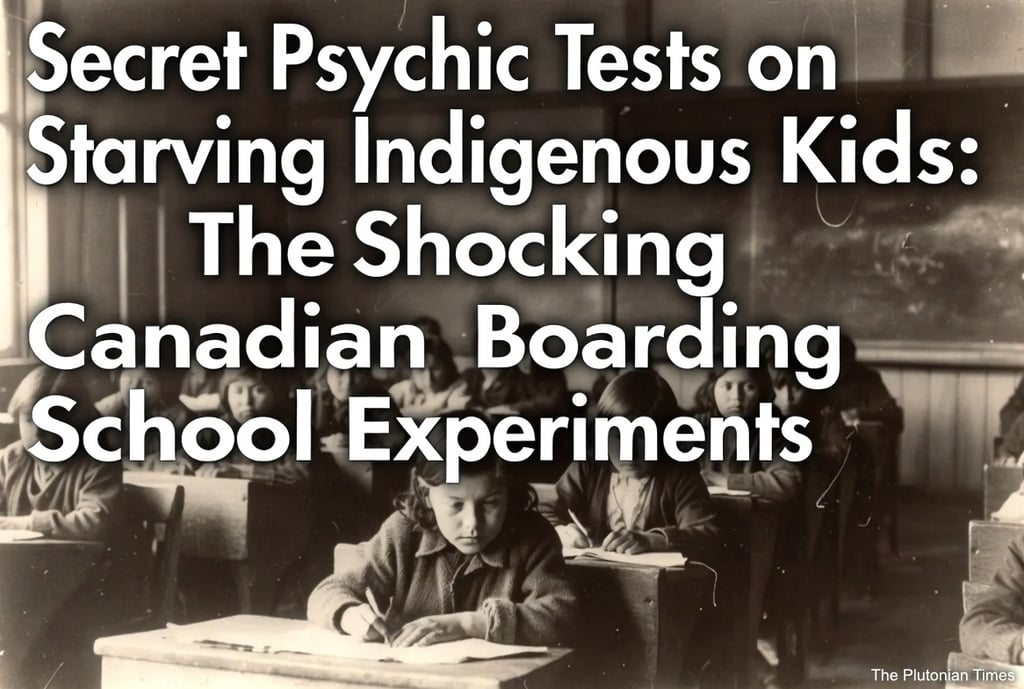
The 1940-1941 ESP Zener card tests at Brandon Indian Residential School in Manitoba, Canada, were arranged by A.A. Foster, who was affiliated with Duke University’s Parapsychology Laboratory in the United States, under J.B. Rhine. Local teacher Miss D. Doyle conducted the tests. The school operated from 1895 to 1972 under church and federal oversight as part of Canada’s forced assimilation policy. It began as the Brandon Industrial Institute (emphasizing agricultural and vocational training alongside academics) and later functioned fully as a residential school under Methodist/United Church and eventually Catholic administration.
It enforced separation of Indigenous children from their families and cultures while imposing European Canadian norms. Harsh living conditions included malnutrition, overcrowding, disease, and abuse, which made the student population especially vulnerable to external research.
This boarding model was standard across Canada’s Indian Residential School system, contributing to the separation of children from their families, cultures, and communities.
Subjects and Lack of Parental Consent
Approximately 50 First Nations children (Plains Indians, ages roughly 6-20, about one-third of the school’s enrollment) took part. Both boys and girls participated, with a final group of ten selected for continued testing based on performance and willingness.
Crucially, no parental consent was obtained or even sought. The children were legal wards of the state under the residential school system, meaning federal authorities and school administrators held complete control over their participation in any activity, including research. Parents had no legal say and were often unaware of the tests.
Methods and Specific Outcomes
Testing followed Rhine-style protocols with Zener cards (five symbols). Researchers compared the standard guessing method against a new screen-touch matching technique (cards hidden behind a screen to block sensory cues or cheating). Children completed around 250 runs, equating to thousands of guesses. The standard method produced significantly above-chance scores that Foster attributed solely to extra-sensory perception. The screen-touch method yielded chance-level results and was deemed a failure for proving ESP, though useful as a control. No individual case studies or standout personal performances were detailed; results remained aggregate and statistical. Foster highlighted the racial novelty, calling it the first ESP testing of this group and noting that the results aligned with assumptions about Indigenous intuition.
Additional Tests (Psi and Medical)
No other psi/ESP experiments occurred at Brandon or other Canadian residential schools. However, the children and ~1,000 others faced unethical nutritional/medical experiments (1942-1952) at six schools: Blood’s (AB), St. Paul des Metis (AB), St. Mary’s (ON), Cecilia Jeffrey (ON), Shubenacadie (NS), and Port Alberni (BC). These involved deliberate malnourishment, withheld vitamins/milk/dental care, and supplement testing without consent. Brandon experienced similar malnutrition issues.
Fates of the Children and Broader Context
No specific follow-up exists for the 50 ESP participants. As boarding students, they remained under institutional control. Many endured disease, abuse, and cultural loss; runaways were common. Brandon had registered deaths and potential unmarked graves (~104 suggested by forensics). Survivors faced lifelong trauma. No evidence shows Canadian authorities shared ESP scores with U.S. government labs; the work was academic and published openly.
References
Foster, A.A. (1943). ESP Tests with American Indian Children: A Comparison of Methods. Journal of Parapsychology, 7, 94-103.
CBC News, APTN News, and Washington Post reports (2015).
Mosby, Ian (2013). Administering Colonial Science: Nutrition Research and Human Biomedical Experimentation in Aboriginal Communities and Residential Schools, 1942-1952.
Truth and Reconciliation Commission of Canada records and survivor accounts.