
San Quentin Prison's Nightmare Doctor: Plastic Surgery, Animal Organs, and Eugenics Horror Exposed
DISCLOSURES
Debbie Edwards
6/5/20263 min read
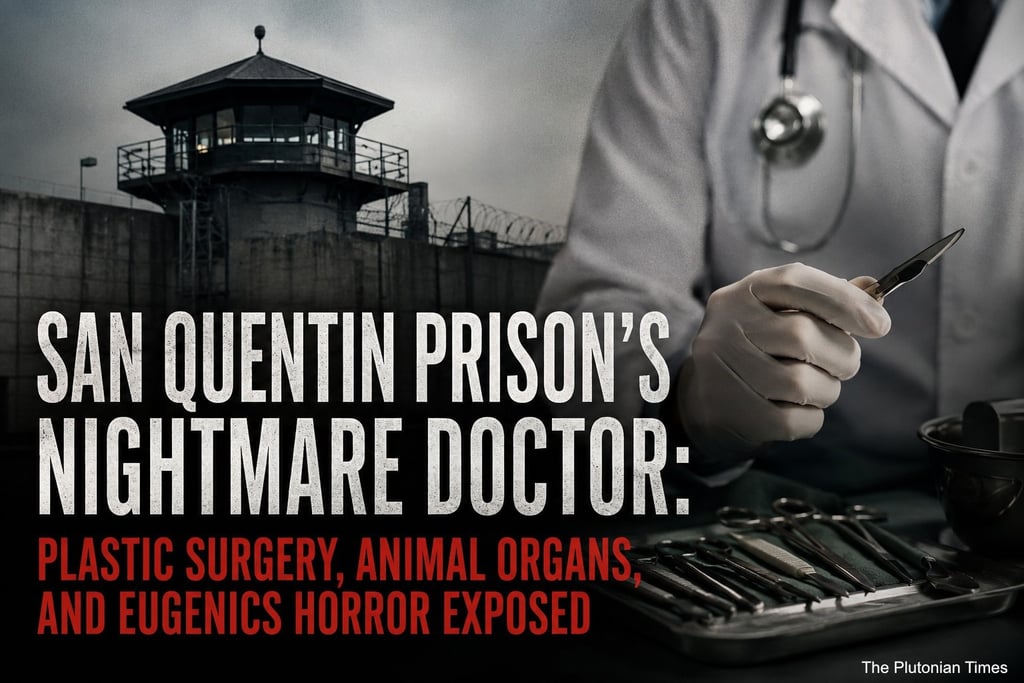
San Quentin State Prison, located in Marin County, California, opened in 1852 and remains one of the oldest operational prisons in the state. While known for housing high profile inmates and its maximum security status, the facility also served as a major site for eugenics based medical experiments in the early to mid twentieth century. These practices reflected broader national trends in eugenics that targeted incarcerated individuals deemed unfit for reproduction.
The Leadership of Dr. Leo Stanley
The central figure in these experiments was Dr. Leo Leonidas Stanley. Born in 1886, Stanley served as chief surgeon at San Quentin from 1913 until his retirement in 1951. Over nearly four decades, he conducted extensive medical interventions on prisoners, driven by eugenics ideology and beliefs about biological causes of crime. Stanley viewed the prison as an ideal laboratory because inmates lived under controlled conditions, allowing for consistent observation and follow up.
Testicular Transplants and Rejuvenation Procedures
One of Stanley's primary focuses was testicular transplantation, also called gland surgery. He implanted testicles from executed prisoners into living inmates, believing this would rejuvenate older or senile men, restore vitality, and potentially reduce criminal tendencies by boosting testosterone and manhood. When human testicles were scarce due to limited executions, he used organs from animals including goats, boars, rams, and deer. By 1940, Stanley had performed over 10,000 such testicular implants. He also conducted variations known as glandular rejuvenation procedures. These operations gained national media attention, including cases documented in his writings and scrapbooks.
Sterilization Practices
In addition to transplants, Stanley advanced forced and voluntary sterilizations. California passed its eugenics sterilization law in 1909, allowing procedures on those deemed feeble minded, morally perverse, or habitual criminals. Stanley encouraged voluntary sterilizations and performed or oversaw hundreds at San Quentin. By 1940, around 600 sterilizations had occurred there, far outpacing other California prisons. Targets often included inmates identified as homosexual, bisexual, or intellectually disabled. Stanley stated that sterilization would stamp out crime and reserve the right to bear children for the fit. He estimated that 20 percent of San Quentin prisoners were feeble minded and advocated sterilizing them all.
Response to the Spanish Flu Epidemic
During the 1918 Spanish flu pandemic, Stanley played a significant role in managing outbreaks at the prison. San Quentin experienced multiple waves of influenza in 1918, including distinct epidemics in April, October, and November. Stanley documented his observations and treatments in a report published in Public Health Reports. He oversaw care for hundreds of affected inmates, noting symptoms such as cough, restlessness, and thirst, along with the progression of the disease. In some accounts, prisoners volunteered or were used as subjects in efforts to develop remedies or preventatives against the flu, reflecting the era's approach to using controlled prison populations for medical study during public health crises.
Plastic Surgeries and Appearance Modification
Stanley also performed numerous plastic surgeries on inmates, believing that correcting physical deformities would improve self image, aid rehabilitation, and reduce the likelihood of recidivism by helping former prisoners secure honest employment. In a 1918 report to the warden, he noted that considerable plastic surgery had been done, particularly for deformed noses and ears. Procedures included pinning back large ears and remaking broken noses. These transformations were so effective that police sometimes struggled to recognize inmates from prior photographs. Stanley and his team turned what he described as plug uglies into men of distinction, with operations funded by California taxpayers.
Broader Context and Legacy
Stanley's work aligned with early twentieth century eugenics movements. He shifted from Lombrosian criminology, which linked physical features to criminality, toward biomedical explanations and later psychological approaches after World War II. His experiments blurred lines between punishment, treatment, and research. California eugenics program was among the most aggressive in the United States. From 1909 to 1979, the state sterilized approximately 20,000 people in institutions, accounting for about one third of the national total. San Quentin under Stanley represented a key example of how these policies extended into the prison system. Stanley was a proponent of racial segregation as well.
Public perception of Stanley's work evolved over time. During his career, he received attention as an innovator who modernized prison medicine. Decades later, these practices were widely debunked as pseudoscience and unethical human experimentation. Revelations about such programs in the 1970s contributed to broader reforms in human subjects research protections. Stanley died in 1976.
San Quentin's history of eugenics experiments highlights dark chapters in American medicine and criminal justice. While the prison has since focused on rehabilitation, education, and reentry programs, the legacy of these procedures serves as a reminder of the ethical failures when vulnerable populations become subjects for unproven scientific theories.
References
Wikipedia entry on Leo Stanley, accessed 2026.
Ethan Blue, The Strange Career of Leo Stanley: Remaking Manhood and Medicine at San Quentin State Penitentiary, 1913-1951, Pacific Historical Review, 2009.
California Department of Corrections and Rehabilitation, San Quentin doctor pushes prison medicine into 20th century, November 8, 2018.
SFGate, The San Quentin prison doctor who performed over 10,000 testicular transplants, August 13, 2019.
Please Kill Me, San Quentin's Surgeon and His Human Experiments, September 21, 2017.
L.L. Stanley, Influenza at San Quentin Prison, California, Public Health Reports, 1919.
Various archival collections including Leo L. Stanley scrapbooks at the Online Archive of California.