
Reaching for the Stars: Elon Musk's Vision for Orbital Data Centers to Escape Earth's Water Crisis
TECHNOLOGY
Debbie Edwards
4/6/20265 min read
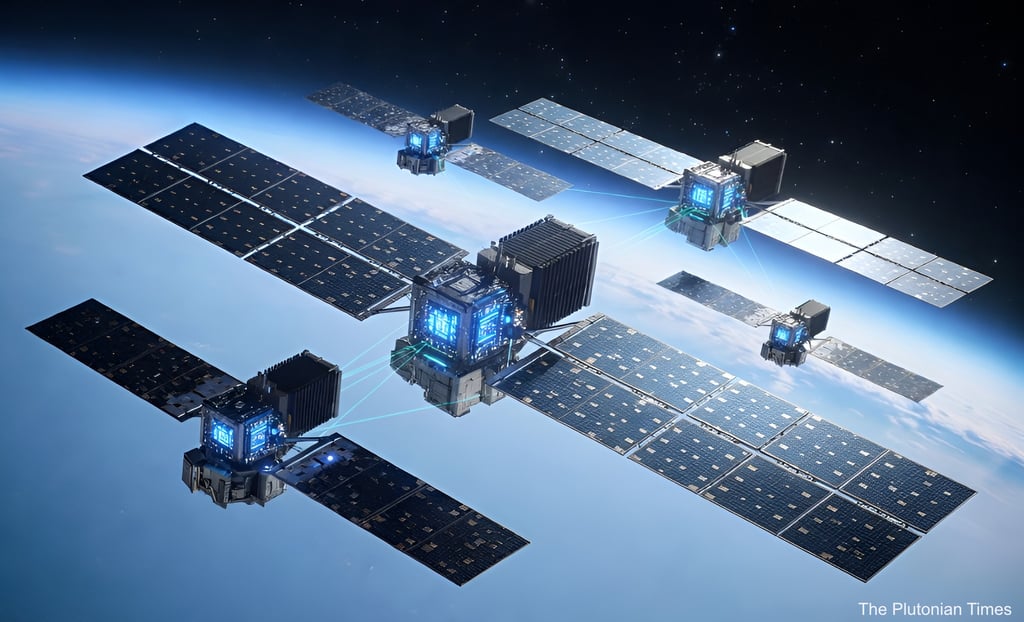
Artificial intelligence is advancing at an unprecedented pace, but the infrastructure powering it faces a growing bottleneck here on Earth. Massive data centers that train and run AI models consume enormous amounts of electricity and, crucially, water for cooling. As demand for AI skyrockets, Elon Musk has proposed a radical solution: migrate these data centers into orbit as solar-powered satellite constellations. This approach could eliminate the water consumption problem entirely while unlocking virtually unlimited compute resources. In early 2026, SpaceX, under Musk’s leadership following its integration with xAI, took concrete steps toward this future by filing plans for up to one million orbital data center satellites.
The water demands of ground-based data centers have become a serious concern. These facilities rely heavily on evaporative cooling systems to manage the intense heat generated by thousands of servers and graphics processing units. A typical large hyperscale data center can use between one million and five million gallons of water per day under peak conditions. Across the United States, data centers directly consumed around 17 to 21 billion gallons of water in 2023 for cooling alone, with projections showing sharp increases as AI workloads expand. Indirect water use, tied to electricity generation, adds hundreds of billions more gallons annually.
A prime example is xAI’s Colossus supercomputer in Memphis, Tennessee. This facility, one of the world’s largest AI training clusters with hundreds of thousands of GPUs, initially required up to five million gallons of water per day from local municipal supplies. Even with plans to shift toward treated wastewater recycling, the scale highlights the strain on regional water resources. Similar stories play out worldwide as tech companies race to build ever-larger data centers, often in areas already facing water stress. Local communities worry about diverted supplies, rising utility costs, and environmental impacts from both direct evaporation and the power plants that supply electricity.
Musk recognized these limitations early and positioned space as the logical next frontier. In January 2026, SpaceX filed an application with the Federal Communications Commission for a constellation of up to one million satellites dedicated to orbital data centers. These would handle advanced AI computations far from Earth’s grid constraints. The move coincided with the integration of xAI into SpaceX operations, allowing the companies to combine rocket launch capabilities with AI hardware expertise. Musk has described the plan in straightforward terms, noting that space-based AI compute will become the lowest-cost option within two to three years.
By March 2026, Musk provided more technical details during a presentation, including renderings of the initial “AI Sat Mini” design. Each satellite features massive solar arrays to capture constant sunlight and deliver around 100 kilowatts of computing power. These units are impressively large, with overall dimensions exceeding those of the International Space Station when fully deployed. The design leverages Starship for launches and incorporates advanced processors manufactured in a new dedicated facility called Terafab. Musk emphasized the simplicity of the concept from first principles: abundant solar energy available 24 hours a day, roughly 30 percent more intense in orbit, and free cooling without any water required.
How Orbital Data Centers Would Operate
In space, the engineering challenges shift dramatically from those on the ground. Solar panels would provide near-constant power with no need for batteries on the sunlit side of the orbit, and heat rejection occurs through radiative cooling. Satellites would deploy large radiator panels on the shadowed side to beam excess thermal energy into the cold vacuum of space. No evaporative water systems are necessary, solving the core resource issue plaguing terrestrial facilities.
Inter-satellite laser links would enable high-speed data transfer within the constellation, while connections to Earth ground stations handle user queries. The setup allows for distributed AI workloads, with raw compute happening in orbit and results beamed back as needed. Musk has pointed out that this architecture avoids the complications of Earth-based cooling and power infrastructure entirely. “Space cooling is free,” he has noted. “You just put a radiator on the dark side of the satellite.”
Key Advantages of the Orbital Approach
The primary benefit aligns directly with the query’s focus: eliminating water consumption. Orbital data centers would require zero gallons for cooling, freeing up freshwater resources for communities and agriculture. Power would come directly from the sun at no marginal cost after launch, sidestepping strained electrical grids that struggle to accommodate gigawatt-scale AI clusters. Land use on Earth becomes irrelevant, as the “real estate” exists in the vastness of low Earth orbit.
Scalability is another major draw. Musk envisions thousands of gigawatts of AI compute capacity through the full constellation, far beyond what current terrestrial plans can achieve without massive environmental trade-offs. He has stated that “space-based AI is obviously the only way to scale” and that “it’s always sunny in space.” This vision positions humanity to harness a tiny fraction of the sun’s energy output while minimizing planetary impact.
Challenges and Realistic Considerations
Of course, the plan faces significant hurdles. Launching and maintaining one million satellites demands an unprecedented cadence of Starship flights, driving costs that analysts estimate could reach trillions of dollars over time. Chips must be hardened against cosmic radiation, and the satellites themselves require robust designs to withstand the space environment. Data latency for real-time applications could pose issues, though many AI training and inference tasks tolerate it well.
Experts also raise concerns about orbital debris, increased light pollution affecting astronomy, and the long-term sustainability of such a dense constellation. Maintenance and upgrades in orbit remain complex without human presence, though robotic servicing or periodic deorbiting could help. Skeptics question whether the economics will truly favor space over continued improvements in terrestrial efficiency, such as advanced air cooling or renewable-powered facilities.
Despite these obstacles, Musk’s track record with Starlink demonstrates that ambitious satellite constellations can move from concept to reality faster than many predict. SpaceX already operates thousands of satellites, providing a foundation for scaling up.
Looking Ahead: A New Era for AI Infrastructure
Musk’s push toward orbital data centers represents more than a technical workaround. It embodies a broader philosophy of expanding humanity’s energy and compute resources beyond Earth. By addressing the water and power bottlenecks of ground-based systems head-on, this initiative could accelerate AI development without further burdening planetary resources.
Whether the full one-million-satellite vision materializes on the proposed timeline remains to be seen. Yet the direction is clear: the future of large-scale computing may well lie in orbit, where the sun shines continuously and cooling comes for free. As AI continues to reshape our world, innovations like these could ensure that progress does not come at the expense of Earth’s most precious resources.
References
SpaceNews: “SpaceX offers details on orbital data center satellites” (March 22, 2026)
Futurism: “Elon Musk’s Orbital Data Centers Are Staggeringly Huge” (March 28, 2026)
PCMag: “Musk Offers Sneak Peek at Orbiting Data Centers” (March 23, 2026)
AP News: “Musk vows to put data centers in space and run them on solar power” (February 4, 2026)
New York Times: “Sorry, SpaceX: It’s Getting Too Crowded Up There” (February 26, 2026)
Various analyses on data center water use from Lawrence Berkeley National Laboratory and industry reports (2023-2026 data)