
Project Matador Exposed: The AI Mega-Project Threatening Texas Air and Water
ENVIRONMENTTECHNOLOGY
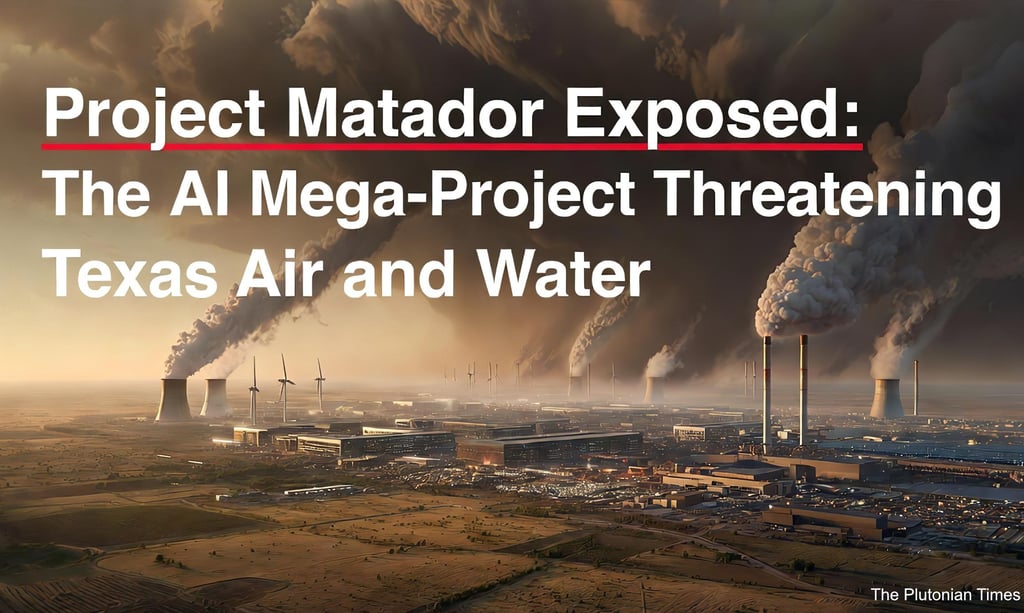
The President Donald J. Trump Advanced Energy and Intelligence Campus, dubbed Project Matador, is a massive proposed data center complex developed by Fermi America in Carson County, Texas. It is approximately 12 miles northeast of Amarillo in the Texas Panhandle. The project spans more than 5,000 acres and plans up to 18 million square feet of hyperscale computing space. It includes a dedicated “HyperGrid” private power system with capacity up to 17 gigawatts, featuring over 5,100 megawatts of natural gas generation from 93 turbines, four Westinghouse AP1000 nuclear reactors, solar arrays, and battery storage. Initial phases have broken ground, with targeted first power in 2026.
The project aims to support AI computing demands through co-located power generation that bypasses public grids. Proponents project over 9,000 peak construction jobs and about 600 permanent positions in a rural county of roughly 6,800 residents. Co-founders include former Texas Governor and U.S. Energy Secretary Rick Perry (co-founder and director) and Toby Neugebauer (former CEO). Other key leadership includes Jacobo Ortiz (COO) and Mesut Uzman (Chief Nuclear Construction Officer).
Key Permits Issued or in Process
Air Quality Permits (TCEQ – Primary for Construction and Operations):
On February 25, 2026, the Texas Commission on Environmental Quality (TCEQ) issued a final Clean Air Act permit for approximately 6 GW of natural gas generation (one of the nation’s second-largest such permits). This authorized construction of the gas-fired power component and allowed vertical construction to proceed after a pause.
A second application for an additional 5 GW was filed on March 27, 2026, to support scaling toward 17 GW total.
Decision-makers: Approved unanimously by TCEQ Commissioners Brooke Paup (Chair), Catarina Gonzales, and Tonya Miller. The commission denied all requests for contested case hearings despite hundreds of public comments and recommendations from the Office of Public Interest Counsel.
Nuclear Construction and Operating Licenses (NRC):
Fermi America submitted a Combined License Application (COLA) for four AP1000 reactors (4.4 GW total) in 2025. The Nuclear Regulatory Commission (NRC) accepted parts of the application for docketing and is preparing an Environmental Impact Statement (EIS) with public scoping. No final licenses have been issued as of May 2026; the process evaluates construction, operation, and environmental effects.
Local Construction and Tax Permits:
Carson County approved a 10-year tax abatement and reinvestment zone in October 2025 to support construction and infrastructure.
Water and Aquifer Usage (Ongoing / Lease-Based):
No specific standalone public water permit details from the Texas Water Development Board (TWDB) or Railroad Commission (RRC) appear in major filings. Instead, Fermi America holds a 99-year sovereign lease with Texas Tech University System granting exclusive rights to extract and utilize ground and surface water on the site, including access to the Ogallala Aquifer.
Data center cooling and nuclear operations could require millions of gallons daily from the depleting Ogallala Aquifer, which already faces long-term decline in the Panhandle. Water demands tie directly into the project’s environmental footprint and local municipal agreements (e.g., with the City of Amarillo).
Environmental Impact
The environmental footprint remains substantial. The natural gas component could emit approximately 23.5 million tons of carbon dioxide equivalent per year. Additional annual air pollutant estimates include about 1,591 tons of nitrogen oxides, nearly 977 tons of fine particulate matter (PM2.5), and hundreds of tons of sulfur dioxide and volatile organic compounds. These emissions raise concerns for air quality, respiratory health, and impacts on nearby agriculture and livestock.
Water usage presents a major challenge in the Ogallala Aquifer region. Operations could consume millions of gallons daily amid existing drought and agricultural demands. The project converts productive farmland, affecting local ranching and farming economies.
Public Response
Hundreds of residents submitted comments to TCEQ opposing air permits, with many requesting contested case hearings. Community meetings highlighted worries over pollution, water scarcity, and proximity to the Pantex Plant. Environmental organizations, including the Sierra Club, criticized the approvals and lack of hearings. While some view the project as economic development, opponents argue the costs to public health and natural resources outweigh uncertain long-term benefits.
Project Matador highlights broader tensions around AI infrastructure growth, energy demands, and local environmental priorities in water-stressed regions.
References
TCEQ permit proceedings and approvals (2025-2026).
NRC Combined License Application filings and Federal Register notices.
Fermi America project descriptions and regulatory announcements.
Sierra Club and independent reporting on emissions and water impacts (2025-2026).
Carson County tax abatement records.