
Pentagon Removes 180 Recognized Religions Overnight: Military Faiths Erased in Shocking Purge
DISCLOSURES
Debbie Edwards
6/5/20263 min read
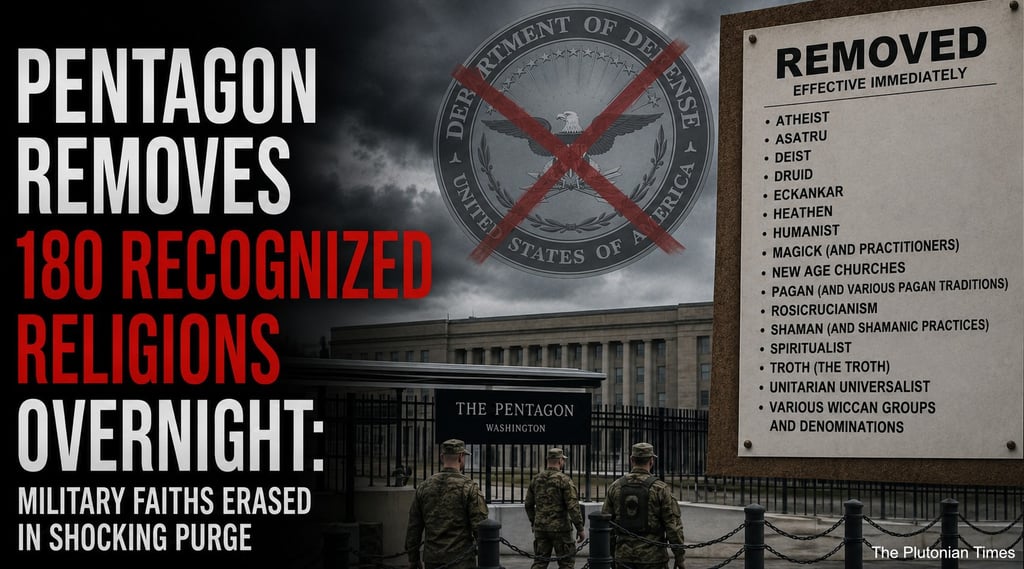
The Department of Defense has taken a dramatic step that many see as the opening salvo in a larger push toward Christian nationalism within government institutions. On June 4, 2026, reports revealed a May 20, 2026, memo from Undersecretary of Defense Anthony Tata that slashed the number of recognized religious affiliation codes from approximately 211 to just 31.
This administrative overhaul, directed by Secretary of War Pete Hegseth, consolidates minority and alternative faiths into vague catch-all categories while elevating traditional Christian denominations. Critics view it not as simple efficiency but as a deliberate move to marginalize non-Christian and non-traditional beliefs in one of the most influential arms of the federal government.
Background and Announcement
Hegseth previewed these reforms in late 2025 and formally announced them in March 2026, framing the previous system as impractical. He emphasized that the vast majority of service members align with a small number of dominant codes. The changes rename categories as religious affiliation codes and refocus chaplain resources accordingly.
While officials claim this improves support for the Chaplain Corps, the pattern aligns with broader ideological shifts outlined in Project 2025, the conservative policy blueprint closely associated with the current administration. Project 2025 promotes expanded religious influence in public institutions, including the military, often with a clear preference for Christian perspectives on morality, chaplain roles, and spiritual readiness.
The Revised List of 31 Recognized Codes
The new streamlined list heavily favors Christian denominations alongside a few major world religions:
Agnostic (AN)
Baha'i faith (BH)
Buddhism (BU)
Christian - Assemblies of God (AG)
Christian - Baptist (BA)
Christian - Brethren (BR)
Christian - Catholic (CA)
Christian - Church of Christ (CC)
Christian - Church of God (CG)
Christian - Church of the Nazarene (CN)
Christian - Episcopal/Anglican (EA)
Christian - Evangelical (EV)
Christian - Jehovah's Witnesses (JW)
Christian - Lutheran (LU)
Christian - Methodist (ME)
Christian - Non Denominational (ND)
Christian - Orthodox (OX)
Christian - Other (CO)
Christian - Pentecostal (PE)
Christian - Presbyterian (PR)
Christian - Quaker (QU)
Christian - Reformed (RE)
Christian - Scientist (SC)
Christian - Seventh Day Adventist (SA)
Church of Jesus Christ of Latter Day Saints (CJ)
Hindu (HI)
Islam (Muslim) (IS)
Judaism (Jewish) (JU)
No Religion (NR)
Other Religions (OR)
Sikh (SI)
Religions No Longer Recognized as Distinct Codes
Approximately 180 belief systems have been removed as distinct options, many folded into the nebulous "Other Religions" category. This erasure affects a wide spectrum of minority, alternative, esoteric, indigenous, and non-theistic traditions. A representative list includes:
Atheist
Asatru
Deist
Druid
Eckankar
Heathen
Humanist
Magick (and practitioners)
New Age churches
Pagan (and various pagan traditions)
Rosicrucianism
Shaman (and shamanic practices)
Spiritualist
Troth (The Troth)
Unitarian Universalist
Various Wiccan groups and denominations
Numerous smaller Christian offshoots, indigenous spiritual practices, mystical groups, and philosophical systems also lost separate recognition. This consolidation sends a clear message about which beliefs the institution deems worthy of visibility and resources.
The Road to Christian Nationalism and Broader Erasure
This military policy fits a larger pattern of institutional preference for dominant Christian frameworks, echoing elements of Project 2025 that seek to strengthen religious (particularly Christian) influence in federal operations, education, and policy. By diminishing the official status of diverse faiths in the armed forces, the change normalizes the idea that some beliefs are more legitimate than others within government structures.
Observers warn this is only the beginning. As similar streamlining logic spreads to civilian agencies, benefits systems, education, and national identity policies, non-Christian and alternative spiritual traditions could face progressive erasure from official recognition across the United States. This aligns with Christian nationalist goals of embedding specific religious values into the fabric of American governance.
Connections to Agenda 2030 raise additional concerns. While the United Nations Sustainable Development Goals promote broad inclusion on paper, critics argue that in practice, globalist frameworks often intersect with centralized control mechanisms that could enable governments to prioritize certain ideologies while sidelining others under the guise of efficiency or social harmony. The Pentagon's move may test public reaction to such consolidation before wider application.
Predictions for the near term include expanded chaplain influence favoring evangelical perspectives, reduced accommodations for minority practices, and potential policy ripple effects into veteran services, public education, and federal hiring. If unchallenged, this could accelerate a shift where "religious freedom" increasingly means freedom primarily for approved traditions.
References
Military.com report on the DOD memo and revised list (June 4, 2026).
The Wild Hunt coverage of impacts on pagan and minority traditions (June 2026).
Statements from the Department of War and Secretary Pete Hegseth (March-May 2026).
Reporting from Fox News, Religion News Service, and analyses of Project 2025 policy documents.