Operation CHAOS: The CIA's Illegal Domestic Surveillance Program
DISCLOSURES
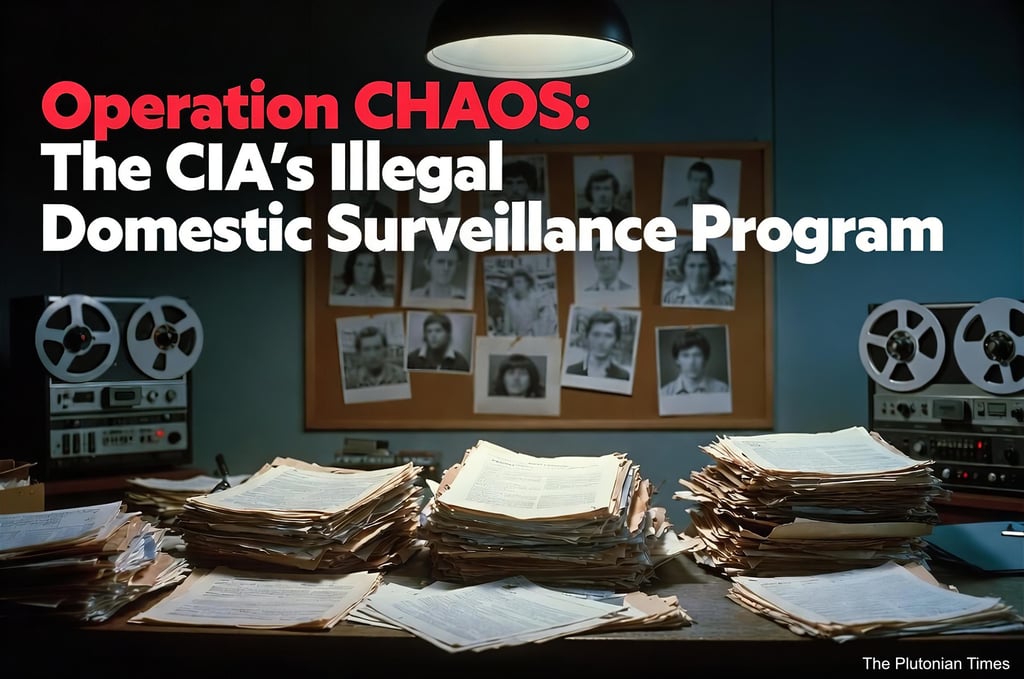
Operation CHAOS, also known as MHCHAOS, was a covert domestic espionage project conducted by the Central Intelligence Agency (CIA) from 1967 to 1974 under President Lyndon B. Johnson. The president directed the CIA to investigate whether foreign governments, such as the Soviet Union, China, or Cuba, were funding or directing U.S. protest movements amid growing opposition to the Vietnam War. The program targeted American citizens involved in anti-war, civil rights, student, and other protest movements. Its stated goal was to uncover possible foreign influence on domestic dissent, but it resulted in widespread illegal surveillance of U.S. citizens.
CIA Director Richard Helms, with input from counterintelligence chief James Jesus Angleton, created a Special Operations Group within the Counterintelligence Staff. Richard Ober led the day-to-day operations. The program expanded significantly under President Richard Nixon, who consolidated various domestic surveillance efforts into CHAOS in 1969.
Scope and Methods
The program operated on a large scale and employed various surveillance techniques:
It compiled approximately 13,000 files, including detailed dossiers on 7,200 American citizens.
A computer index tracked over 300,000 individuals and organizations.
CIA agents collected information from overseas stations, FBI reports, mail interception, and informants.
The agency infiltrated groups, monitored demonstrations, and gathered data on activists, including figures associated with the civil rights movement.
Most collected material came from overt sources or FBI sharing rather than direct clandestine operations inside the United States. However, the sheer volume of domestic data storage and analysis clearly crossed legal boundaries. Despite extensive efforts, the program found little evidence of significant foreign control over American protest movements.
Exposure by Seymour Hersh
The public learned of Operation CHAOS through investigative journalism. On December 22, 1974, The New York Times published a front-page article by Seymour Hersh titled “Huge C.I.A. Operation Reported in U.S. Against Antiwar Forces, Other Dissidents in Nixon Years.”
This revelation came amid the Watergate scandal and heightened public distrust of government. The program had officially ended in 1973, but the exposure triggered immediate outrage and official investigations.
Investigations and Findings
President Gerald Ford established the Rockefeller Commission in 1975 to examine CIA domestic activities. The commission confirmed that CHAOS had accumulated extensive files on Americans and violated the agency’s charter in several respects.
The Senate Select Committee to Study Governmental Operations with Respect to Intelligence Activities, known as the Church Committee, conducted a broader investigation. Its reports highlighted CHAOS as part of a pattern of intelligence abuses and recommended stronger congressional oversight.
Key conclusions included:
The program exceeded the CIA’s statutory authority by maintaining large repositories of domestic intelligence.
It produced repeated reports showing minimal foreign influence, yet pressure from the White House led to continued expansion.
Some activities, while improper, were not always the result of rogue operations but stemmed from presidential directives.
Legacy and Reforms
Operation CHAOS led to significant changes in U.S. intelligence practices. It contributed to the creation of permanent congressional intelligence committees and stricter legal restrictions on domestic surveillance. The Foreign Intelligence Surveillance Act (FISA) of 1978 emerged partly from these revelations.
The program is frequently studied alongside other 1970s scandals, such as the FBI’s COINTELPRO and CIA’s MKUltra, as cautionary tales of government power during the Cold War. Declassified documents remain available in the CIA’s reading room for researchers.
References
Wikipedia: Operation CHAOS
Rockefeller Commission Report, Chapter 11: Special Operations Group (aarclibrary.org)
Seymour Hersh, The New York Times, December 22, 1974
Church Committee Reports
CIA Reading Room declassified documents