
OpenAI Whistleblower Dead at 26 After Saying ChatGPT Violates Copyright Law
DISCLOSURESUNSOLVED MYSTERIES & CRIME
Debbie Edwards
6/1/20263 min read
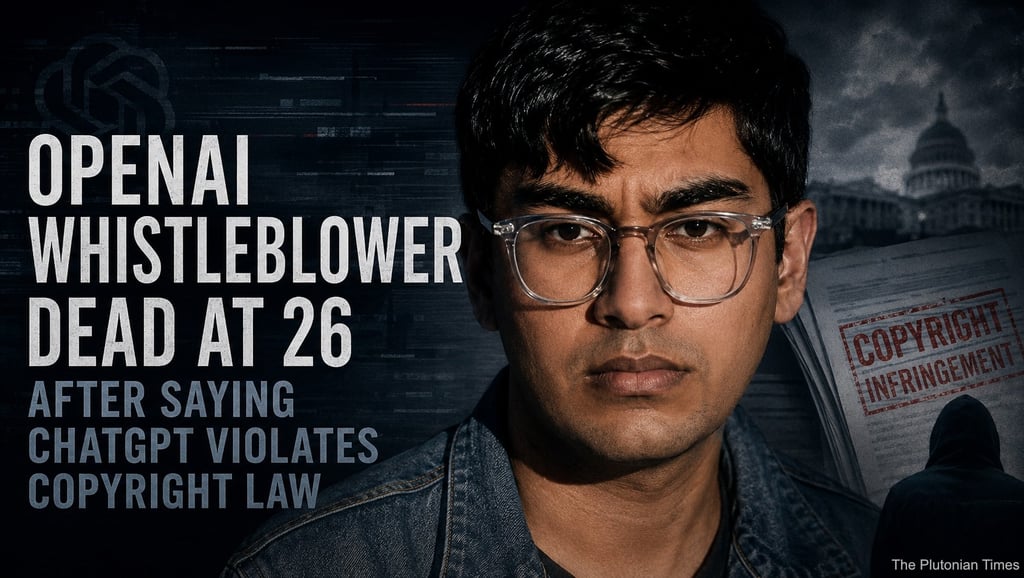
Suchir Balaji was an American artificial intelligence researcher known for his contributions to OpenAI and his later public criticism of the company's data training practices. Born on November 21, 1998, Balaji worked at OpenAI from 2020 until his resignation in August 2024. He played a key role in data systems for major models, including work on WebGPT, which helped pave the way for ChatGPT.
Early Career and Time at OpenAI
Balaji graduated from the University of California, Berkeley, with a degree in computer science. He joined OpenAI in November 2020 as a researcher. During his nearly four years there, he focused on data systems and organization for training large language models. OpenAI co-founder John Schulman highlighted Balaji's essential contributions to projects that led to ChatGPT.
Balaji became disillusioned with OpenAI's direction, particularly its commercial priorities and the ethical implications of its training methods. He resigned in August 2024, the same day as Schulman. After leaving, Balaji worked on personal projects and planned to establish a nonprofit focused on machine learning and neuroscience.
Public Criticism of OpenAI's Practices
In October 2024, Balaji went public with his concerns. In a New York Times interview published on October 23, 2024, he argued that OpenAI's training of models like ChatGPT violated U.S. copyright law. He stated that the company scraped vast amounts of internet data, including copyrighted material, without permission.
Balaji contended that this approach caused market harm to original creators and threatened the commercial viability of the web. He explained: "If you believe what I believe, you have to just leave the company." He believed generative AI outputs could substitute for human-created content, undermining the incentive to produce new works.
Balaji supported his arguments in a detailed essay titled "When does generative AI qualify for fair use?" published on his personal website (suchir.net) around the same time. In it, he applied the four-factor fair use test under U.S. copyright law and concluded that systems like ChatGPT did not qualify, citing mathematical analysis of model outputs and their effects.
His statements positioned him as a potential witness in ongoing lawsuits, including The New York Times v. OpenAI, where he was named in a court filing on November 18, 2024, as possessing "unique and relevant documents."
Death and Family's Response
On November 26, 2024, Balaji, aged 26, was found dead in his San Francisco apartment from a single gunshot wound to the head. San Francisco police and the medical examiner ruled the death a suicide. The gun was registered to him, purchased in January 2024, and no signs of foul play were found in the initial investigation.
Balaji's parents, Poornima Ramarao and Balaji Ramamurthy, strongly disputed the suicide ruling. They cited the absence of a suicide note, their son's positive demeanor in recent conversations, and a lack of prior suicidal ideation. They hired private investigators and conducted an independent autopsy, claiming inconsistencies with the official report. The family has pursued legal action, including a wrongful death lawsuit against Balaji's apartment complex, alleging issues with surveillance footage and evidence preservation.
Concerns about potential foul play, linked to his whistleblowing activities, have fueled public debate. Figures such as Congressman Ro Khanna called for a transparent investigation. The case has highlighted broader issues around protections for AI whistleblowers and corporate accountability in the tech industry.
Legacy and Ongoing Impact
Suchir Balaji's brief but impactful public stance brought attention to copyright challenges in AI development. OpenAI has maintained that its use of publicly available data falls under fair use and is supported by legal precedents.
His death in late 2024 intensified discussions about the pressures faced by those who challenge powerful tech companies. As of 2026, investigations and lawsuits related to his case continue to draw scrutiny.
References
Wikipedia entry on Suchir Balaji.
New York Times interview (October 23, 2024).
Balaji's essay on suchir.net (October 2024).
Reports from The Guardian, CBS News, San Francisco Standard, and Courthouse News Service.