
Mind Control at Princeton: The Shocking CIA Experiment Hidden for Decades
DISCLOSURESPARAPSYCHOLOGY & CONSCIOUSNESS STUDIES
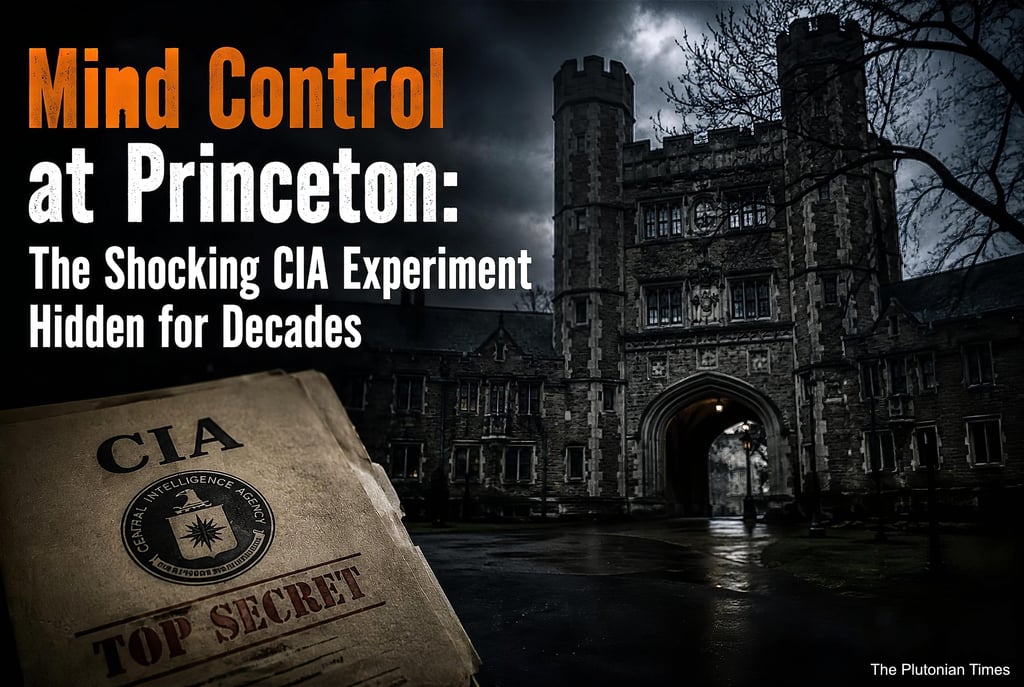
In the early years of Project MKUltra, the CIA’s expansive and secretive program exploring behavioral modification and mind-altering substances, Subproject 1 marked one of the first documented efforts. Launched at Princeton University between 1953 and 1954, this subproject focused on isolating and characterizing alkaloids from the seeds of the morning glory plant, scientifically known as Ipomoea corymbosa (also referred to as Rivea corymbosa or Turbina corymbosa).
The primary objective involved literature searches, chemical purification, and analysis to evaluate these compounds’ effects on the central nervous system (CNS). Researchers sought to understand their potential as agents capable of influencing human consciousness, perception, and behavior; interests that aligned with broader MKUltra goals amid Cold War fears of Soviet and Chinese “brainwashing” techniques.
The Plant and Its Alkaloids
Ipomoea corymbosa, native to Latin America and traditionally used in indigenous rituals as “ololiuqui,” contains ergoline alkaloids, most notably ergine (lysergic acid amide, or LSA). This compound is structurally similar to lysergic acid diethylamide (LSD), which Swiss chemist Albert Hofmann synthesized in 1938 and later isolated from related sources. Hofmann himself identified key alkaloids in ololiuqui seeds in 1960, confirming ergine, isoergine, and trace amounts of other lysergic acid derivatives as the psychoactive components.
These alkaloids produce hallucinogenic and CNS-altering effects, though generally milder and shorter-lasting than LSD. Ingestion of morning glory seeds has been linked to visual distortions, altered thought patterns, and physiological responses such as nausea or vasoconstriction. The CIA’s interest stemmed from their potential as natural, accessible tools for interrogation, disorientation, or behavioral influence.
Funding and Execution Details
The subproject received modest funding of approximately $1,300, disbursed via a sterile cashier’s check under a notional cover mechanism to maintain secrecy. An unidentified researcher in Princeton’s chemistry department conducted the work, which included extraction and characterization of the seed alkaloids. One declassified summary notes a payment of around $765 for related alkaloid studies conducted between April and June 1953.
The research participant was witting, meaning aware of the project’s sensitive nature. CIA oversight included monitoring by Robert V. Lashbrook, deputy to Sidney Gottlieb, head of the Technical Services Staff. Gottlieb and colleagues approved the effort as part of MKUltra’s umbrella structure, authorized in 1953 by CIA Director Allen Dulles.
Historical Context Within MKUltra
Subproject 1 fit into MKUltra’s 149 documented subprojects (1953–1973), many involving universities and focusing on drugs with CNS activity. While much of MKUltra emphasized LSD testing often on unwitting subjects, this early effort explored natural plant sources. Related work continued in Subproject 22, which further examined morning glory effects.
Documents released in the 1970s via the Church Committee and Rockefeller Commission revealed MKUltra’s scope, including human experimentation and destruction of most records in 1973. Subproject 1 stands out for its academic setting and relatively contained chemical focus, contrasting with more notorious elements like safehouse operations or unwitting dosing.
Significance and Legacy
This Princeton initiative highlights the CIA’s systematic recruitment of scientific talent for mind-control research during the 1950s. It predates widespread public awareness of LSD and underscores early interest in ethnobotanical psychedelics. Today, Ipomoea corymbosa seeds remain studied for their LSA content, with ongoing research into ergot alkaloids and their fungal origins in morning glories.
The subproject exemplifies the ethical complexities of classified government-funded science, where academic inquiry intersected with national security imperatives.
References
CIA MKUltra Briefing Book (declassified summaries).
Kook Science Wiki: Project MKULTRA/Subproject 1.
Wikipedia and scientific sources on Ipomoea corymbosa and ololiuqui.
Princeton University Archives on MKUltra connections.
Senate Select Committee on Intelligence reports (Church Committee, 1975–1977).