
Mind Control at Boston University: From Campus Labs to CIA Black Projects and Secret Parapsychology Experiments
DISCLOSURESPARAPSYCHOLOGY & CONSCIOUSNESS STUDIES
Debbie Edwards
6/7/20263 min read
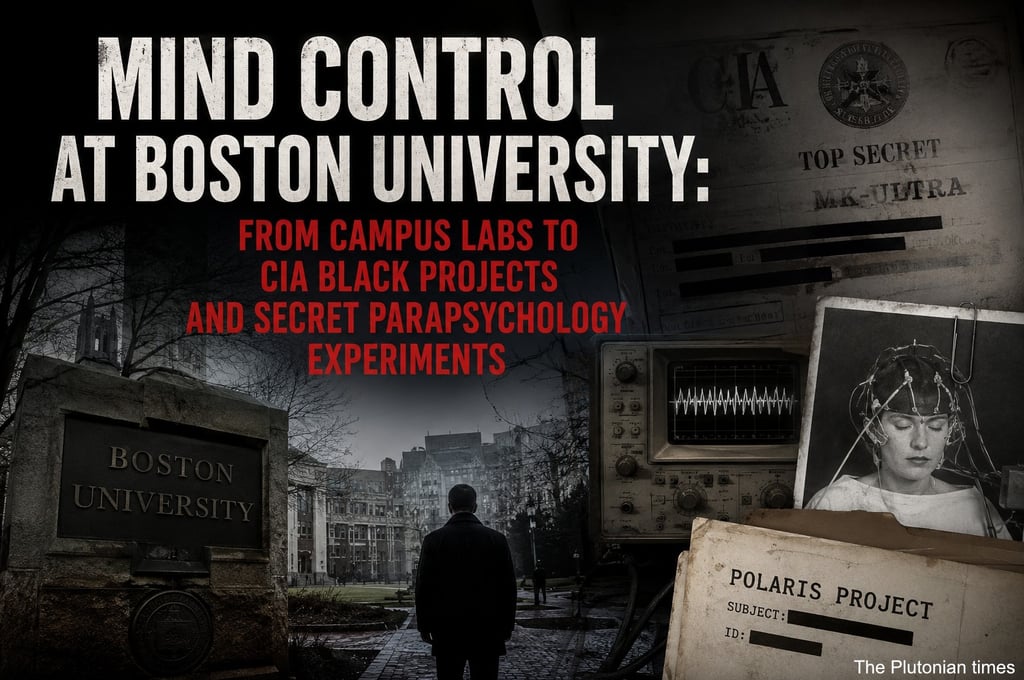
Boston University, as a major academic institution in a hub of psychological and medical research during the mid-20th century, operated in close proximity to programs exploring human behavior modification and anomalous cognition. While direct institutional involvement in classified CIA initiatives remains partially obscured by destroyed records, connections through affiliated hospitals, researchers, and funding channels reveal patterns of collaboration in areas overlapping with MKULTRA and related psychic phenomena studies.
LSD and Behavior Modification at Boston Psychopathic Hospital
One prominent link centers on Boston Psychopathic Hospital, later renamed the Massachusetts Mental Health Center. This facility maintained strong affiliations with Harvard Medical School and served as a key site for early LSD research funded by the CIA. Deputy director Dr. Robert Hyde played a central role. In 1949, Hyde became one of the first Americans to ingest LSD after the hospital obtained samples from Sandoz Laboratories in Switzerland.
By 1952, the CIA began directly funding LSD experiments at the hospital. Hyde and his team administered the substance to themselves, colleagues, student volunteers from local institutions including Emerson, Harvard, and MIT, and hospital patients. Hyde participated in four MKULTRA subprojects over the subsequent decade. These efforts examined reactions to LSD, compared its effects to alcohol, and explored variables influencing subject responses in controlled settings.
The experiments occurred amid broader MKULTRA activities, which spanned 1953 to 1973 under CIA oversight by figures like Sidney Gottlieb. Funding often flowed through front organizations such as the Human Ecology Fund, which supported behavioral research at multiple universities and hospitals. In the Boston area, this included work on predicting individual reactions and potential applications for interrogation or control.
Student participants from Boston-area colleges, including some potentially linked to broader university networks, received payments around $15 per session in some cases. Outcomes varied, with reports of severe adverse reactions, including at least one suicide in a clinic setting. These activities aligned with MKULTRA's goals of developing chemical and psychological tools for intelligence operations during the Cold War.
Hypnosis Research and CIA Funding Channels
Additional ties emerged through hypnosis studies at the Massachusetts Mental Health Center in the early 1960s. Researcher Martin T. Orne led the Studies in Hypnosis Project, which received approximately $30,000 from the CIA via the Human Ecology Fund. The project tested hypnotizability among Boston-area college students, including those from Brandeis and other local schools, with support also from the Air Force and National Institute of Mental Health.
Orne's team sought to evaluate hypnosis as a potential method for behavioral influence or information extraction. Results ultimately suggested it was ineffective for reliable mind control, but the funding underscored CIA interest in non-drug approaches to psychological manipulation. This work occurred within the same ecosystem of institutions serving the Boston academic community, where researchers frequently collaborated across Harvard, BU, and affiliated centers.
Skepticism and Parapsychology in BU's Psychology Circles
Boston University contributed voices to the broader debate on psychic phenomena, often from a critical perspective. Psychologist Ray Hyman, who studied at Boston University before advancing his career elsewhere, became a prominent skeptic of parapsychology. His background in magic and mentalism informed critiques of remote viewing and extrasensory perception claims pursued in CIA programs like Stargate.
While Stargate, active from the 1970s into the 1990s, focused primarily at Stanford Research Institute and later Science Applications International Corporation, it built on earlier interest in anomalous cognition. Boston-area researchers monitored and sometimes challenged these efforts, reflecting ongoing academic engagement with psi topics amid government exploration. No major declassified records indicate direct BU operation of remote viewing trials, but the university's psychology department operated in a regional environment saturated with such inquiries.
Broader Context and Legacy
MKULTRA encompassed 149 subprojects across more than 80 institutions, including universities and hospitals. Many records were destroyed in 1973 on orders from CIA Director Richard Helms, limiting full transparency. Congressional investigations in the 1970s, including the Church Committee, exposed aspects of these programs, highlighting ethical breaches such as unwitting human subjects and lack of informed consent.
Boston institutions like the Psychopathic Hospital and Mental Health Center provided practical testing grounds due to their access to diverse subject pools and psychiatric expertise. BU, embedded in this ecosystem, reflects the era's blurred lines between academic inquiry and national security imperatives. Later BU faculty, such as those examining perpetrator psychology or bioethics, have addressed related legacies of government-backed research.
These historical threads underscore patterns of institutional complicity in secretive programs. Full accountability remains elusive, as surviving documentation offers only fragments of the complete picture.
References
National Security Archive documents on CIA behavior control experiments (2024).
Senate Select Committee on Intelligence hearings on Project MKULTRA (1977).
Contemporary reports from The New York Times and Harvard Crimson on regional experiments.
Declassified CIA materials on subprojects and Human Ecology Fund.
Biographical and academic records on researchers including Hyde, Orne, and Hyman.
This article draws from publicly available declassified sources and historical analyses to highlight specific Boston connections without broader repetition of well-trodden MKULTRA narratives.