
Michigan Data Center Disaster: Millions in Tax Exempt Subsidies, Zero Long-Term Jobs, and Farmlands Destroyed
ENVIRONMENTTECHNOLOGY
Debbie Edwards
6/3/20263 min read
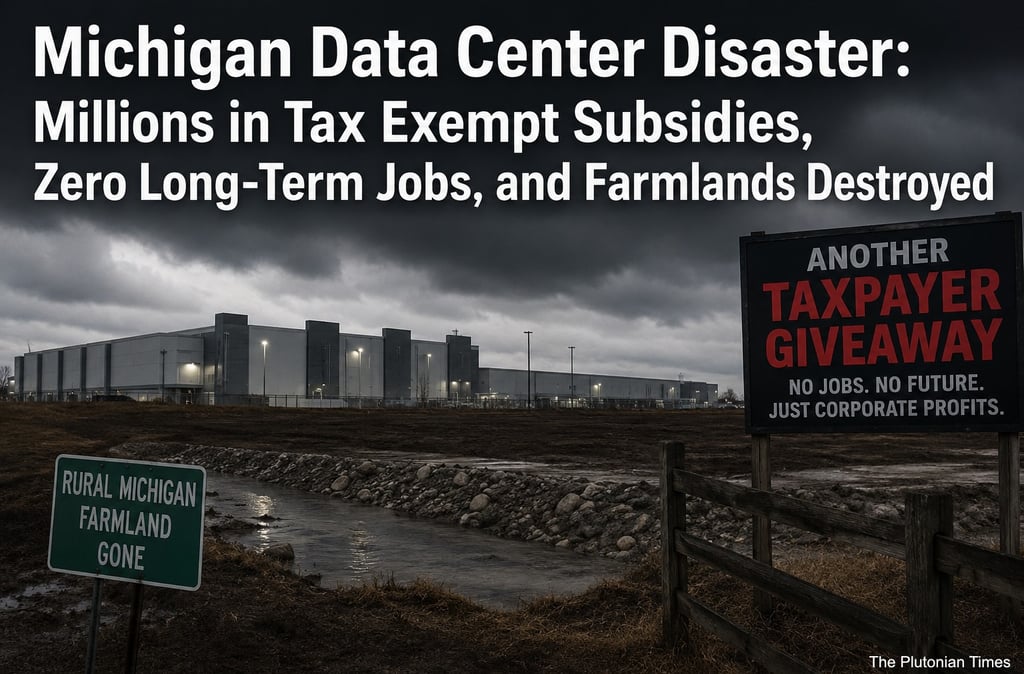
Michigan Governor Gretchen Whitmer has pushed forward large scale data center developments across the state. These projects promise short term construction activity but deliver limited lasting economic benefits for Michigan residents. One major example is the Stargate project in Saline Township in Washtenaw County.
In October 2025 Governor Gretchen Whitmer announced the multi billion dollar OpenAI Stargate project developed with Oracle and Related Digital. The facility on former farmland in Saline Township was called the largest single investment in state history. Officials projected 2,500 union construction jobs along with 450 permanent on site jobs and 1,500 indirect jobs. However critics point out that the vast majority of these positions are temporary construction roles that end once building finishes. Long term data center operations typically require only a small number of technicians often fewer than a dozen per shift leading to no sustained prosperity for local workers or the broader economy.
Loss of Farmland
Construction of the Saline Township data center known as The Barn began in 2026 on hundreds of acres of prime farmland. This conversion destroys productive agricultural land that supported local farming families for generations. Michigan continues to lose farmland to such industrial developments threatening food security and rural character in areas like Washtenaw County.
Tax Breaks and Lack of Financial Return
Governor Whitmer signed legislation in late 2024 granting significant sales and use tax exemptions for qualifying data centers. These incentives apply to projects investing at least 250 million dollars. The Stargate project stands to receive hundreds of millions in tax breaks. Such facilities receive substantial public subsidies yet provide minimal ongoing financial return to Michigan taxpayers. They consume vast local resources while contributing little to the tax base due to the exemptions.
Water Consumption Concerns
Even with claims of closed loop cooling systems data centers still consume significant water through evaporation and other losses. Scientific studies show that closed loop systems reduce but do not eliminate water use. Approximately 80 percent of withdrawn water in cooling processes can evaporate depending on design and climate. For a large scale facility like Stargate estimates suggest daily water consumption in the range of millions of gallons with some projections reaching up to 5 million gallons per day for hyperscale operations. This strains local water resources in a state already managing Great Lakes protection and inland supplies.
Environmental and Community Risks
Additional risks include noise pollution from constant cooling fans and equipment which disrupts rural tranquility. Residents near the site report heavy construction traffic and ongoing hum that affects quality of life. There are also concerns about electromagnetic field radiation from high power infrastructure and potential changes to community character as quiet farmland transforms into industrial zones. These factors can lower property values and alter the rural lifestyle that drew many families to the area.
Resident Pushback
Local pushback has been strong. In Saline Township residents packed meetings to voice opposition citing threats to water supplies energy costs and farmland. Kathryn Haushalter a local resident and Marine veteran spoke out about protecting her family home and the countryside for her children. Similar concerns appear in other Washtenaw County communities where residents highlight risks of higher utility rates and environmental strain. Protests and public hearings have occurred with many calling the projects a net loss for Michigan.
How Citizens Can Advocate
Citizens can advocate effectively to stop or limit these projects. Successful strategies include attending township board meetings to voice concerns attending public hearings on zoning and power contracts organizing petitions and rallies and contacting state representatives. In some Michigan communities residents have pushed for moratoriums on data center development or ballot initiatives to let voters decide. Forming local groups to demand transparency on water and energy use has yielded results in delaying or blocking projects elsewhere. Legal challenges and pressure on utilities like DTE Energy during Michigan Public Service Commission reviews have also slowed approvals. Unified resident action has proven viable in influencing outcomes.
References
Michigan Advance and Bridge Michigan coverage of Stargate project and Whitmer announcements October December 2025.
Tech Policy Press analysis of data center tax incentives and job realities December 2025.
EESI and scientific reports on data center water consumption and closed loop systems 2024 2025.
Local resident statements and Planet Detroit reporting on Saline Township opposition January June 2026.
Washtenaw County and township records on farmland impacts and public hearings 2025 2026. Bay City Bridge Partners and MLive reports on bridge lease agreements 2019 2025.
Michigan Economic Development Corporation details on data center exemptions late 2024.