
Memory That Survives Metamorphosis: What Science Reveals About Caterpillar Brains and Butterfly Behavior
SCIENCE
Debbie Edwards
4/21/20264 min read
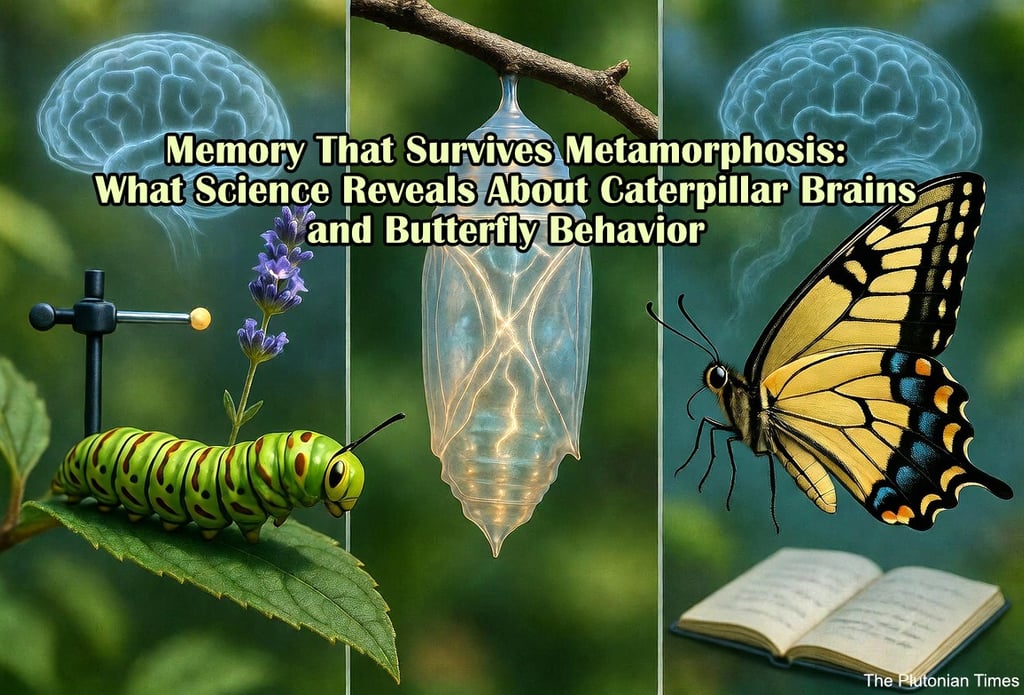
Metamorphosis in butterflies and moths ranks among the most dramatic transformations in the animal kingdom. A voracious, leaf-eating caterpillar seals itself inside a chrysalis. There, most of its tissues break down into a nutrient-rich soup. Specialized groups of cells called imaginal discs then reorganize the material to build the adult form, complete with wings, compound eyes, and reproductive organs. For many years, biologists assumed this radical reorganization would erase any learned experiences from the larval stage. After all, if the body essentially dissolves and rebuilds, how could memories persist?
Scientific inquiry into this question dates back over a century, but a key breakthrough came in 2008. Researchers at Georgetown University, led by Martha Weiss, designed a clear experiment using the tobacco hornworm moth (Manduca sexta). They trained late-stage caterpillars to associate a specific neutral odor (ethyl acetate) with a mild aversive stimulus, in this case a gentle electric shock. The caterpillars quickly learned to avoid the scented area.
After the insects completed pupation and emerged as adult moths, the team tested them again with the same odor. The results were striking. Adult moths that had been trained as caterpillars still avoided the odor, showing that the associative memory had survived the complete overhaul of metamorphosis. Control groups that received no training or unpaired stimuli showed no such avoidance. The study ruled out simple chemical traces left behind, confirming that the memory was a true learned association preserved through neural or molecular mechanisms.
This 2008 paper, published in PLOS ONE, provided the first conclusive evidence that associative memory can endure in Lepidoptera (the order that includes moths and butterflies). It challenged the long-held view that the caterpillar essentially becomes a blank slate inside the chrysalis. The findings raised important questions about which parts of the nervous system survive or get rebuilt in ways that maintain specific behavioral preferences. Some evidence points to preserved synaptic connections in key brain regions, such as the mushroom bodies, or to molecular processes like epigenetic modifications that could encode learned information across life stages.
Subsequent research has explored related aspects of insect learning and memory. While some studies on fruit flies suggest extensive rewiring of certain neural circuits during metamorphosis (potentially limiting memory transfer in that species), work on larger lepidopterans like moths and butterflies consistently supports the retention of certain learned behaviors. These memories appear particularly robust when training occurs in later larval stages, close to pupation. The ecological implications are significant. Retained larval memories could influence adult choices in host plants, oviposition sites, or avoidance of predators and noxious stimuli, potentially affecting survival and evolution in these insects.
Building on this foundation, a young researcher brought the question to a new species and a more accessible setup. Jo Nagai, a student from Kobe, Japan, became fascinated with swallowtail butterflies (Papilio xuthus) that he raised at home. Inspired by the Georgetown study, he corresponded with Martha Weiss over several years, seeking guidance on experimental design.
Jo trained Papilio xuthus caterpillars using lavender essential oil as the odor cue, paired with a very mild electric stimulus from a muscle-therapy device. He carefully calibrated the intensity after testing it on himself to ensure it created an association without causing harm. The caterpillars learned to avoid the lavender-scented area. Control groups showed no aversion.
After the caterpillars pupated and emerged as adult butterflies, Jo tested their responses. Approximately 80 percent of the trained butterflies actively avoided the lavender odor they had first encountered as caterpillars. This result extended the 2008 findings from moths to a true butterfly species, strengthening the evidence that memory retention across metamorphosis occurs in multiple lineages within Lepidoptera.
Jo also explored whether the learned aversion might pass to the next generation. Preliminary observations suggested that offspring of the trained butterflies showed some avoidance behavior even without direct conditioning, hinting at possible transgenerational effects. Such findings open intriguing avenues for research into epigenetic inheritance of behavioral traits.
Jo presented his work at the 2024 International Congress of Entomology in Kyoto. There, he shared his methods, results, and observations with professional scientists. His careful, ethical approach (using a natural odorant and minimizing discomfort) and clear communication earned recognition and sparked wider interest in the topic.
Together, the 2008 study and Jo Nagai’s replication demonstrate that certain memories can endure one of nature’s most extreme biological transformations. While the precise mechanisms (whether preserved neurons, rebuilt circuits, or molecular tags) continue to be investigated, the evidence shows that the “self” of a caterpillar is not entirely erased when it becomes a butterfly. Some essential learned information carries forward.
This line of research offers broader insights into developmental biology and neuroscience. It reminds us that profound change does not always mean complete loss. In insects, as perhaps in other organisms, continuity can persist amid transformation. Future studies using modern tools like genetic labeling or neuroimaging may reveal exactly how these memories are stored and retrieved across life stages.
For now, the story of memory in butterflies stands as a beautiful example of how careful observation and well-designed experiments continue to uncover surprises in the natural world.
References
Blackiston, D. J., Silva Casey, E., & Weiss, M. R. (2008). Retention of memory through metamorphosis: Can a moth remember what it learned as a caterpillar? PLOS ONE, 3(3), e1736.
Georgetown University Department of Biology news on the collaboration between Martha Weiss and Jo Nagai, including details from the Radiolab / Signal Hill podcast episode.
International Congress of Entomology 2024 (ICE Kyoto) presentation records for contributions on learning and memory in Lepidoptera.
Additional summaries and discussions of memory retention in Lepidoptera appear in scientific reviews and conference materials from 2008 through 2025.