
Junkyards Across America In Flames as New Surveillance Vehicles Roll Out
TECHNOLOGYUNSOLVED MYSTERIES & CRIME
Debbie Edwards
5/31/20264 min read
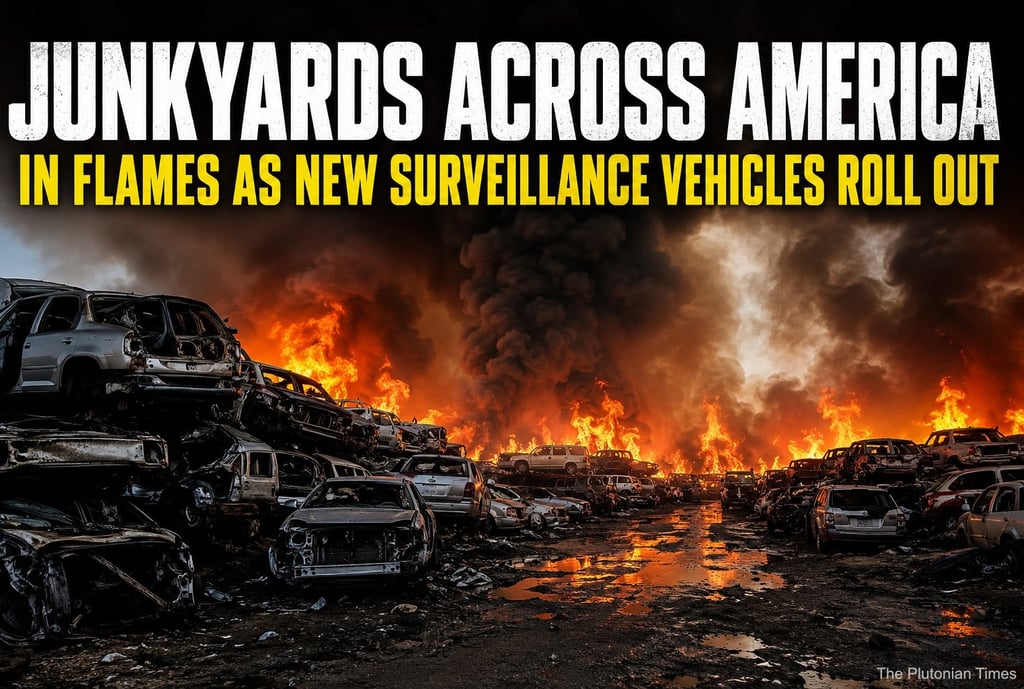
In recent months, a series of destructive fires at auto junkyards and scrap facilities across the United States has raised public concern. Observers have connected these incidents to growing controversy over federal requirements for artificial intelligence and biometric monitoring systems in new passenger vehicles. Although authorities have not established any link, the timing has generated significant online speculation.
The Push for AI Biometric Technology in Vehicles
The controversy stems from the Infrastructure Investment and Jobs Act of 2021. Section 24220 of the law directs the National Highway Traffic Safety Administration to establish a federal safety standard for advanced impaired driving prevention technology. This requirement is expected to apply to all new passenger vehicles beginning around model year 2027.
These systems use cameras, infrared sensors, and artificial intelligence to monitor driver biometrics such as eye movement, head position, facial expressions, and behavioral indicators. The goal is to detect impairment from alcohol, drugs, drowsiness, or distraction and potentially restrict vehicle operation. Supporters highlight potential reductions in traffic fatalities. Critics contend that the technology enables mass biometric surveillance and erodes personal privacy.
Debate escalated in early 2026 as manufacturers moved closer to compliance. Public discussions reached a peak in April and May 2026 amid fears of constant vehicle monitoring.
The Recent Junkyard Fires
Since 2025, multiple auto salvage and scrap facilities have been destroyed by fires. Key incidents include the following:
In August 2025, Chet’s Auto Wrecking and Scrap Metal on Page Boulevard in Springfield, Massachusetts, experienced a large fire that burned for 16 hours. Firefighters battled flames consuming a 60-foot pile of car parts and scrap metal, likely caused by a nickel-cadmium battery mixed into the debris.
On April 28, 2025, Ashley Salvage in Gratiot County, Michigan, saw nearly two acres of the salvage yard catch fire, starting from a vehicle fire that spread rapidly.
On September 27, 2025, a large junkyard fire broke out at a south suburban facility along Joe Orr Road near Western Avenue in Chicago Heights, Illinois, burning numerous vehicles and tires and producing thick black smoke visible for miles.
On October 17, 2025, a salvage yard fire in New Orleans, Louisiana, sent smoke visible across the city in a one-alarm incident.
On October 28, 2025, a two-alarm fire erupted at a junkyard on Alum Creek Drive in southeast Columbus, Ohio, at a site that had also experienced a major fire in 2024.
On November 11, 2025, a fire at a salvage yard in Clinton Township involved an explosion from a car battery during compression, affecting around 20 vehicles.
On December 18, 2025, a junkyard fire in Phoenix, Arizona, near Broadway Road and 19th Avenue left around 30 cars burning.
On February 25, 2026, J&K Salvage Yard in Spring Garden Township near York, Pennsylvania, caught fire. The blaze required hazardous materials response due to oil totes and other substances on site.
On March 18, 2026, a salvage yard fire in Ogden, Utah, drew multiple fire crews as smoke rose visibly over the area.
On March 23, 2026, several vehicles caught fire at a used auto parts business on West Beaver Street in Jacksonville, Florida.
On April 30, 2026, an auto wrecking yard in Graham, Washington, caught fire and sparked explosions, occurring around the same time as another nearby salvage yard fire in Thurston County.
On May 1, 2026, a salvage yard in Yelm, Washington, in Thurston County was destroyed in a blaze that also affected a nearby auto yard.
On May 3, 2026, an automobile salvage yard in Pacoima, Los Angeles, California, burned with concerns over lithium-ion batteries, damaging multiple vehicles and requiring a heavy firefighter response.
On May 4, 2026, a fire broke out at Fosnaught Auto Parts scrap yard in Jackson Township, with reports of an explosion and heavy damage to the facility.
On May 4-5, 2026, Mid-City Scrap in Westport, Massachusetts, suffered a significant fire involving a large pile of debris.
On May 24, 2026, a massive two-alarm industrial fire engulfed an auto service yard along Industrial Avenue in South Gate, California, involving salvaged automotive parts.
On May 25-26, 2026, a major fire broke out around 5 p.m. at a junkyard near Northwest 131st Street and Cairo Lane in Opa-locka, Florida. The six-alarm blaze impacted two junkyards, a trucking company, and several small businesses. Miami-Dade Fire Rescue deployed over 80 units, evacuated about 125 residents, and battled the fire for days. It was described as one of the largest in the area’s history.
On May 29-30, 2026, EMR Recycling on Atlantic Avenue and South Front Street in Camden, New Jersey, experienced another fire. The facility had previously burned in February 2025.
These events, along with others reported in spring 2026, have been cited in online discussions as totaling around a dozen junkyard or scrapyard fires in a concentrated period.
Junkyard fires occur regularly due to flammable materials, tires, batteries, and other hazards. Even so, the clustering of incidents in 2025 and 2026 has prompted questions about possible patterns.
Speculation and Public Reaction
Many social media users on platforms such as TikTok and Threads have suggested the fires were intentional to destroy older vehicles and parts. This would theoretically reduce the availability of non-monitored cars and encourage purchases of new models equipped with the 2027 AI biometric systems. Phrases such as "They are burning old cars to force surveillance" circulated widely.
Law enforcement has investigated the fires individually as possible accidents or arsons. No evidence of a coordinated national effort has been publicly confirmed. Privacy advocates and lawmakers like Representative Thomas Massie of Kentucky continue to oppose the mandate. Massie has supported the No Kill Switches in Cars Act to limit or repeal the requirement.
What This Means for Vehicle Owners
Should the 2027 mandate proceed, new vehicles will include passive biometric monitoring. Older models without these systems may temporarily gain value as sources of parts. However, insurance rates, parts scarcity, and regulatory pressures could accelerate the shift toward newer vehicles.
Investigations into the fires and final National Highway Traffic Safety Administration rules will help clarify whether these events are coincidental or related to broader vehicle policy changes.
References
Infrastructure Investment and Jobs Act, Section 24220 (2021).
Miami-Dade Fire Rescue reports on the Opa-locka junkyard fire, May 25-26, 2026.
York County emergency management updates on J&K Salvage Yard fire, February 25, 2026.
Local news coverage of EMR Recycling fires in Camden, New Jersey (2025 and 2026).
Springfield Fire Department reports on Chet’s Auto Wrecking fire, August 2025.
National Highway Traffic Safety Administration documents on impaired driving prevention technology.