
Israeli Psychic Uri Geller and the CIA: Declassified Documents Reveal 1973 Psychic Experiments at Stanford Research Institute
DISCLOSURESPARAPSYCHOLOGY & CONSCIOUSNESS STUDIES
Debbie Edwards
3/31/20263 min read
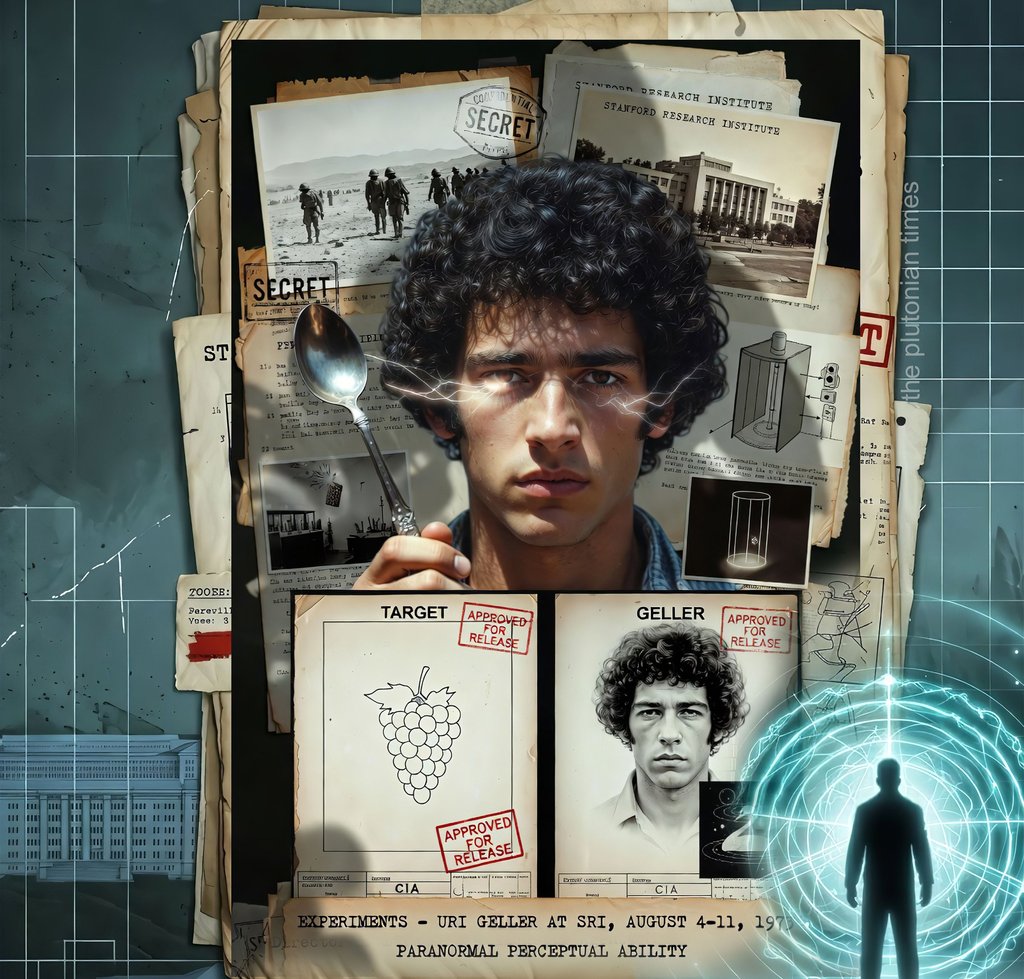
In the summer of 1973, the United States government quietly conducted a series of extraordinary tests on an Israeli-born entertainer named Uri Geller. Over eight days, from August 4 to August 11, researchers at the Stanford Research Institute in California placed Geller inside an opaque, acoustically and electrically shielded room. They then attempted to verify whether he possessed genuine paranormal perceptual abilities under tightly controlled conditions designed to eliminate any possibility of sensory leakage or ordinary trickery.
The primary declassified document detailing these sessions is the Central Intelligence Agency report titled “Experiments - Uri Geller at SRI, August 4-11, 1973.” Physicists Harold Puthoff and Russell Targ led the work, which formed part of the broader US intelligence community’s early exploration of parapsychology. This effort eventually evolved into the well-known STARGATE Project, aimed at investigating whether extrasensory perception could be harnessed for espionage purposes during the Cold War.
Each day followed a similar protocol. A researcher in a separate location would randomly select a target, often by picking a word from a dictionary and then drawing a simple picture to represent it. The drawing remained hidden from Geller, who stayed sealed inside the shielded chamber. Via intercom, the team would notify him when the target was ready. Geller would then describe what he perceived and produce his own drawing on paper. The report includes numerous side-by-side comparisons of the original targets and Geller’s reproductions.
In one memorable trial, the target word chosen was “fuse,” and the corresponding image depicted a firecracker. Geller described seeing a cylinder with noise coming out of it, and he drew a drum-like shape that closely resembled the form of the hidden picture. On other days, he produced strikingly accurate sketches for targets such as a bunch of grapes, a swan, and even more intricate diagrams like a representation of the solar system. The researchers documented both strong matches and occasional less precise results. They emphasized, however, that many correspondences were precise enough to rule out chance, especially given the rigorous safeguards in place.
After reviewing the full set of trials, the report reached a notable conclusion: “As a result of Geller’s success in this experimental period, we consider that he has demonstrated his paranormal perceptual ability in a convincing and unambiguous manner.” This positive assessment came despite the high stakes of the research, which sought potential intelligence applications against adversaries such as the Soviet Union.
Geller, at the time a former Israeli paratrooper who had served in the Israel Defense Forces Paratroopers Brigade and was wounded during the 1967 Six Day War, arrived in the United States through the efforts of Dr. Andrija Puharich. Puharich, a physician and parapsychology researcher with documented ties to US intelligence circles, had discovered Geller in Israel and facilitated his introduction to the Stanford Research Institute team.
The declassified SRI report itself contains no references to direct collaboration, joint programs, or official sponsorship between the US government and the Israeli government in the field of parapsychology. Geller is treated strictly as an individual test subject, brought from Israel for evaluation, without any mention of state-level coordination from Israeli authorities.
That said, Geller’s personal background provides an indirect link. He has long maintained in interviews, books, and documentaries that his public career as a psychic entertainer, famous for spoon-bending demonstrations, served partly as a cover for intelligence-related activities. He has claimed involvement with both the Israeli Mossad and the CIA, including during sensitive operations such as the 1976 Entebbe hostage rescue. These assertions, however, do not appear in the 1973 SRI document or other publicly released STARGATE files, which focus solely on the laboratory results.
Broader STARGATE collection materials mention Geller in passing, noting his demonstrations at places like Bell Laboratories after his arrival from Israel. Yet they stop short of describing any formalized bilateral US-Israeli parapsychology initiative. The Israeli connection remains biographical rather than institutional in the available records, with Geller himself acting as the primary bridge between the two nations’ potential interests in unconventional intelligence methods.
The 1973 experiments, while intriguing in their reported outcomes, represented just one chapter in a larger US government effort. The STARGATE Project continued in various forms into the 1990s before being discontinued after internal reviews questioned its operational value. Declassified files from the program, released in batches over the years, have fueled ongoing public fascination with the intersection of science, intelligence, and the paranormal.
Uri Geller’s case stands out as a rare instance where a foreign national with claimed extrasensory abilities underwent documented testing by American researchers under intelligence oversight. Whether viewed as groundbreaking research or an artifact of Cold War-era curiosity, the declassified accounts offer a detailed window into one of the more unusual episodes in US government history. The absence of explicit joint US-Israeli government ties in the files leaves open questions about the full extent of any cross-border interest in parapsychology during that period.
Today, these documents remain publicly accessible through the CIA’s reading room, inviting continued scrutiny and debate about the boundaries of human perception and the lengths to which nations will go in pursuit of strategic advantage.