
Inside the Ganzfeld Experiments: Can Sensory Deprivation Unlock Real Telepathy?
SCIENCEDISCLOSURESPARAPSYCHOLOGY & CONSCIOUSNESS STUDIES
Debbie Edwards
6/7/20264 min read
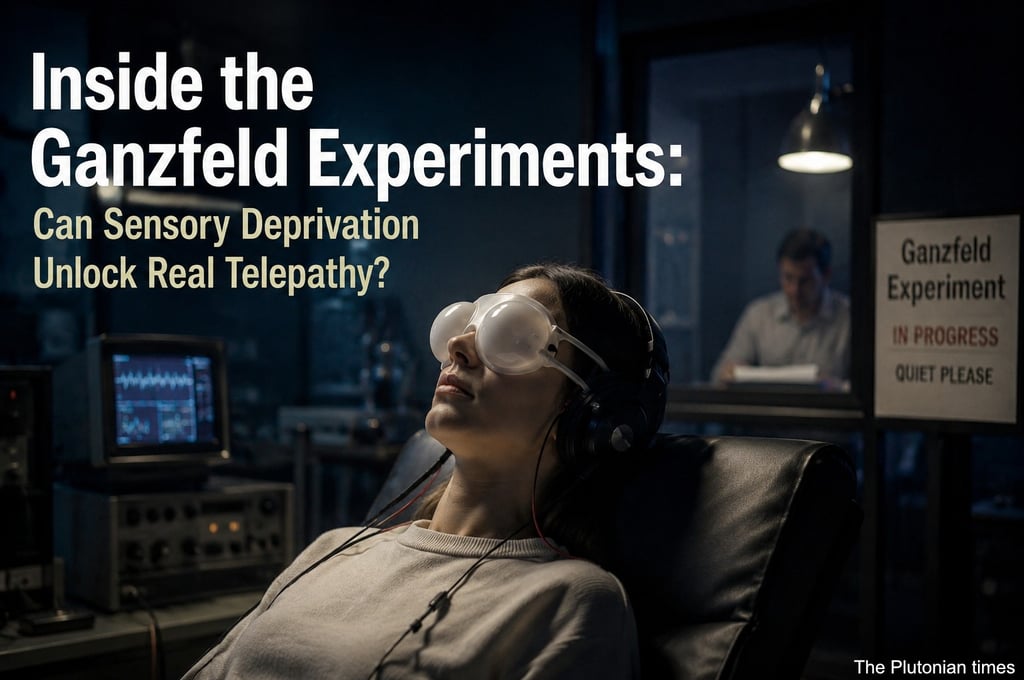
Ganzfeld studies are a popular type of research in parapsychology. They test whether people can send or receive information using just their minds, a phenomenon often called extrasensory perception or ESP, especially telepathy. The word "Ganzfeld" is German for "entire field" or "full field." Researchers use a mild form of sensory deprivation with a uniform visual field and steady background noise. The goal is to quiet normal senses so any subtle mind-to-mind effects might stand out more clearly.
How It Started
The idea traces back to the 1930s. German psychologist Wolfgang Metzger (1899–1979) found that staring at a completely even visual field could create strange perceptions or mild hallucinations.
In the early 1970s, American researcher Charles Honorton at Maimonides Medical Center in New York City expanded on this. He had studied dream telepathy and wanted reliable ways to test ESP. In 1974, Honorton and Sharon Harper published the first full Ganzfeld experiment in the Journal of the American Society for Psychical Research. This became a standard method for many later studies.
The Typical Setup
In a standard Ganzfeld test, the "receiver" sits comfortably. Half ping-pong balls cover their eyes with a red light shining through to create a soft, uniform glow. Headphones play white or pink noise like steady static. This lasts about 30 minutes and reduces everyday sensory input.
A "sender" in another room views a randomly chosen picture or video clip and tries to mentally send it. The receiver describes any images, feelings, or impressions that arise. Later, the receiver sees four options (the real target plus three similar ones) and picks the best match. Pure guessing would succeed about 25 percent of the time.
The Phantasia Spectrum and Its Role
People vary widely in their ability to create mental images. This is known as the phantasia spectrum. At one end is aphantasia, where people cannot voluntarily picture things in their mind's eye. At the other end is hyperphantasia, where mental imagery is extremely vivid, almost like seeing real scenes with rich details across multiple senses. Most people fall somewhere in the middle.
Hyperphantasiacs, with their exceptionally clear and lifelike inner vision, appear predisposed to stronger results in psychical and telepathic tasks. Their enhanced ability to generate and hold detailed mental impressions may help them better receive, interpret, and describe subtle information during sensory-reduced states like the Ganzfeld. This vivid imagery could make faint mental signals feel more real and easier to report accurately. While direct large-scale studies linking the two are still emerging, the connection fits with broader findings that creative individuals or those with prior ESP-like experiences often perform better in these tests.
Brain Activity Changes During Ganzfeld
Modern brain imaging reveals interesting shifts during Ganzfeld sessions. Studies using fMRI show a progressive decoupling between the thalamus (a key sensory relay station) and the cortex, particularly visual and auditory areas. This reduces normal sensory processing and allows internal signals or noise to become more prominent.
The brain starts amplifying its own activity to fill the sensory void, which can lead to hallucinations or clearer access to subtle impressions. EEG patterns often shift toward alpha waves associated with relaxed, inward-focused states. For hyperphantasiacs, stronger connectivity between prefrontal areas (involved in focus and planning) and visual processing regions may enhance this process, making mental imagery during the session more intense and potentially more receptive to external mental influences.
Main Findings and Modern Examples
From 1974 to 1982, researchers ran dozens of Ganzfeld experiments. Honorton reported hit rates above chance. Skeptic Ray Hyman noted possible issues with methods. In 1986, they agreed on stricter standards.
Honorton later ran improved computer-controlled "autoganzfeld" studies at the Psychophysical Research Laboratories in Princeton, New Jersey. A 1994 analysis by Daryl Bem and Honorton of 11 strong studies showed a 32 percent hit rate, well above chance, with videos working better than static images.
Later reviews continued to find small but consistent effects. A 2010 meta-analysis by Lance Storm, Patrizio Tressoldi, and Lorenzo Di Risio of studies from 1997–2008 reported a 32.2 percent hit rate. People with psi-friendly traits (creativity, prior experiences, belief) often scored higher. Analyses in 2021 and 2024 by Tressoldi and colleagues confirmed small but reliable effects above chance.
Modern examples include refined Ganzfeld and related "Ganzflicker" setups that reliably produce vivid hallucinations and altered states. A 2020 study on multimodal Ganzfeld documented clear thalamo-cortical decoupling and altered consciousness. Recent artwork installations and lab experiments (2024–2025) using Ganzfeld techniques have shown consistent induction of complex hallucinations and immersive experiences, supporting its use for exploring consciousness and potential anomalous perception.
Where the Research Happened
Early work was at Maimonides Medical Center in New York. Key autoganzfeld studies occurred in Princeton, New Jersey. In the UK, Carl Sargent worked at Cambridge University in the late 1970s, and the Koestler Parapsychology Unit at the University of Edinburgh continued research in the 1990s. William Braud and others explored similar relaxed states in the 1970s.
References
Bem, D. J., & Honorton, C. (1994). Does psi exist? Replicable evidence for an anomalous process of information transfer. Psychological Bulletin.
Honorton, C., & Harper, S. (1974). Journal of the American Society for Psychical Research.
Hyman, R., & Honorton, C. (1986). A joint communiqué: The psi Ganzfeld controversy. Journal of Parapsychology.
Schmidt, T. T., et al. (2020). The multimodal Ganzfeld-induced altered state of consciousness. Scientific Reports.
Storm, L., Tressoldi, P. E., & Di Risio, L. (2010). Meta-analysis of free-response studies. Psychological Bulletin (related analyses).
Tressoldi, P. E., et al. (2021/2024). Anomalous perception in a Ganzfeld condition: A meta-analysis.