Inside Project Cardinal: Yorkville's Massive 17-Million-Square-Foot Data Center Campus and the Lake Michigan Water Connection
TECHNOLOGYENVIRONMENT
Debbie Edwards
4/21/20264 min read
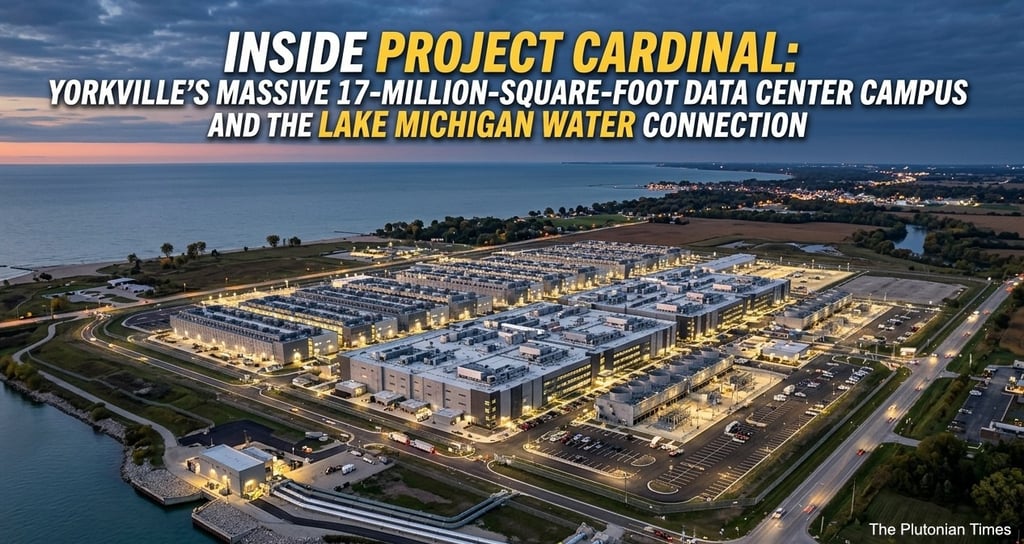
Project Cardinal represents one of the largest proposed data center campuses in the Midwest, located in Yorkville, Illinois, within Kendall County in the Chicago metropolitan suburbs. Developed by Pioneer Development, LLC, the project involves the transformation of approximately 1,037 acres of land across 20 parcels into a massive hyperscale data center facility. The site sits northwest of Route 47 and Galena Road, south of Baseline Road, and east of Ashe Road. Plans call for 14 two-story data center buildings with a combined footprint exceeding 17 million square feet. Eleven of the buildings measure roughly 1.9 million square feet each, while the remaining three add approximately 940,000 square feet.
The campus includes significant supporting infrastructure. Developers plan two on-site electrical substations along with a utility switchyard connected to ComEd for grid power. Additional features encompass stormwater detention basins, extensive landscaping and buffers, security fencing, and utility corridors. The total power capacity reaches about 1.8 gigawatts, equivalent to the electricity needs of roughly 1.4 million homes according to some community estimates. Each of the larger buildings targets around 144 megawatts, with the smaller ones at approximately 73 megawatts.
Water usage projections sparked considerable discussion during the approval process. At full build-out, the project anticipates domestic water consumption of around 350,000 gallons per day in earlier estimates, though later clarifications from city officials and the developer emphasized that cooling relies on closed-loop air chillers rather than evaporative systems drawing heavily from municipal supplies. Municipal water serves only domestic needs such as employee restrooms and sinks, with some reports citing an average of 42,000 gallons per day for those purposes once fully operational. The facility contributes a water connection fee and supports the city’s broader Lake Michigan water infrastructure efforts. Construction-phase water demands remain undetermined at the planning level.
Developer, Timeline, and Approval Process
Pioneer Development, LLC, (Sheridan, Wyoming; representative Matt McCarron, linked to Cirrus Farms) serves as the petitioner and contract purchaser. The company collaborates with multiple property owners, including entities such as Galena & 47th, LLC, MPLIV10, LLC, and members of the Konicek family. Applications for the project were filed around mid-2025, triggering a series of public hearings, plan revisions, and technical studies throughout 2025 and early 2026. These studies addressed traffic impacts, sound levels, wetlands, stormwater management, air quality, and wildlife considerations, including reports on eagles and other species.
The approval timeline unfolded as follows. Preliminary approvals for annexation, rezoning from residential and business districts to M-2 General Manufacturing District, and Planned Unit Development status occurred in stages. After extended public meetings, including one lasting nearly six hours, the Yorkville City Council granted final approvals for the annexation agreement, development agreement, utility agreement, rezoning, and Planned Unit Development in March 2026. This decision followed presentations on noise mitigation, photometric lighting plans, and other environmental factors. A related resident lawsuit concerning project impacts reportedly moved toward settlement around the time of approval.
Construction proceeds in phases, with one or two buildings added per phase. Each building reaches operational status within approximately 24 months of groundbreaking. The first data center building is expected to come online by 2029, while full build-out of all 14 structures could extend over 10 to 20 years. No specific end-user tenant, such as a major hyperscaler or artificial intelligence company, has been publicly disclosed, which remains common for early-stage speculative or build-to-suit hyperscale projects.
Economic Benefits and Community Contributions
Supporters of Project Cardinal emphasize its potential economic advantages. The development agreement includes approximately 51 million dollars in upfront impact fees paid over four years. A substantial portion, around 38 million dollars, directs to Yorkville School District 115 for facility expansions and related needs. Remaining funds support the fire district, city infrastructure projects, and local charitable organizations. Individual operational buildings could generate between 500,000 dollars and 1 million dollars annually in property taxes once online.
Construction activity promises thousands of temporary jobs over the decade-plus build period, while ongoing operations offer more stable roles in facility management and maintenance. Building trades unions voiced support during hearings, highlighting the opportunity to position Yorkville and Illinois as a data center hub amid surging demand for cloud computing and artificial intelligence infrastructure. The project’s location benefits from flat terrain, proximity to Chicago, and access to ComEd electrical infrastructure.
Concerns Raised by Residents and Opposition
The scale of Project Cardinal generated significant community debate and opposition. Residents expressed worries about noise from constant cooling systems and backup generators, with some demonstrations at public meetings using audio equipment to simulate expected sound levels. Sound studies and peer reviews informed mitigation measures, including buffers and restrictions on generator testing to non-holiday weekdays. Critics argued that modeling may not fully capture long-term construction noise or cumulative effects over the multi-year build-out.
Other concerns included potential strain on local power and water resources, increased traffic from construction vehicles and workers (with peak daily estimates of 1,000 to 1,500 personnel), light pollution, air quality impacts, and the visual transformation of semi-rural farmland into an industrial campus. A Change.org petition opposing both Project Cardinal and the nearby Project Steel gathered more than 4,500 signatures. Some residents filed or supported legal actions citing quality-of-life and health issues.
City officials and the developer responded by updating plans for greater setbacks, enhanced landscaping, and other adjustments. Project Cardinal does not draw cooling water directly from Yorkville’s municipal allocation in the same manner as some fears suggested, relying instead on closed-loop technology for primary operations. Despite these measures, opposition persisted, with residents questioning whether the area could absorb multiple large-scale data centers without overwhelming existing infrastructure and character.
Broader Context in the Data Center Boom
Project Cardinal fits within a larger wave of data center development in the Midwest, fueled by explosive growth in artificial intelligence workloads, cloud services, and digital infrastructure. Illinois has seen heightened interest in suburban and exurban locations with available land and grid capacity. Yorkville has approved or advanced several projects, including Project Steel to the south of Cardinal and the earlier CyrusOne campus. Together, these efforts reflect national trends where data centers could consume a significantly larger share of U.S. electricity in coming years.
As of spring 2026, with approvals secured, Project Cardinal advances toward land closing and the start of construction. Nearby proposals continue to face scrutiny, with at least one other developer withdrawing an application citing limited community appetite for additional projects. The long-term success of such campuses will depend on balancing technological and economic gains against local impacts on residents, schools, utilities, and the environment.
This article draws from public records, city documents, news reports, and meeting summaries available through 2026. For the most current construction status or updated technical studies, consult the City of Yorkville’s official project page or recent local government announcements.
Resources to explore:
https://www.datacentermap.com/c/pioneer-development/
https://www.cirrusfarms.com/
https://www.change.org/p/block-project-steel-and-project-cardinal-in-kendall-county-yorkville-il
https://baxtel.com/data-center/project-cardinal
https://www.yorkville.il.us/906/Project-Cardinal-Data-Center-Campus-Anne