
Inside Peru’s Brutal Illegal Gold War: How Criminal Cartels Are Turning the Amazon Into a Toxic Killing Field for Gold
ENVIRONMENT
Debbie Edwards
4/25/20263 min read
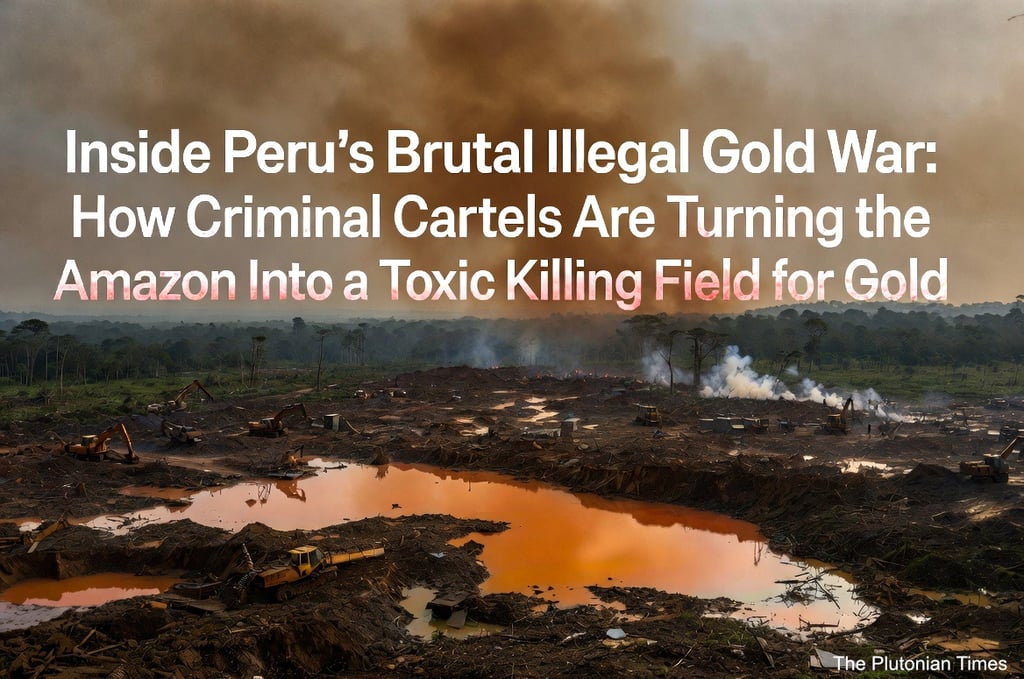
Illegal gold operations in Peru’s Amazon have devastated forests, released mercury into rivers, and sparked violence that kills dozens annually, including recent massacres of artisanal workers by criminal gangs. This shadow economy thrives in remote jungle regions such as Madre de Dios, Loreto, and expanding zones in Ucayali and along the Ecuador border. Surging global gold prices near record highs have drawn miners, cartels, and organized crime groups into the rainforest. What was once a localized activity has become a sophisticated criminal enterprise that reshapes entire ecosystems and communities.
Deforestation stands as one of the most visible scars. Illegal miners use bulldozers, excavators, and floating dredges to strip away vegetation and carve deep pits into floodplains and riverbanks. In Madre de Dios alone, operations have cleared over 139,000 hectares of primary Amazon forest in recent years, creating barren moonscapes dotted with stagnant mercury pools. The destruction spreads rapidly along new river corridors and into previously untouched areas like the central Amazon near Panguana Biological Station. There, heavy machinery arrived in late 2025, turning intact jungle into unrecognizable wastelands within weeks. Roads built for mining equipment open pathways for further encroachment, accelerating habitat loss for countless species and disrupting the rainforest’s role as a carbon sink. Environmental groups note that this expansion now affects all Peruvian Amazon regions, with floodplains and river systems bearing the brunt of irreversible damage.
Mercury pollution compounds the ecological crisis and directly threatens human health. Artisanal and small-scale miners rely on mercury amalgamation to separate gold from sediment, a cheap but toxic process that releases hundreds of tons of the heavy metal into waterways each year. Rivers in mining zones turn an eerie ochre or milky color as contaminated sediment plumes spread downstream. On the Nanay River in Loreto, which supplies drinking water to Iquitos and supports over 500,000 people, dredges and explosives have ravaged 362 hectares across 24 rivers and 29 Indigenous communities between 2021 and 2025. A 2025 study by the Center for Amazonian Scientific Innovation found that 79 percent of residents in seven Nanay-area communities had mercury levels in their hair exceeding the World Health Organization’s safe limit of 2.2 mg/kg. Fish, a dietary staple, accumulate the toxin, leading to neurological damage, developmental issues in children, and long-term health risks akin to historical mercury disasters. Mercury also infiltrates forest soils and wildlife, entering the broader food web far beyond the mines.
Violence has become inseparable from the gold trade. Criminal gangs and transnational organizations, including Brazilian Comando Vermelho and Colombian FARC dissidents, control mining camps, extort operators, and traffic humans for labor and sex work. They use military-grade weapons, drones for surveillance, and hidden supply routes to maintain dominance. In Madre de Dios, long a hotspot, turf wars in towns like La Pampa have left miners and environmental defenders dead in shootouts. At least 29 land and rights defenders were killed since 2020 in conflicts tied to illegal mining. Broader patterns show dozens of deaths annually across Peru’s gold fields from clashes, extortion, and targeted killings.
Recent massacres highlight the escalation. In May 2025, criminal gangs linked to illegal operations kidnapped and executed 13 security workers and contractors at a gold mine in Pataz, northern Peru. The victims, tied to major producer Poderosa Mining, were found bound and tortured in a mine tunnel after an eight-day captivity. Company records show this brought the total to 39 workers killed by gangs in the region since 2020. A suspect known as “Cuchillo,” leader of the Great Alliance 2 gang, was identified but evaded immediate capture. The government responded with a temporary mining suspension and curfew, yet similar attacks continued, including a New Year’s Eve 2025 assault that killed at least three informal miners in the same area. While Pataz lies in the Andean highlands, the tactics mirror those in the Amazon, where gangs shift between regions using the same logistics once reserved for cocaine. Corruption, weak enforcement, and political interference further embolden these groups, who bribe officials and push for laws that hinder investigations.
Government efforts have yielded mixed results. Operations like the 2019 Mercury crackdown temporarily slashed deforestation in Madre de Dios by up to 92 percent through equipment seizures and military presence. A 2023 multisector commission now targets illegal mining nationwide, destroying millions of dollars in machinery. Yet miners quickly return, relocating to new rivers or using sophisticated evasion tactics. Indigenous communities and scientists warn that without sustained enforcement, stronger anti-corruption measures, and viable economic alternatives, the cycle of destruction and violence will only intensify.
Peru’s illegal gold boom delivers short-term wealth to some but exacts an unbearable toll on the Amazon’s forests, waterways, and people. As criminal governance expands and gold prices remain high, the human and environmental costs continue to mount, turning one of the world’s most biodiverse regions into a frontline of ecological and social crisis.
References
Associated Press: Illegal gold mining surges into new parts of Peru’s Amazon (February 2026).
Mongabay: Mercury, dredges and crime on Peru’s Nanay River (December 2025).
InSight Crime: Peru massacre exposes mining gangs’ power (May 2025).
The Guardian and Reuters reports on Pataz violence and Amazon impacts (2025-2026).
Center for Amazonian Scientific Innovation (CINCIA) studies on mercury exposure (2025).
Environmental Investigation Agency and Amazon Watch analyses (2025).