
Injectable Nanoparticles for Brain-Computer Control: Inside Battelle’s BrainSTORMS Project
TECHNOLOGY
Debbie Edwards
4/3/20263 min read
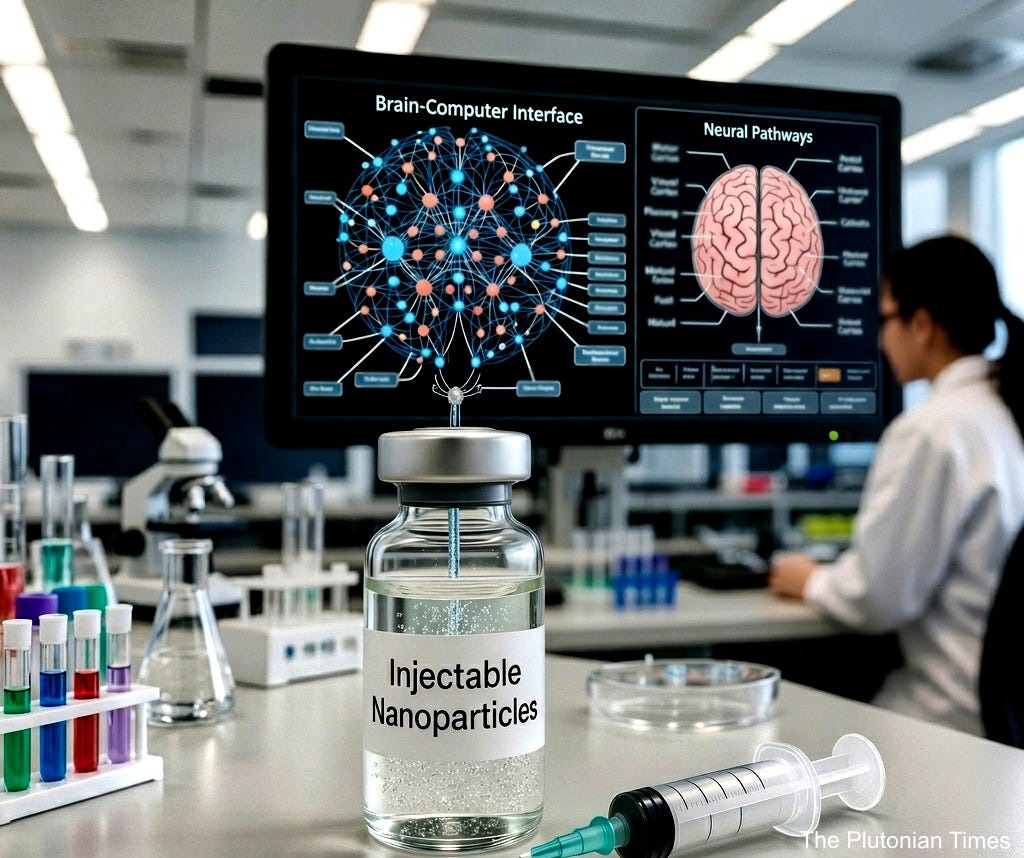
Battelle developed BrainSTORMS (Brain System to Transmit Or Receive Magnetoelectric Signals) as a minimally invasive brain-computer interface technology. The project received funding from the Defense Advanced Research Projects Agency under the Next-Generation Nonsurgical Neurotechnology program. The core innovation relies on magnetoelectric nanotransducers, known as MEnTs or magnetoelectric nanoparticles.
These nanoparticles measure less than 50 nanometers in diameter. Thousands of them could fit across the width of a human hair. Researchers design the particles with a magnetic core, often made from materials such as cobalt ferrite, surrounded by a piezoelectric shell, such as barium titanate. This structure exploits the magnetoelectric effect. An external magnetic field causes the core to change shape slightly through magnetostriction. That mechanical stress then generates a localized electric field in the shell. The reverse also occurs. Neural electrical signals can influence the particles magnetic properties in ways that an external system can detect.
The Injectable Application Process
The injectable nature of the technology forms its most distinctive feature. Here is how the process works step by step:
Injection into the bloodstream: Medical personnel introduce the magnetoelectric nanoparticles into the circulatory system through a simple intravenous injection. No surgery is required at this stage.
Magnetic guidance to the brain: Once in the blood, researchers or clinicians apply external magnetic field gradients. These fields steer the nanoparticles across the blood-brain barrier and direct them precisely to targeted regions of brain tissue. The particles localize in the desired neural areas.
Bidirectional communication with neurons: After the nanoparticles reach the target tissue, they interface directly with nearby neurons.
For reading neural activity: The electrical signals from active neurons affect the particles. An external helmet-based transceiver detects the resulting changes in the particles magnetic properties through the skull.
For writing to the brain: The helmet generates controlled magnetic fields. The nanoparticles convert these fields into localized electrical stimuli that can activate or modulate specific neurons, such as triggering action potentials.
Removal after use: When the session ends, operators use magnetic guidance again to direct the nanoparticles out of the brain tissue and back into the bloodstream. The body then processes and clears them naturally through normal excretion pathways. The design aims for temporary use with minimal long-term residue.
This approach avoids permanent implants, skull openings, or invasive hardware. It enables high-resolution, bidirectional communication while remaining removable and potentially repeatable.
Battelle led the overall integration and neurophysiology aspects of the project. Key collaborators included Cellular Nanomed Inc. for the external transceiver electronics, power systems, and control; the University of Miami, led by Sakhrat Khizroev, for nanoparticle synthesis, characterization, and underlying physics; plus contributions from Indiana University-Purdue University Indianapolis and Carnegie Mellon University in areas such as electromagnetics and nanoscale materials.
The Air Force Research Laboratory served as an explicit collaborator. AFRL personnel planned to conduct human demonstration studies if the project advanced to later phases. The overall program targeted performance improvements for able-bodied service members, such as thought-based control of unmanned systems or enhanced multitasking in military operations.
Program Timeline and Status
Battelle received initial funding of approximately 2 million dollars in 2019 for Phase I to demonstrate the core concept. The team advanced to Phase II in late 2020. During these phases, researchers achieved proof-of-concept results for precise neuron reading and writing in laboratory and animal models. Phase III would have involved regulatory planning with the FDA and potential human testing. Public updates largely end after early Phase II. DARPA lists the broader N3 program as complete, with content retained for reference only. Related nanoparticle research by Khizroev and colleagues continues in peer-reviewed publications, including recent work on wireless brain interfaces and extensions to other medical applications.
Government ties remain clear and direct. The Defense Advanced Research Projects Agency funded the effort as part of its focus on national security applications for warfighters. Battelle, a major nonprofit research organization with extensive U.S. government contracts, acted as the prime contractor. The Air Force Research Laboratory provided collaboration on testing and human performance aspects.
The injectable nanoparticle method represents a significant step toward truly noninvasive yet high-performance brain-computer interfaces. It prioritizes ease of delivery, precise targeting, temporary presence, and safe clearance. While public details emphasize proof-of-concept success in controlled settings, full human application details have not been widely released.
For deeper technical reading, refer to Battelle press releases from 2019 and 2020, DARPA N3 program descriptions, and peer-reviewed papers from Sakhrat Khizroev and Ping Liang on magnetoelectric nanoparticles. Recent publications (2025–2026) continue to explore the physics and pathways for this wireless, minutely invasive platform.