
How the CIA Used Hypnosis on American College Students to Create the Perfect Spy
DISCLOSURESPARAPSYCHOLOGY & CONSCIOUSNESS STUDIES
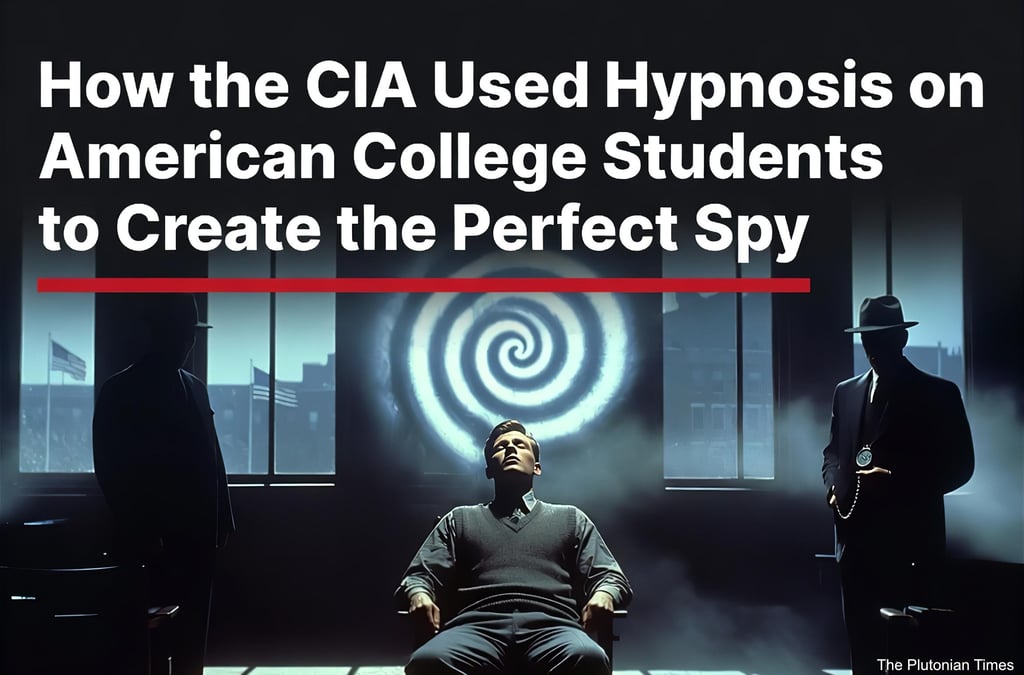
In the early years of the Cold War, the Central Intelligence Agency launched Project MKUltra, a sprawling program of behavioral modification experiments aimed at developing mind control techniques for espionage and interrogation. Among its 149 documented subprojects was Subproject 5, a focused effort on hypnosis that ran from 1953 to 1956. This initiative began with a hotel room demonstration designed to showcase the potential of hypnosis as a tool for clandestine services. What followed was a series of university-based studies exploring whether hypnosis could serve as a memory enhancer, a learning aid, a way to deceive polygraph machines, and a method to assess the susceptibility of certain personality types.
Origins and Key Participants
The research originated at the University of Minnesota and later moved to the University of Denver. It was conducted under a contract with Alden B. Sears, a graduate student and researcher who held TOP SECRET clearance and signed a secrecy agreement with the agency. Sears, who later became a Methodist minister in Nebraska, performed hypnosis experiments that included tests on dozens of University of Denver students. These students participated without knowing the true sponsor of the work.
A 1953 memorandum for the record noted that both Sears and the head of the Department of Psychiatry at the University of Minnesota were cleared through TOP SECRET and understood the real purposes of the project. The studies also connected to related MKUltra efforts on hypnotic couriers and potential “Manchurian candidate” programming.
Funding and CIA Oversight
Funding for Subproject 5 came through the Geschickter Fund for Medical Research, a private foundation that served as a CIA cover mechanism. The agency funneled approximately 12,000 dollars per year through this front organization to conceal its involvement. Sidney Gottlieb, the chemist who directed MKUltra’s Technical Services Division, approved the project and oversaw its financial and operational aspects. Other CIA monitors included Robert V. Lashbrook.
University administrators at Denver later confirmed in 1977 that the school had participated in the experiments but had no knowledge at the time that the grants originated with the CIA.
Implications
The implications of Subproject 5 extended far beyond academic curiosity. During the Cold War, U.S. intelligence feared Soviet advances in brainwashing and sought countermeasures as well as offensive capabilities. Hypnosis research aimed to create tools for enhancing agent performance, extracting information during interrogations, and potentially implanting false memories or commands.
It formed part of a broader set of eight MKUltra subprojects on hypnosis, some of which combined it with drugs.
Evidence of Deceptive Practices
Evidence of deceptive practices permeates the entire effort. The CIA deliberately hid its sponsorship behind the Geschickter Fund so that universities and researchers operated under the illusion of legitimate medical or psychological grants. Subjects at the University of Denver participated unwittingly in mind control studies. Secrecy agreements bound participants like Sears to silence about the true nature of the work.
Across MKUltra, the agency routinely bypassed informed consent, used front organizations, and destroyed most records in 1973 on orders from Director Richard Helms to avoid exposure. Subproject 5 followed this pattern: a hotel demonstration evolved into funded university research without transparent disclosure of its intelligence purpose.
Federal Convictions and Legal Outcomes
Congressional investigations, including the 1977 Church Committee hearings and the Rockefeller Commission, exposed the experiments and documented ethical violations on a massive scale. Some victims of related MKUltra work received civil settlements, such as the family of Frank Olson in the LSD dosing case, but prosecutors brought no charges against Gottlieb, Sears, or other participants.
The destruction of records and the passage of time shielded those involved from legal accountability. The University of Denver publicly acknowledged its unwitting role only after the CIA notified it decades later, yet no lawsuits or convictions followed specifically for Subproject 5.
References
Central Intelligence Agency. (1976). MKULTRA Subproject 5 documents. CIA Reading Room.
U.S. Senate Select Committee on Intelligence. (1977). Project MKULTRA, the CIA’s Program of Research in Behavioral Modification.
Marks, John. (1979). The Search for the Manchurian Candidate: The CIA and Mind Control. New York: Times Books.
Ross, Colin A. (2000). Bluebird: Deliberate Creation of Multiple Personality by Psychiatrists. Richardson, TX: Manitou Communications.
New York Times. (1977, September 5). “Unwitting Part in Behavior Tests for C.I.A. Disclosed by Denver U.”
University of Denver Clarion. (2023, April 24). “CIA Experiments on DU Students.”