
How Criminals, Cartels, and Billionaires Weaponize Overpriced Art for Tax Evasion and Fraud
DISCLOSURESUNSOLVED MYSTERIES & CRIME
Debbie Edwards
5/29/20263 min read
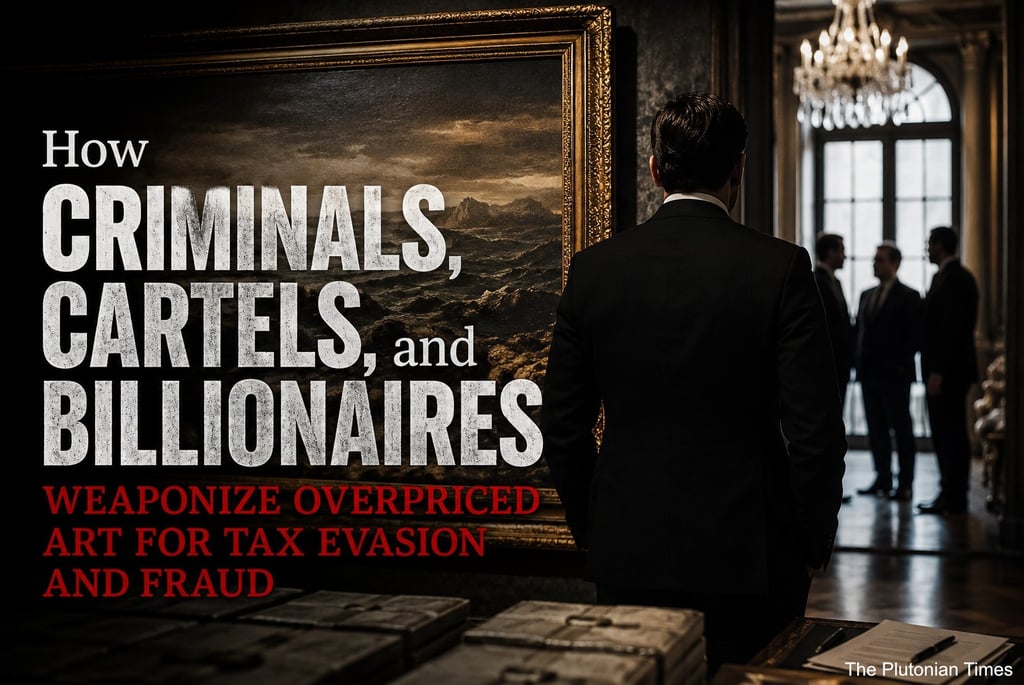
The fine art market, with its subjective valuations, opacity, and global mobility, has long served as a vehicle for financial crimes. Overinflated appraisals and prices allow criminals to launder dirty money, evade taxes, commit fraud, and traffic illicit goods. Art's portability, lack of standardized pricing, and use of intermediaries make it ideal for these schemes. This article examines notable examples across eras, with specific names and dates.
Ancient Roots and Historical Precedents
Art-related financial manipulation dates back centuries. During the Nazi era in the 1930s and 1940s, systematic looting of Jewish-owned art served both ideological and economic purposes. The Nazis plundered an estimated one-fifth of Europe's art, using sales of "degenerate" works to generate foreign currency for the war effort and personal collections. Figures like Hildebrand Gurlitt acted as dealers to liquidate looted pieces. This plunder functioned as state-sponsored theft and money movement, with artworks traded or sold to fund operations. Post-war restitution efforts continue today, highlighting how undervalued forced sales and hidden transfers concealed origins.
Modern Tax Evasion Through Inflated Appraisals
In the United States, inflated appraisals for charitable donations have enabled tax evasion. A 2008 Los Angeles Times investigation revealed that over two decades, the IRS audited only a fraction of art donation claims but found half overvalued by nearly double their worth, catching 183 million dollars in exaggerated deductions. A 2006 IRS inspector general study showed more than a third of reviewed objects overvalued by an average of three times.
In the 1970s and 1980s, schemes at institutions like the Getty involved artifacts appraised at inflated values for tax deductions. Robert Olson and Jonathan Markell of Silk Roads Gallery in Los Angeles forged inflated appraisals. J. Paul Getty Museum curator Jiri Frel oversaw donations valued at over 14 million dollars, often at four and a half times market price. Donors in high tax brackets profited from deductions exceeding purchase costs.
Money Laundering and Drug Cartels
Drug cartels have exploited art for laundering. In the 1980s and 1990s, Colombia's Cali Cartel used artworks to legitimize proceeds. In November 1994, a cartel member offered three paintings valued at 9 million dollars (Joshua Reynolds' "Portrait of a Gentleman," Peter Paul Rubens' "Saint Paul," and Pablo Picasso's "Head of a Beggar") to undercover agents for laundering. Leader José Santacruz Londoño employed decorators to buy luxury art.
Mexican cartels were major buyers until 2014 regulations required buyer reporting, causing gallery sales to drop up to 70 percent in some cases, indicating heavy prior reliance on anonymous cash purchases.
In 2014-2015, Ronald Belciano in Pennsylvania used art to launder marijuana proceeds. Authorities seized over 4 million dollars in cash, marijuana, and paintings worth more than 619,000 dollars. Belciano received a five-year sentence in 2015.
Forgery Scandals and White-Collar Fraud
The Knoedler Gallery scandal (late 1990s to 2011) involved over 60 forged paintings sold for more than 80 million dollars. Dealer Glafira Rosales supplied fakes by Pei-Shen Qian, attributed to artists like Jackson Pollock, Mark Rothko, and Robert Motherwell. Rosales pleaded guilty in 2013 to wire fraud, tax evasion, and money laundering, receiving home confinement. The gallery closed after 165 years.
Inigo Philbrick's fraud (2010s) involved overselling shares in artworks (up to 220 percent of one piece) and forging documents. He targeted artists like Christopher Wool and Wade Guyton. Sentenced in 2022 to seven years, he forfeited 86.7 million dollars.
High-Profile Corruption and Trafficking
The 1MDB scandal (exposed around 2015-2016) saw Malaysian financier Jho Low allegedly use embezzled funds (over 4.5 billion dollars) to buy art. Purchases included a Basquiat for 48.8 million dollars (2013 record), Van Gogh, Monet, Picasso, and Warhol works. Assets forfeited in settlements included paintings later auctioned or returned, linking art to international embezzlement and laundering.
Brazilian banker Edemar Cid Ferreira (convicted 2006) smuggled art, including a Basquiat declared at 100 dollars on invoices, to launder embezzled funds.
Broader Implications and "Shills" in Trafficking
Art's role extends to trafficking shills, where intermediaries inflate values or use straw buyers. Freeports (tax-advantaged storage) and anonymous auctions facilitate movement without scrutiny. The market's subjectivity allows "shills" to bid up prices artificially or create false provenance.
These cases illustrate systemic vulnerabilities: subjective valuations, privacy norms, and weak regulation. Reforms like due diligence and transparency have increased, but challenges persist. The art world remains a canvas where beauty and crime intertwine.
References (drawn from public reports and investigations):
Los Angeles Times (2008) on IRS appraisals.
U.S. Department of Justice statements on Knoedler (2013) and Belciano (2015).
Reports on Cali Cartel (1994) from DEA-related accounts.
1MDB forfeiture announcements (U.S. DOJ, 2019-2024).
Various art market analyses from Artnet, IMF discussions, and investigative journalism (2019-2025).