
How Al Gore Turned Climate Panic Into a Fortune - And Buried the Scientists Who Proved Him Wrong
DISCLOSURESSCIENCE
Debbie Edwards
5/29/20263 min read
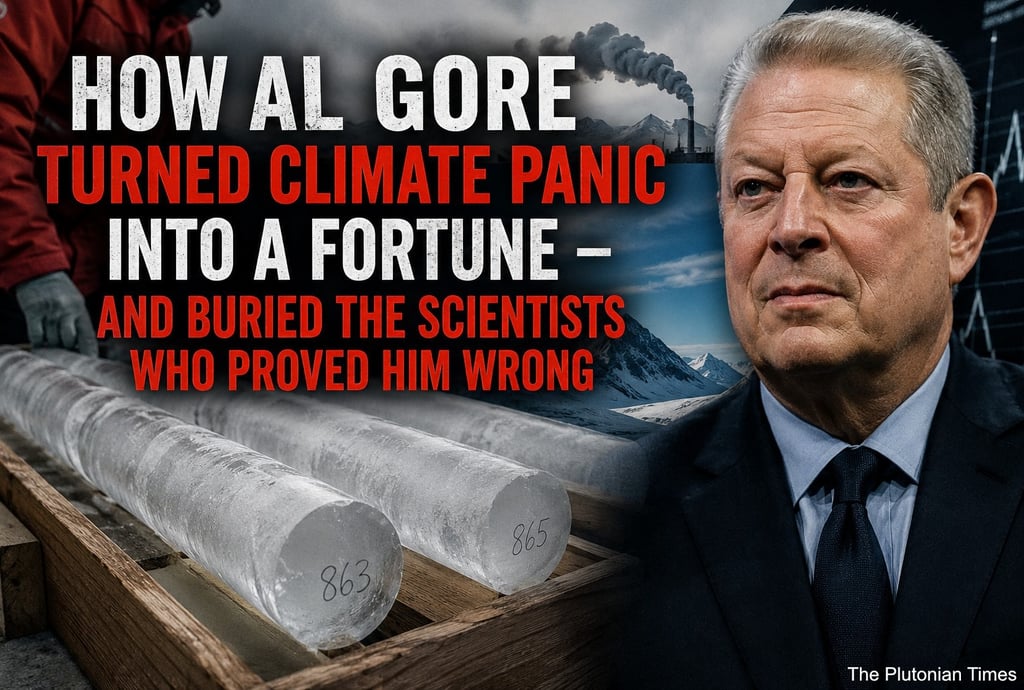
Former U.S. Vice President Al Gore became the most visible champion of urgent climate action with his 2006 documentary An Inconvenient Truth. The film used dramatic ice core graphs to argue that rising carbon dioxide from human activity was driving dangerous warming. It reached millions and shaped public opinion. However, critics say Gore exaggerated claims to create fear and advance policies that benefited him financially.
In 2007, a UK High Court reviewed the film for use in schools. The judge found it "broadly accurate" on basic science but identified nine significant errors or exaggerations presented in a context of "alarmism." These included overstated predictions about sea level rise from melting ice, links between global warming and hurricane strength, and the causes of Mount Kilimanjaro ice loss. Schools could still show the film but needed guidance notes for balance.
In December 2009, at the Copenhagen climate summit, Gore told audiences there was a 75 percent chance the North Pole could be ice-free in summer within five to seven years. This prediction, based on selective interpretation of research, did not come true on that timeline, though Arctic sea ice has declined.
Gore co-founded Generation Investment Management in 2004, a firm focused on "sustainable" and climate-related investments. The company has grown to manage billions of dollars. Gore reportedly built substantial personal wealth, estimated in the hundreds of millions, through speaking fees, book sales, and these investments tied to green policies he promoted. Critics argue this created a clear conflict of interest: Gore warned of catastrophe while profiting from the solutions he advocated, such as carbon trading and subsidies.
Scientists Who Refuted Alarmism and Faced Pushback
While Gore and others pushed strong alarmist messages, several respected scientists pushed back. They argued for more balanced views that recognize natural climate variability, uncertainties in models, and the value of adaptation alongside emission reductions. Many of these experts faced professional challenges, reduced funding opportunities, or public criticism for questioning the dominant narrative.
Richard Lindzen, a longtime MIT atmospheric physicist and member of the National Academy of Sciences, has argued that climate sensitivity to carbon dioxide is lower than often claimed and that models overestimate feedbacks. He criticized what he saw as politicization and "consensus enforcement" in science.
Judith Curry, former chair of the School of Earth and Atmospheric Sciences at Georgia Tech, resigned her position partly due to what she described as groupthink and overconfidence in projections. She has spoken out about uncertainties in climate science and the dangers of alarmist messaging that ignores natural factors.
Roger Pielke Jr., a researcher focused on extreme weather and disasters, has shown that many trends in hurricanes, floods, and droughts do not match the most alarming claims when looking at long-term data. He faced significant professional backlash for these findings.
Other notable figures include atmospheric scientists Roy Spencer and John Christy, who work with satellite temperature data and highlight that warming has been less severe than some predictions, and geologist and solar expert Willie Soon, who emphasizes natural solar and ocean influences on climate.
These scientists and others have maintained that while humans influence the climate, the degree of catastrophe is often overstated. They argue policies should be based on rigorous evidence rather than fear, especially when figures like Al Gore profited handsomely from promoting urgency.
Censorship, Marginalization, and the Broader Picture
Some skeptical scientists have reported difficulties publishing papers, securing grants, or maintaining visibility. Social media platforms have at times reduced reach or banned accounts sharing data that challenges mainstream views. Court cases have been limited, with the 2007 UK case on Gore's film being one prominent example of legal scrutiny of alarmist presentations. Broader debates continue about whether funding incentives and institutional pressures have silenced balanced discussion.
For the average person, ice core data reminds us that Earth’s climate is complex and has varied naturally for millions of years. Al Gore played a central role in framing the issue dramatically while building personal wealth. At the same time, brave scientists have risked careers to emphasize nuance, evidence of lower sensitivity, and the need for calm, practical responses rather than panic. Readers should review primary studies from both sides to form their own informed views.
References:
Al Gore's An Inconvenient Truth release: 2006.
UK High Court ruling on nine errors in the film: October 10, 2007.
Al Gore Copenhagen speech on Arctic ice: December 2009.
Generation Investment Management founding by Al Gore: 2004.
Vostok ice core studies showing temperature leading CO2: Key papers 1990s-2010s, including Petit et al. 1999.
Statements and experiences of scientists Lindzen, Curry, Pielke Jr., Spencer, Christy: Various publications and interviews from 2000s to 2025.