
High-Level Oversight of Psychic Intelligence: Clapper, Berbrich, and the Secret STARGATE Program
DISCLOSURESPARAPSYCHOLOGY & CONSCIOUSNESS STUDIES
Debbie Edwards
3/31/20264 min read
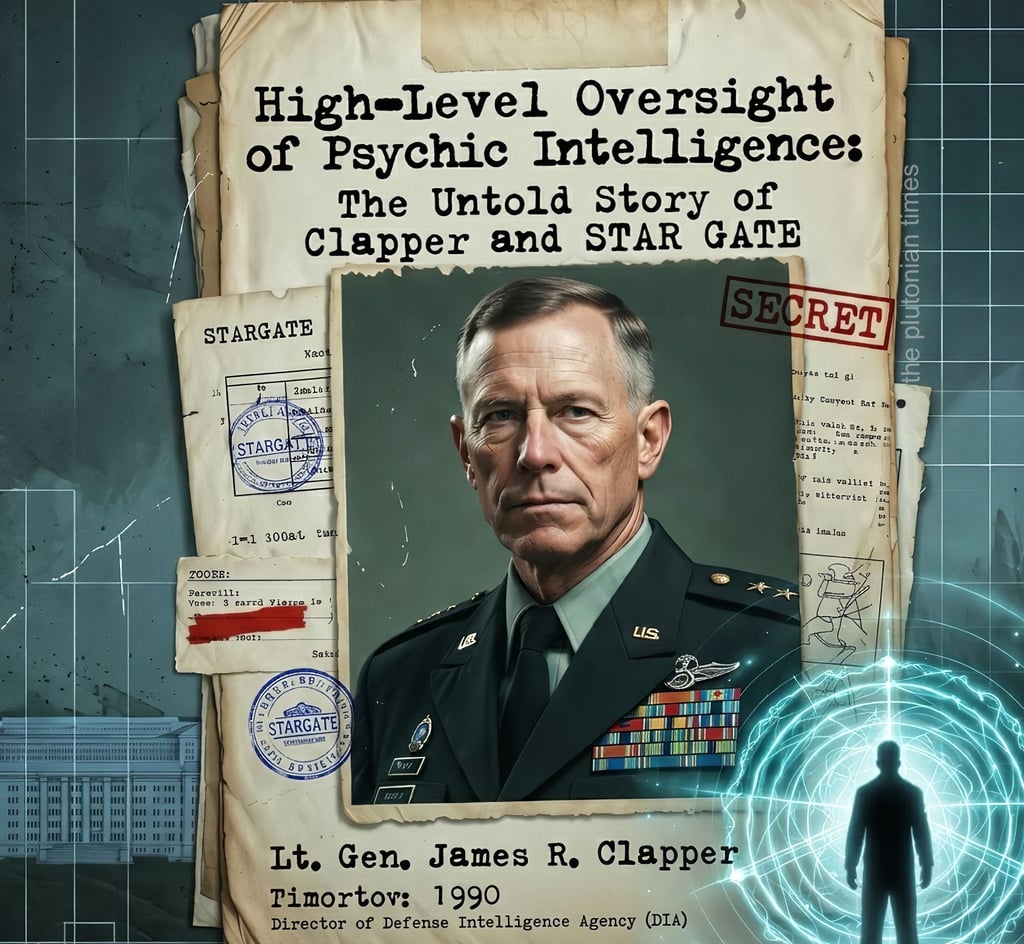
STARGATE (originally Grill Flame, then Center Lane, Sun Streak, etc.) was a real, multi-year U.S. government effort (1972–1995) to investigate remote viewing and other “psychic” or anomalous cognition phenomena for intelligence purposes. It was funded at a modest ~$20 million total over 23 years and housed primarily under DIA in its later phase.
John T. Berbrich and Lt. Gen. (Dr.) James R. Clapper Jr. were senior Defense Intelligence Agency (DIA) officials whose names appear together in internal STARGATE program documents (part of the larger trove of declassified CIA/DIA files made publicly available in the CIA’s 2017 Reading Room release).
Who They Were and Their Exact Roles in STARGATE
John T. Berbrich He was the Assistant Deputy Director for Scientific and Technical Intelligence (Asst. DDSTI) at DIA in the early-to-mid 1990s. He succeeded Dr. Jack Vorona in that scientific-intelligence oversight role. Berbrich handled day-to-day administrative and policy management of STARGATE: correspondence with contractors (SRI/SAIC), operational tasking, congressional briefings, and program reviews. He was the senior bureaucrat directly responsible for keeping the remote-viewing effort alive, funded, and integrated into DIA’s broader scientific/technical intelligence portfolio. Documents show him signing off on reports, arranging briefings, and ultimately participating in the decisions that led to the program’s wind-down.
Lt. Gen. (Dr.) James R. Clapper Jr. Clapper was Director of the Defense Intelligence Agency from 1991 to 1995, the exact period when STARGATE was in its final DIA-managed phase. (He already held a Ph.D. in political science, which is why some documents or references style him as “Dr. Clapper” alongside his military rank.) As DIA Director, he was the ultimate agency head responsible for everything under DIA, including STARGATE. Memos were prepared for him personally; he received briefings on operational results, research findings, and future funding options. He was not a day-to-day “program manager” but the top-level approver/oversight official whose awareness and sign-off were required for continuation.
It was not a “fringe” or rogue operation:
The presence of the DIA’s top scientific-intelligence official (Berbrich) and the agency director himself (Clapper) proves STARGATE was a formally authorized, bureaucratically managed program inside the mainstream U.S. intelligence community. It received the same kind of high-level staffing and briefing treatment as any other classified technical collection program (e.g., imagery or signals intelligence). This directly counters the popular narrative that the government only dabbled in psi research at low levels or as a quirky side project.
Serious institutional buy-in at the highest levels of DIA:
Clapper’s involvement as DIA Director (and Berbrich’s role as his senior science advisor on the project) shows that remote viewing was deemed worth the personal time and attention of the person running the entire Defense Intelligence Agency. Briefings were prepared for Clapper and, in at least one documented instance, for escalation to the Secretary of Defense and Deputy Secretary. That level of visibility indicates the program had produced enough credible operational intelligence “hits” (agencies reported an ~89 % customer satisfaction/return rate on remote-viewing taskings) to justify continued high-level review even into the 1990s.
Continuity with later high-profile intelligence leadership:
Clapper went on to become Under Secretary of Defense for Intelligence (2007–2010) and then Director of National Intelligence (DNI) under President Obama (2010–2017). His early direct oversight of STARGATE is therefore a direct link between 1970s–90s psi research and the very top of the post-9/11 U.S. intelligence apparatus. It illustrates that senior officials who later shaped national intelligence policy had firsthand exposure to unconventional collection methods and the classified data they generated.
Context for the program’s 1995 termination:
The same documents show that, even with Berbrich and Clapper’s involvement, the program was ultimately closed in 1995. Reasons cited in the declassified files include budget pressures, shifting post–Cold War priorities, and the conclusion that while remote viewing produced statistically interesting results and some operational utility, it was not reliable or accurate enough to serve as a standalone intelligence source. The high-level names therefore also mark the end of the official U.S. government experiment in this area.
Broader cultural and historical significance of the 2017 release:
The fact that these names surfaced in the 2017 CIA document dump (the full STARGATE collection was uploaded to the CIA Reading Room that year) gave the public concrete proof that two-star and three-star-level officials had managed a psychic spying program. It fueled renewed public and academic interest in government psi research, declassified archives, and questions about what other “anomalous” programs might still exist.
Examples of Activities Conducted Under Their Oversight
Under the oversight of Berbrich (who managed day-to-day operations and briefings) and Clapper (who received high-level updates as DIA Director), the STARGATE program continued operational remote-viewing taskings alongside research into protocols and methods. These were treated as legitimate intelligence collection tools. Specific examples from the program’s later years include:
Location and identification of foreign weapons or facilities: Remote viewers were tasked with describing hidden or inaccessible targets, such as underground facilities, tunnels, or weapons sites. One category of work involved determining the purpose of structures or locating SCUD missiles and secret biological or chemical warfare projects. Another involved assessing foreign technology developments worldwide, which aligned with the program’s stated mission under DIA in the 1990s.
Support for specific intelligence queries: In the early 1990s period overlapping with Clapper’s tenure, viewers responded to operational tasks that included attempts to locate plutonium-related activities in North Korea (1994) and to provide information on chemical weapons work (for example, descriptions of ships potentially transporting chemicals from Libyan ports). Protocols often used controlled remote viewing (CRV) methods, which involved providing viewers with only sealed coordinates, photos, or minimal cues to minimize bias, followed by detailed session reporting and evaluation against known intelligence. These sessions were documented, reviewed, and fed into broader customer feedback processes, with an overall high return rate from requesting agencies.
In short, the appearance of Berbrich and Clapper in the same STARGATE document is strong evidence that the program operated with full institutional legitimacy and senior executive oversight inside the Defense Intelligence Agency right up until its official closure. It was treated as a legitimate, if unconventional, intelligence capability rather than a sideshow. That is why the document stands out to researchers: it anchors the entire effort at the highest levels of the U.S. intelligence bureaucracy.