
From Smartphones to Cancer Therapy: How Gold Is Changing Technology and Healthcare With Less Environmental Harm
TECHNOLOGYENVIRONMENT
Debbie Edwards
4/4/20263 min read
Gold is quietly changing and improving electronics and healthcare in ways that could be much better for the environment than traditional battery materials like cobalt and lithium.
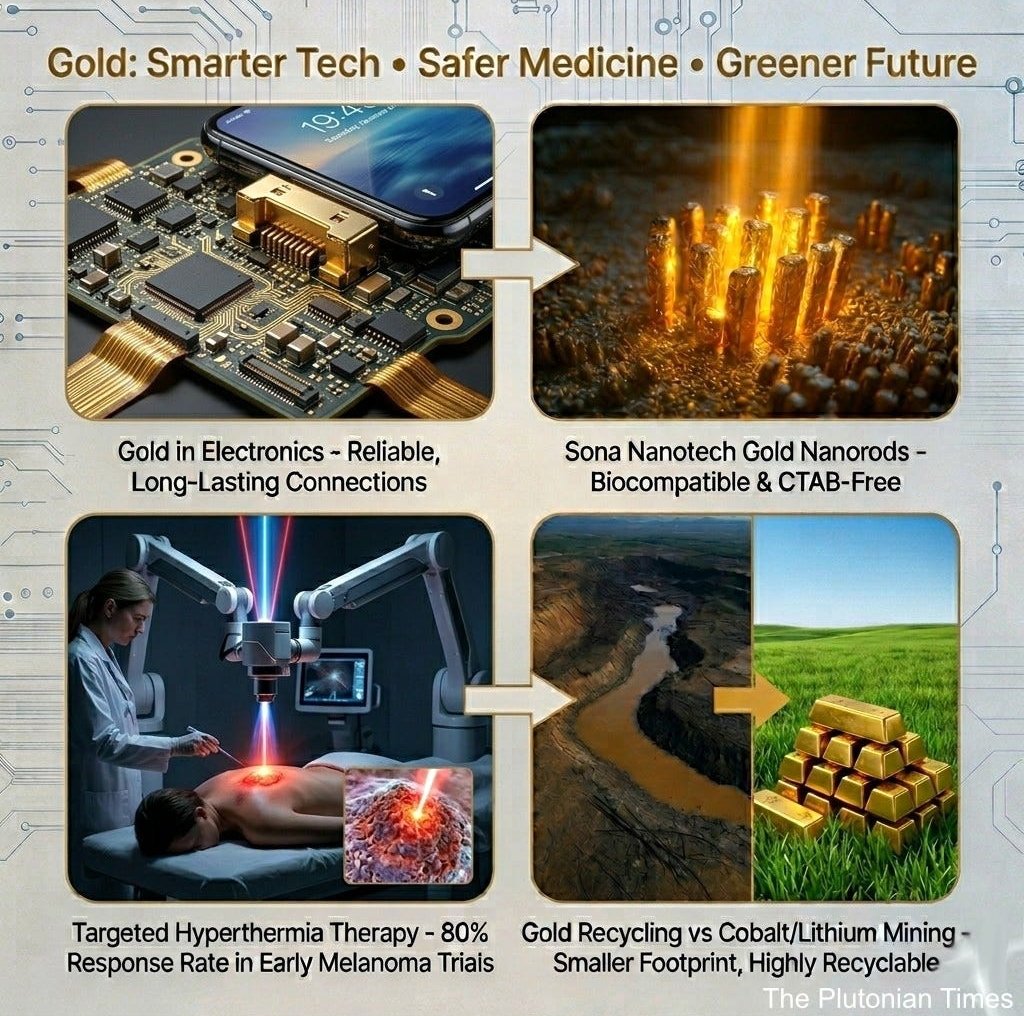
Most people know gold as jewelry or a store of value. But this precious metal has special properties that make it extremely useful in modern technology. It conducts electricity very well and does not corrode or tarnish over time, even in harsh conditions. That is why manufacturers use tiny amounts of gold in smartphones, computers, medical devices, and other electronics for connectors, switches, and circuits. These connections stay reliable for years, which helps devices last longer and reduces the need to replace them so often.
Now, gold is taking on an even more exciting role in healthcare thanks to advances in nanotechnology. One standout example comes from a company called Sona Nanotech. They have developed a patented way to make gold nanorods, which are tiny rod-shaped particles, without using a toxic chemical called CTAB that is common in other gold nanorod production. Removing this chemical makes the particles much safer and more biocompatible for use inside the human body according to a Sona Nanotech white paper on CTAB-free gold nanorods.
Sona uses these gold nanorods in a treatment called Targeted Hyperthermia Therapy. Here is how it works in simple terms: doctors inject the nanorods directly into a solid tumor. Then they shine a special near-infrared light on the area. The gold nanorods absorb the light and turn it into gentle heat, raising the temperature inside the tumor to about 42 to 48 degrees Celsius. This heat stresses and kills cancer cells while leaving healthy tissue largely unharmed. At the same time, the process triggers a strong immune response in the body, including something called immunogenic cell death. This can help the immune system recognize and attack cancer cells elsewhere in the body too, sometimes producing effects on distant tumors.
In Sona’s first-in-human clinical study with ten patients who had advanced, immunotherapy-resistant cutaneous metastatic melanoma, the treatment showed an 80 percent overall response rate. Six out of ten patients experienced complete responses in treated tumors confirmed by biopsy with no detectable residual melanoma, and this happened within two weeks of initial treatment. The therapy also demonstrated a favorable safety profile according to a Sona Nanotech clinical trial update on October 2025.
Sona’s gold nanorods are also being studied for faster and more sensitive diagnostic tests and targeted drug delivery. Preclinical safety studies, including FDA-required toxicity testing, showed no signs of acute or systemic toxicity even at 100 times the proposed clinical dose in a toxicity study results published May 2025.
What makes this approach especially interesting from an environmental and safety standpoint is how it compares to the mining of materials like cobalt and lithium, which are heavily used in batteries for electric vehicles and electronics.
Cobalt mining, often concentrated in the Democratic Republic of Congo among many other locations, has been linked to serious concerns including child labor, forced labor, toxic runoff that pollutes water and soil, and habitat destruction in U.S. Department of Labor reports and environmental studies. Lithium extraction frequently requires large amounts of water in already dry areas, which can disrupt local ecosystems and communities. Both processes are energy-intensive and generate significant carbon emissions and waste.
Gold, by contrast, is used in very small quantities in electronics. Because it is so valuable, there are strong economic incentives to recover and recycle it from old devices, known as e-waste. Recycling gold from electronics can be far less energy-intensive than virgin mining and creates a much smaller environmental footprint. Studies show that urban mining from e-waste can be up to 13 times cheaper and significantly more environmentally friendly than extracting new gold ore, while reducing habitat destruction, water pollution, and greenhouse gas emissions discovered in research on e-waste recycling vs. virgin mining.
Sona’s innovation adds another layer of responsibility. By producing gold nanorods without toxic surfactants, the manufacturing process itself reduces chemical hazards and waste compared with traditional methods.
Overall, these developments point toward a future where gold helps create more durable electronics that last longer and powerful new medical treatments that are precise and relatively low in toxicity. While gold will not replace cobalt or lithium in batteries anytime soon, its expanding role in longer-lasting devices and advanced healthcare offers a path that relies more on recyclable, high-value materials and less on the most damaging aspects of traditional mining.
Companies like Sona Nanotech are showing how gold can be part of smarter, safer innovation in both technology and medicine.