
From Brain Mapping to Faster Training: Militarized Neural Interface for Airmen, What Could Go Wrong?
TECHNOLOGY
Debbie Edwards
4/3/20264 min read
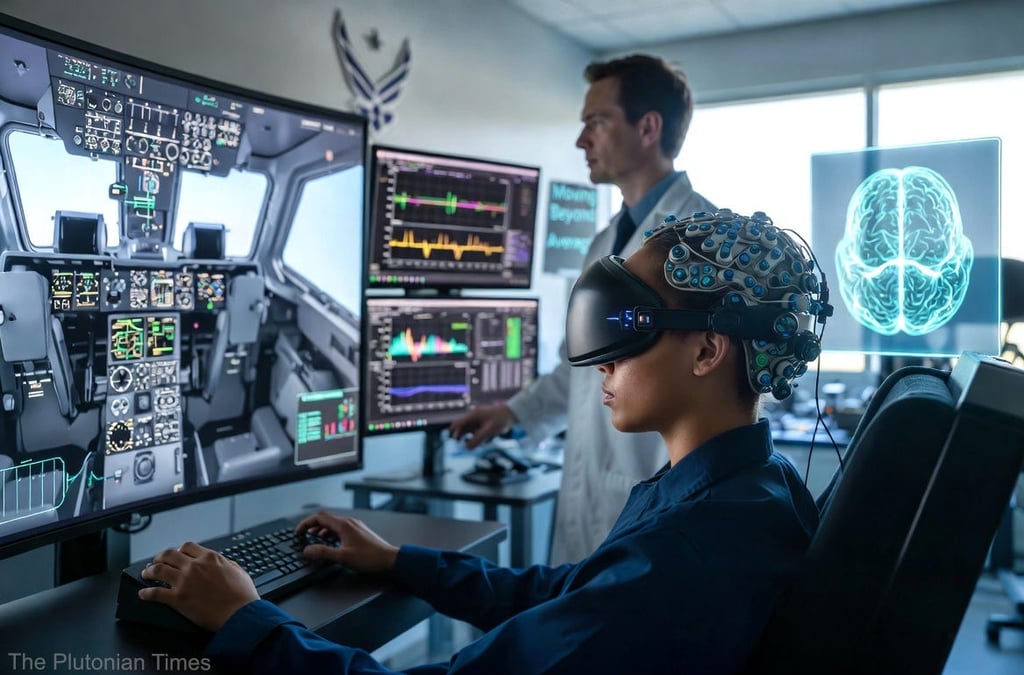
In the high-stakes world of air, space, and cyber operations, one-size-fits-all training no longer cuts it. The Air Force Research Laboratory’s 711th Human Performance Wing (711 HPW) is rewriting the rules of skill acquisition with neurotechnology that treats every Airman’s brain as uniquely capable. At the center of this effort stands the Individualized Neural Learning System, or iNeuraLS, a program that uses real-time brain monitoring to personalize learning like never before.
Recent public presentations by the program’s leadership offer the clearest window yet into its maturing vision. In his 2023 AFRL Inspire talk titled “Moving Beyond Averages,” Dr. Nathaniel “Nate” Bridges, the biomedical engineer who leads iNeuraLS at the 711 HPW, described a shift away from group-based training metrics toward hyper-personalized cognitive optimization. Drawing on years of brain-activity data, the system identifies each learner’s optimal neural states for absorbing new information, then actively guides them into those states. Bridges emphasized that traditional averages in training overlook individual variability in attention, fatigue, and memory formation. iNeuraLS instead creates a closed-loop experience that adapts in real time, promising to help Airmen reach peak proficiency faster and with greater consistency.
By early 2024, Bridges had received national recognition for his contributions to next-generation brain-machine interface technology through iNeuraLS, underscoring the program’s enduring priority within the Air Force’s human-performance portfolio. Ongoing investments in the 711 HPW’s Applied Cognitive Neuroscience efforts, including active research fellowships in brain-computer interfaces as of 2024, show that the foundational work continues to fuel broader advancements in cognitive modeling and human-technology symbiosis. While detailed experimental results from the planned 2023 virtual-reality flight-simulator demonstration remain internal, the program’s influence is evident in the wing’s continued focus on adaptive, proficiency-based training tools that move warfighters beyond conventional limits.
These latest insights build directly on more than a decade of cognitive neuroscience research at the 711 HPW. Yet to fully appreciate where iNeuraLS stands today, it helps to trace its origins, the deliberate choices that turned a bold idea into a funded, multidisciplinary reality.
The Spark: How iNeuraLS Was Born in 2020
The story begins in the summer of 2020, when the Air Force was grappling with accelerating demands on its training pipelines. Pilot shortages, complex new systems, and peer-level competition required faster, more effective ways to build expertise. AFRL leadership launched the Seedlings for Disruptive Capabilities Program (SDCP) to fund high-risk, high-reward ideas aligned with the service’s 2030 science and technology strategy. Out of a competitive field, iNeuraLS was selected as one of seven inaugural projects.
Led by the 711 HPW’s cognitive neuroscience team, the three-year proof-of-concept received multimillion-dollar annual funding to mature a completely new approach to skill acquisition. The core challenge was clear: traditional repetition-based training takes too long and fails to account for individual differences in how brains encode and retain knowledge under stress. iNeuraLS proposed a solution, an augmented learning platform that would monitor cognitive states in real time and intervene to keep learners in their personal “sweet spot” for absorbing information.
Dr. Gaurav Sharma, then Senior Technical Lead for Cognitive Neuroscience at AFRL, captured the excitement at launch: neurotechnology represented a major focus area with “huge potential” for the Air Force. Dr. Nathaniel Bridges, tapped as Neural Interface Team lead and later overall program lead, described the goal in vivid terms: the system would deliver “unprecedented access to the brain” to pinpoint ideal learning conditions and then enhance them on the fly.
From day one, iNeuraLS was designed as a true partnership. Internal AFRL collaborators from the Materials and Manufacturing Directorate contributed advanced sensor materials, while the Munitions Directorate supported modeling and simulation. External partners brought specialized expertise: Microsoft Research for virtual and augmented reality platforms, MIT Lincoln Laboratory for machine-learning algorithms, Sonera Magnetics for next-generation EEG/MEG sensor hardware, and Teledyne Technologies for system integration. This collaborative model allowed the team to move quickly from concept to prototype.
The project timeline was ambitious yet methodical. Years one and two focused on foundational research, algorithm development, and human-subject studies with small groups of 20 to 30 non-pilot volunteers at Wright-Patterson Air Force Base. The capstone, originally scheduled for 2023, involved a live demonstration in a virtual-reality-enabled flight simulator, where participants would train on complex maneuvers far faster than control groups using conventional methods.
The Technical Heart: Hybrid Interfaces and Closed-Loop Personalization
At its core, iNeuraLS relies on a hybrid brain-machine interface that fuses two proven, non-invasive neuroimaging technologies. Electroencephalography (EEG) captures rapid electrical brain-wave changes through scalp electrodes, revealing moment-to-moment shifts in attention, relaxation, or cognitive load. Magnetoencephalography (MEG) measures the faint magnetic fields produced by the same neuronal activity, providing precise spatial mapping of where in the brain key processes occur. Combining them yields both high temporal and spatial resolution, something neither technology achieves alone.
While a learner engages in a training task, the system streams continuous brain-activity data. Advanced algorithms, refined through machine learning, identify the user’s individualized “optimal brain state” for encoding new information. Once detected, the closed-loop system responds in one of two complementary ways:
Non-invasive neuromodulation gently stimulates targeted brain regions to nudge activity into the ideal zone.
Augmented-reality overlays dynamically adjust the training environment, highlighting cues, reducing distractions, or modulating task difficulty to sustain peak engagement.
Every intervention is tailored. No two users receive the same stimulation pattern or AR guidance because the system learns each brain’s unique dynamics in real time.
From Proof-of-Concept to Enduring Impact
The 2020 launch of iNeuraLS marked a philosophical pivot for the 711 HPW, treating the human mind not as a fixed constraint but as an optimizable asset. Early experiments validated the feasibility of hybrid interfaces and closed-loop modulation. By the program’s later stages, the focus had sharpened on practical outcomes, compressing training timelines for high-value skills such as piloting, maintenance diagnostics, and intelligence analysis.
Today, the lessons from iNeuraLS echo across the wing’s broader cognitive neuroscience portfolio. Ongoing research fellowships in passive brain-computer interfaces and cognitive performance modeling show that the foundational technologies continue to evolve. The 2024 national award to Dr. Bridges and his repeated invitations to speak at AFRL flagship events signal that the program’s vision, personalization at the neural level, has moved from seedling idea to established priority.
Challenges remain. Brain data is intensely personal, so privacy safeguards, long-term safety of repeated neuromodulation, and equitable performance gains across diverse user populations require continued scrutiny. Yet the 711 HPW has approached these issues with the same rigor that defined the original SDCP proposal: voluntary participation, transparent protocols, and multidisciplinary oversight.
The Road Ahead
As the Air Force confronts increasingly complex operational environments, tools like iNeuraLS position Airmen to learn faster, retain more, and adapt under pressure. The latest insights from program leaders paint a future where training is no longer limited by averages but accelerated by each individual’s neural signature. What began as a 2020 Seedling for Disruptive Capabilities has grown into a cornerstone of human-performance research, one that treats every Airman’s brain as the ultimate high-performance asset.