
EXPOSED: Secret Bluetooth Surveillance Grid Now Being Used by Police Across America
TECHNOLOGY
Debbie Edwards
6/10/20263 min read
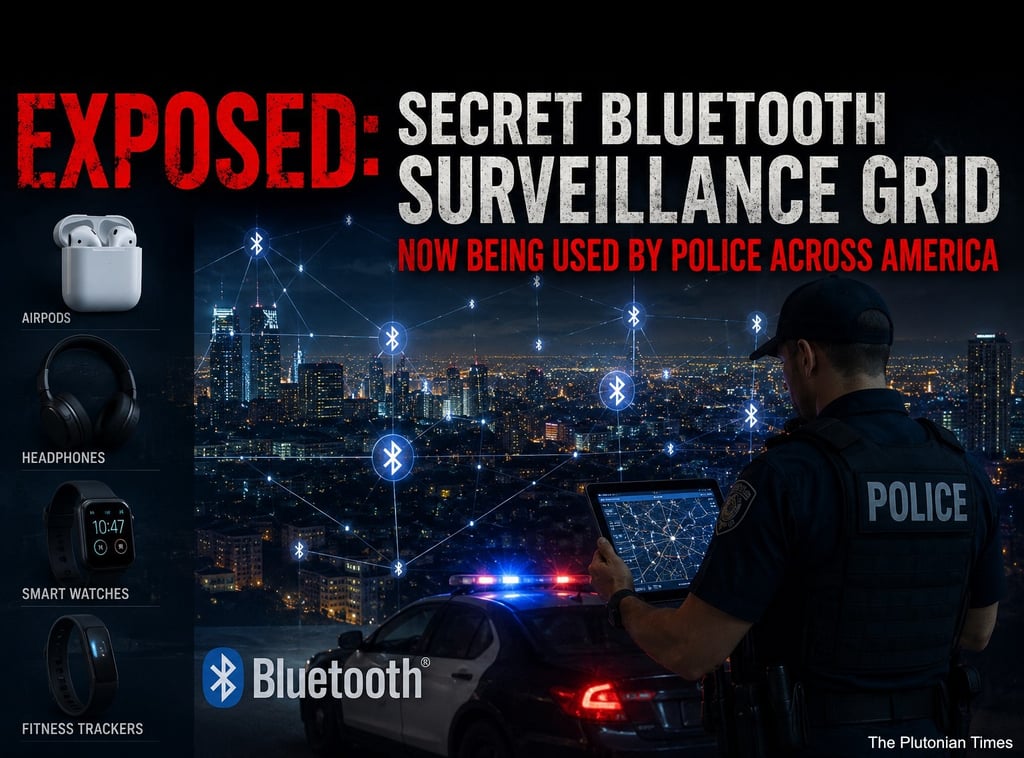
Bluetooth technology, particularly Bluetooth Low Energy (BLE), has expanded beyond personal device connectivity into law enforcement applications for tracking and surveillance. While Bluetooth enables features like proximity detection and data sharing, its signals can be intercepted, logged, or combined with other tools to monitor movements without traditional warrants in some cases. This raises significant implications for civil liberties in an era of widespread device connectivity.
Key Systems and Technologies
One notable example is TraffiCatch, a system from manufacturer Jenoptik. Deployed by law enforcement including the Department of Homeland Security (DHS) and agencies in Texas border counties since at least 2019, TraffiCatch detects Wi-Fi and Bluetooth signals from vehicles. It captures Bluetooth device addresses (public or random) emitted by smartphones, smartwatches, wireless earbuds, and car infotainment systems.
Webb County (including Laredo) has used the technology since around 2019, and Val Verde County (including Del Rio) approved it in 2022. The system combines Bluetooth data with Automated License Plate Readers (ALPR) to track individuals even if they switch vehicles or alter plates. This allows persistent monitoring of movements through signal emissions.
Law enforcement also leverages consumer Bluetooth trackers such as Apple AirTags and similar BLE devices. Departments like the Denver Police Department in March 2025 offered hundreds of free AirTags and SmartTags to residents to combat auto theft. Police use location data from these devices to recover stolen vehicles and property. Sacramento County Sheriff’s Office reported involvement in multiple investigations using such trackers in the year leading up to late 2023. The New York Police Department similarly distributed 500 AirTags in April (year context around 2023 reports) amid car theft spikes.
In addition, tools like Fog Reveal aggregate location data from mobile advertising IDs, which often rely on Bluetooth, Wi-Fi, and GPS signals harvested from apps. Police agencies have used it to query billions of records from hundreds of millions of devices for “patterns of life” analysis, sometimes without warrants. While not exclusively Bluetooth, advertising IDs enable device tracking via BLE beacons and signals.
Police equipment itself has become trackable. In May 2026, reports highlighted a Bluetooth vulnerability in Axon tasers and body-worn cameras used by Australian police. The flaw allows detection of these devices within hundreds of meters by scanning for manufacturer codes, potentially compromising officer locations.
Policies and Legal Context
Many uses operate under the “vehicle exception” or commercial data purchases, bypassing traditional warrants. For instance, vehicle forensics kits can extract data from car Bluetooth connections, including GPS and personal information, sometimes without warrants according to 2022 analyses. The Supreme Court has required warrants for certain cell phone location data, but gaps remain for Bluetooth-derived information and aggregated commercial datasets.
Agencies often justify these tools for crime prevention, missing persons searches (e.g., signal detection for BLE-emitting devices like pacemakers in 2026 cases), and investigations. However, privacy advocates highlight the lack of transparency and oversight.
Implications for Privacy and Society
Bluetooth tracking enables granular, real-time or historical surveillance because many devices broadcast signals continuously when Bluetooth is enabled. This creates digital trails that law enforcement or others can exploit, even with MAC address randomization on modern phones (which is imperfect against advanced systems).
Implications include:
Mass Surveillance Potential: Combining BLE detection with ALPR, cameras, and data brokers allows persistent tracking of everyday movements without direct device access.
Chilling Effects: Citizens may self-censor activities knowing signals could be logged near crime scenes or sensitive locations.
Equity Concerns: Border areas and high-crime zones see heavier deployment, disproportionately affecting certain communities.
Counter-Surveillance and Vulnerabilities: The same technology can be turned against police (as in the Axon flaw), and civilians risk stalking via AirTag-like devices.
Data Security: Aggregated Bluetooth-derived data increases breach risks and misuse by third parties.
Broader adoption of BLE in public safety (e.g., RTLS for personnel tracking in facilities) normalizes constant connectivity monitoring.
To mitigate risks, individuals can disable Bluetooth when not in use, use airplane mode in sensitive situations, and monitor for unknown trackers via device settings. Advocacy for stronger warrant requirements and data privacy laws continues.
References (drawn from public reports and analyses):
Criminal Legal News on TraffiCatch and DHS use, June 15, 2024.
EFF report on Bluetooth border surveillance, May 6, 2024.
CBS News on Denver Police AirTag program, March 18, 2025.
PBS News on Fog Reveal, September 1, 2022.
ABC News on Axon Bluetooth flaw, May 4, 2026.
The Conversation on police equipment tracking, May 4, 2026.
Various procurement and law enforcement reports from 2019–2026.