
Declassified: How the CIA Trained People to Remote View INSIDE Their Dreams
DISCLOSURESPARAPSYCHOLOGY & CONSCIOUSNESS STUDIES
Debbie Edwards
5/2/20263 min read

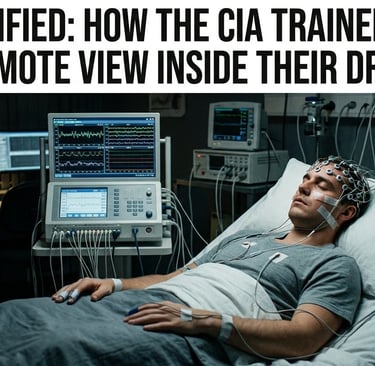
In December 1991, amid ongoing U.S. government interest in unconventional intelligence methods, Science Applications International Corporation (SAIC) prepared a draft technical protocol for the CIA. Titled “Anomalous Cognition in Lucid Dreams,” the 40-page document (CIA-RDP96-00789R003100140001-2) proposed a novel way to harness psychic abilities, or what researchers called “anomalous cognition” (AC). AC encompassed phenomena such as remote viewing, where individuals attempt to perceive distant or hidden targets without using ordinary senses. The authors, Edwin C. May, Ph.D., a leading figure in the CIA’s psychic research efforts, and Stephen LaBerge, a prominent lucid dreaming researcher, suggested testing whether these abilities could be accessed more reliably during lucid dreams, when a person becomes consciously aware they are dreaming.
This document emerged from the broader STARGATE program, the CIA’s umbrella effort (also known by earlier code names like GRILL FLAME, CENTER LANE, and SUN STREAK) to investigate parapsychological techniques for intelligence gathering. By the early 1990s, STARGATE had explored various approaches to AC, but this protocol stood out by combining it with lucid dreaming, a state where dreamers can potentially control or direct their experiences.
What Is Lucid Dreaming and Why Pair It with Psychic Research?
Lucid dreaming occurs when a sleeper realizes they are in a dream and can sometimes influence its content. LaBerge had pioneered scientific verification of this state in the 1980s at Stanford University in California. His team used eye-movement signals during rapid eye movement (REM) sleep to confirm lucidity in laboratory settings. The protocol drew on this foundation, noting that earlier dream-based psychic experiments, such as those conducted from 1962 to 1972 at the Maimonides Medical Center in Brooklyn, New York, had shown promising but inconsistent results for dream telepathy. In those studies, dreamers reported impressions of randomly selected targets viewed by a “sender” in another room. However, participants were not lucid and thus not actively focused on the task.
The 1991 proposal aimed to improve on this by training subjects to become lucid on demand and then deliberately seek out target information during the dream.
Details of the Proposed Pilot Study
The objective was straightforward: determine whether anomalous cognition can be observed during a lucid dream. The plan called for a three-month pilot involving 12 volunteer “receivers” divided into two groups. Five were experienced lucid dreamers recruited from LaBerge’s prior research pool. The other seven were individuals who had already demonstrated strong AC abilities in previous SAIC studies.
Training involved a lucid dreaming home-study course provided by the Lucidity Institute (a subcontractor) plus two weekend seminars. Participants also received access to the DreamLight, a sleep mask developed by LaBerge’s team. It detected REM sleep via eye movements and flashed lights to cue the dreamer without fully waking them.
The experimental trials were designed for home use to make them practical:
Each receiver received a sealed envelope containing one randomly selected photograph from a pool of 100 National Geographic images.
Before sleep, they placed the unopened envelope in their bedroom.
Using the DreamLight, they aimed to achieve lucidity, “open” the envelope in the dream, memorize the image, and then wake up.
Upon waking, they recorded detailed written and drawn impressions.
They mailed the unopened envelope along with their report back to the principal investigator for judging.
For comparison, each participant first completed eight waking AC baseline trials at the SAIC Cognitive Sciences Laboratory in Menlo Park, California. In these sessions, a monitor and receiver sat in a simple office while a computer randomly selected a target. The receiver described impressions for 15 minutes before feedback was provided.
Data analysis relied on a standard rank-order judging method. Targets were grouped into packets of five visually distinct images. Independent judges ranked how well each response matched the actual target, producing statistical measures of accuracy.
Locations, Schools, and Scope of Testing
The protocol itself described a small-scale pilot rather than a large deployment. All waking baseline sessions occurred at the SAIC Cognitive Sciences Laboratory located at 1010 El Camino Real, Suite 330, Menlo Park, California. Lucid dream trials took place unsupervised in the participants’ own homes, with no specific states or multiple locations identified beyond this California base. The document makes no reference to any schools, educational institutions, or widespread rollout across states for testing or studies. Training relied on a home-study course and weekend seminars, but these were limited to the selected volunteers.
References
Central Intelligence Agency. (1991). Anomalous Cognition in Lucid Dreams (Draft Technical Protocol). CIA-RDP96-00789R003100140001-2.
Child, I. L. (1985). Psychology and anomalous observations. American Psychologist, 40(11), 1219-1230. (Cited in the protocol.)
LaBerge, S., et al. (1981, 1986, 1988). Various papers on lucid dreaming physiology and verification (reprinted in the protocol appendix).