
Climate Change Is Fueling Evolution – Scientists Witness Species Evolving in Real Time Right Now
ENVIRONMENT
Debbie Edwards
6/11/20262 min read
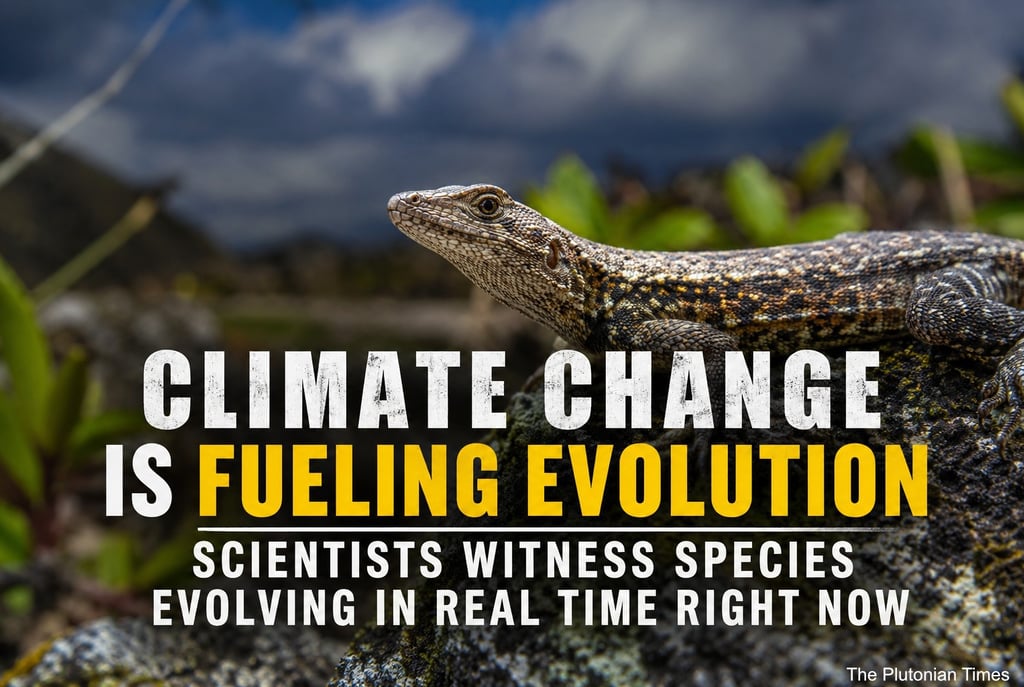
Evolutionary ecology reveals a story of remarkable adaptability and discovery. Across 2025 and 2026, scientists have described thousands of new species while uncovering how organisms evolve rapidly in response to changing climates. These findings highlight the positive potential of nature's ingenuity, offering hope for biodiversity in a dynamic world.
A Surge in Species Discoveries
The pace of new species descriptions reached exciting heights in recent years. Researchers documented an average of more than 16,000 new species annually between 2015 and 2020, a trend that continued strongly into 2025 and 2026. This includes thousands of animals, plants, fungi, and microbes, demonstrating that Earth's biodiversity remains richer than previously estimated.
In 2025 alone, notable finds included the Chachapoya Mouse Opossum from Peru's Rio Abiseo National Park, a tiny marsupial highlighting untapped diversity in Andean ecosystems. Marine explorations yielded treasures such as the Darth Vader Supergiant Isopod and several new deep-sea amphipods.
The Ocean Census project delivered a landmark achievement. From April 2025 to March 2026, scientists identified 1,121 previously unknown marine species worldwide. This 54 percent increase over prior years included a new ghost shark and symbiotic worms, showcasing the vast potential still hidden in our oceans.
Rapid Evolution in Response to Climate Pressures
Species are not merely being found; many demonstrate active evolutionary adaptation to warmer conditions, altered seasons, and shifting habitats. A groundbreaking experiment with Arabidopsis thaliana (a model plant) across 30 global sites tracked genetic changes over multiple generations. By 2026, results showed that populations with sufficient genetic diversity evolved adaptive traits within just three to five years, pinpointing DNA variants that enhance survival under climate-like stresses.
Animals also show encouraging resilience. Meta-analyses of over 200 studies on 73 vertebrate species, published in early 2026, confirmed that many shift their phenology (timing of life events like breeding or migration) in adaptive ways. These changes help populations align with new seasonal patterns driven by warming temperatures.
Birds on the West Coast of North America provide a clear example. Over recent decades, species such as tree swallows and Calliope hummingbirds advanced nesting by five to 12 days compared to a century ago, better matching earlier springs. In marine environments, three-spined stickleback fish in California evolved changes in body armor and habitat preferences over about 40 years, thriving in warmer, drier conditions.
Positive Interactions Between Discovery and Adaptation
Climate shifts sometimes facilitate new discoveries and evolutionary opportunities. As habitats change, previously overlooked populations reveal themselves as distinct species through advanced genetic tools. This process underscores nature's capacity for innovation. For instance, hybrid eelgrass in California bays exhibited superior performance in murky waters, with genomic studies identifying beneficial circadian clock genes that support photosynthesis under challenging conditions.
Deep-sea and tropical explorations in 2025 and 2026 uncovered species with unique traits suited to extreme or transitioning environments. These findings expand our appreciation for evolutionary creativity, from carnivorous sponges to vibrant poison dart frogs with metallic hues.
Looking Ahead With Optimism
These breakthroughs affirm that life possesses remarkable tools for persistence. Rapid evolution, combined with ongoing species discovery, paints a picture of dynamic ecosystems capable of responding to change. Continued research into genetic diversity and adaptive potential will further empower conservation efforts, ensuring future generations can witness even more of nature's wonders.
References
Wiens et al. (2025). Science Advances.
Ocean Census Project (May 2026).
Expósito-Alonso et al. (March 2026). Science.
Various studies summarized in Nature Communications (January 2026). NOAA Fisheries and other taxonomic reports (2025-2026).