
Bruce Greyson and the Near-Death Experience Scale: Breakthroughs in Non-Local Consciousness Research
PARAPSYCHOLOGY & CONSCIOUSNESS STUDIES
Debbie Edwards
6/7/20263 min read
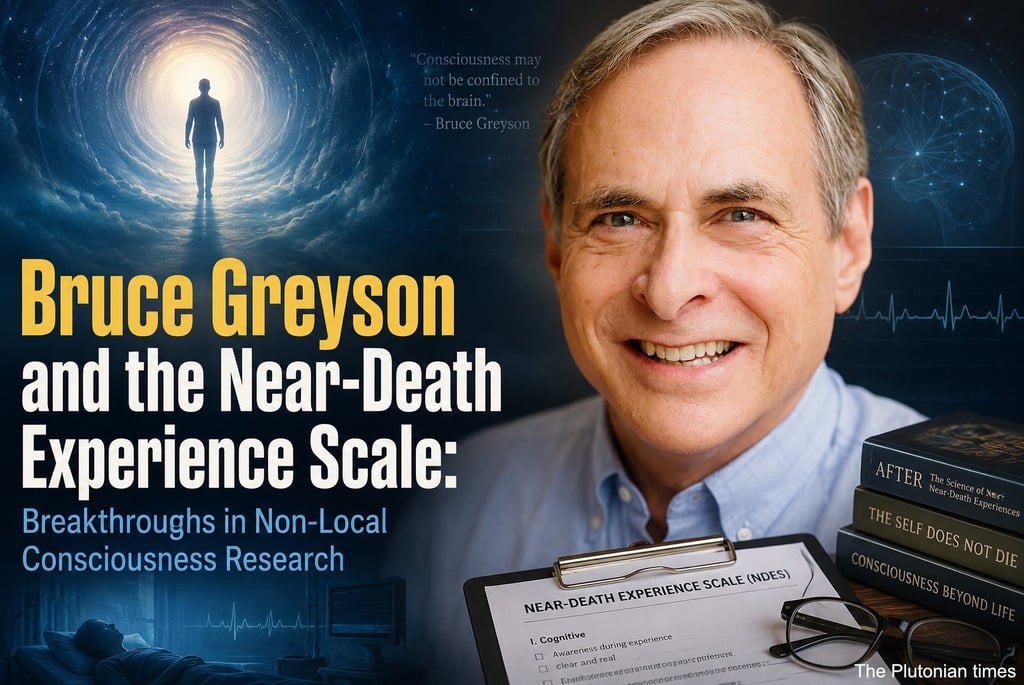
Bruce Greyson, MD, is the Chester Carlson Professor Emeritus of Psychiatry and Neurobehavioral Sciences at the University of Virginia. He has dedicated more than 45 years to the rigorous scientific examination of near-death experiences as Professor Emeritus and former Director of the Division of Perceptual Studies. His work challenges materialist assumptions about consciousness and explores the possibility that mind may function independently of the brain.
The Near-Death Experience Scale
One of Greyson's most significant contributions came in 1983 with the creation of the Near-Death Experience Scale. This 16-item instrument quantifies the depth and components of NDEs based on statistical analysis of common features reported by experiencers. It covers four main dimensions: cognitive aspects such as accelerated thought and life review, affective elements including peace, joy, and cosmic unity, paranormal features like out-of-body experiences and precognitive visions, and transcendental elements such as encounters with deceased relatives or mystical beings. A score of 7 or higher on the 32-point scale indicates a genuine NDE for research purposes. The scale has high reliability and validity. It remains the most widely used tool in the field and is cited extensively in studies worldwide.
Early Research and Background
Greyson began his NDE research in the mid-1970s while training in psychiatry at the University of Virginia. An early encounter with a patient who reported accurate details from an out-of-body perspective during a medical crisis prompted him to investigate systematically. This experience shifted his perspective from strict materialism toward openness regarding the continuity of consciousness. He later co-founded the International Association for Near-Death Studies and edited the Journal of Near-Death Studies from 1982 to 2007.
Additional Tools: The Physio-Kundalini Scale
Greyson also developed the Physio-Kundalini Scale in the 1980s to assess physiological and psychological changes often reported after NDEs, such as heightened sensitivity or transformative shifts.
Research Methods and Database
His research primarily relies on retrospective analysis of firsthand accounts, clinical interviews, and surveys rather than controlled laboratory induction of NDEs. He has compiled and validated a database of over 1,000 cases. These confirm that experiencers were medically close to death and document consistent patterns across cultures and eras.
Prospective Studies: The AWARE Project
Greyson participated in prospective studies such as the AWARE project led by Sam Parnia. These efforts placed visual targets in hospital rooms to test veridical out-of-body perceptions during cardiac arrest. While some intriguing cases emerged, large-scale controlled verification remains challenging due to the infrequency of NDEs in monitored settings.
Aftereffects of Near-Death Experiences
He has explored aftereffects of NDEs, including reduced fear of death, increased empathy, spiritual transformation, and sometimes enhanced intuitive or psychic sensitivities. His studies show these changes are lasting and distinguishable from hallucinations or psychological artifacts. Recent collaborative work with Marieta Pehlivanova includes 2025 critiques of neurophysiological models of NDEs. These highlight features like enhanced cognition during brain shutdown that current brain-based explanations cannot fully account for.
Contributions to Non-Local Consciousness
Greyson's findings contribute to broader debates on non-local consciousness. NDEs often feature accurate perceptions from outside the body, life reviews with verified details, and encounters that defy conventional neuroscience. His co-authored book Irreducible Mind from 2007 and edited The Handbook of Near-Death Experiences from 2009 compile evidence suggesting consciousness may not be solely produced by brain activity.
In his 2021 book After: A Doctor Explores What Near-Death Experiences Reveal about Life and Beyond, Greyson synthesizes decades of data to argue for rethinking life, death, and the mind-brain relationship. His research aligns with other work on extended consciousness, such as that by Pim van Lommel, and supports models where the brain acts more as a filter or transceiver than the sole generator of awareness.
Impact and Legacy
Successes include widespread acceptance of the NDE Scale as a research standard, documentation of transformative aftereffects in psychologically healthy individuals, and growing interdisciplinary interest linking NDEs to quantum-inspired consciousness theories and psychedelic studies. Challenges persist in replication of veridical elements and integration with mainstream neuroscience. Yet Greyson's rigorous, evidence-based approach has elevated the field.
Bruce Greyson's career demonstrates how careful scientific inquiry can illuminate profound mysteries. By cataloging thousands of experiences with names, dates, and verifiable details where possible, he has advanced understanding of human consciousness beyond physical limits. His work remains influential for researchers, clinicians, and those exploring the nature of reality.
References
Greyson, B. The near-death experience scale: Construction, reliability, and validity. Journal of Nervous and Mental Disease, 1983.
Greyson, B. After: A Doctor Explores What Near-Death Experiences Reveal about Life and Beyond. Macmillan, 2021.
Greyson, B., and Pehlivanova, M. A neuroscientific model of near-death experiences reconsidered. 2025.
Kelly, E.F., et al. Irreducible Mind: Toward a Psychology for the 21st Century. Rowman and Littlefield, 2007.
Parnia, S., et al. AWARE study. Resuscitation, 2014.
Division of Perceptual Studies, University of Virginia. Near-Death Experiences research overview.
Greyson, B. career and publication summaries from academic profiles.