
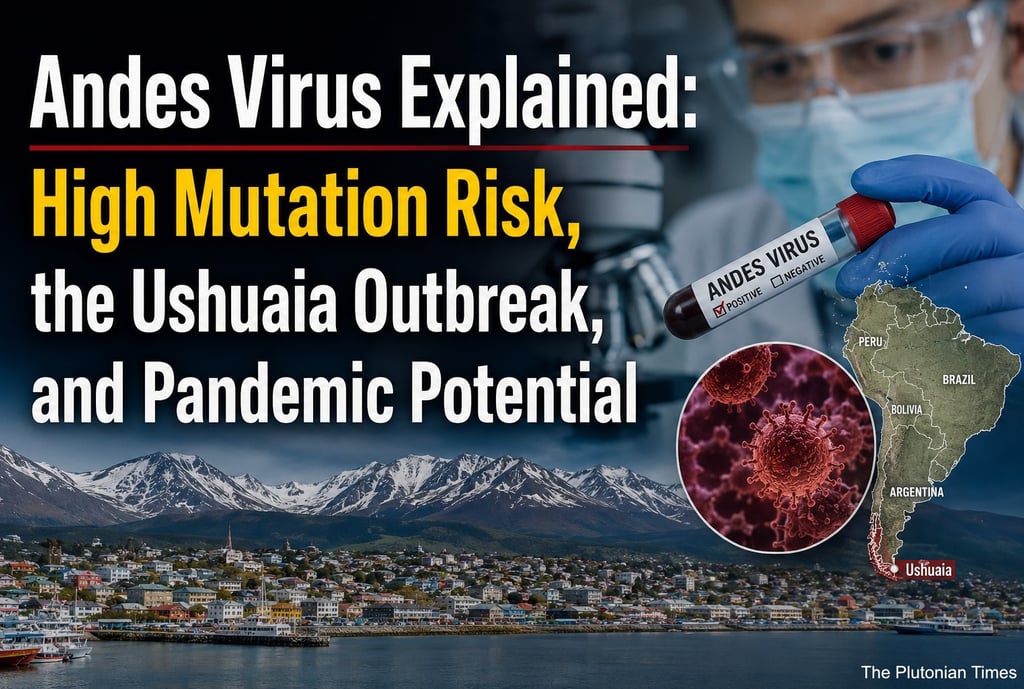
Andes Virus Explained: High Mutation Risk, the Ushuaia Outbreak, and Pandemic Potential
SCIENCEHEALTH
Debbie Edwards
5/7/20264 min read
My post content
The MV Hondius outbreak (April to May 2026) gives us the latest real-world example of Andes virus (ANDV) behavior. ANDV is an RNA virus from the Bunyavirales order. RNA viruses store their genetic information in RNA instead of DNA. They copy themselves using an error-prone enzyme that lacks proofreading, so they make many small genetic mistakes during replication. This gives them a high mutation rate.
The ship left Ushuaia, Argentina (Tierra del Fuego province) on April 1, 2026. The first cases were a Dutch couple who got sick on April 6. Health officials believe they caught the virus from infected rodents during a bird-watching trip that included a local landfill. This was the first time hantavirus appeared in that province. Later cases on the ship suggest limited person-to-person spread in close contact situations.
What Could Happen If Andes Virus Mutated to Spread Like COVID-19
Because ANDV is an RNA virus, it can change quickly as it spreads. Past outbreaks already show specific mutations that made limited person-to-person transmission more efficient.
History shows what often happens when RNA viruses spread widely among people. The constant mutations create a mix of slightly different virus versions inside each infected person. Natural selection then favors versions that spread better, evade immunity, or survive longer outside the body.
For ANDV to evolve from requiring close, prolonged contact (such as household or caregiving situations) to spreading casually through the air like COVID-19 would require several big changes at once. These could include better survival in air droplets, stronger binding to cells in the upper airways, and easier shedding from infected people.
If such a mutation occurred (a low-probability but high-impact scenario), the results would be very serious. The current death rate for ANDV is 30 to 50 percent even with hospital care. A more contagious version would combine fast spread with rapid, severe lung and heart failure. This could lead to millions of deaths in the first year, overwhelmed hospitals, and greater economic damage than COVID-19. Super-spreader events would accelerate outbreaks in schools, workplaces, and public places. More rodent population surges linked to climate change could spark additional spillovers.
Detection would be delayed by the long incubation period (up to eight weeks). Close monitoring of virus genetics would be essential to catch dangerous changes early. The World Health Organization would likely declare a global public health emergency.
How Andes Virus Kills a Host
ANDV infects endothelial cells (the thin lining of blood vessels), especially in the lungs. It does not usually destroy these cells directly. Instead, it triggers a combination of:
Increased vascular permeability (capillary leak): Infected cells and the body’s immune response make tiny blood vessels leaky. Fluid, proteins, and blood components pour into the lung tissues and air sacs.
Non-cardiogenic pulmonary edema: The lungs fill with fluid, severely impairing oxygen exchange.
Cardiogenic shock and heart failure: The virus and immune overreaction depress heart muscle function, reducing the heart’s ability to pump blood. This leads to low blood pressure, poor oxygen delivery to organs, and multi-organ failure.
Immune dysregulation: There is often massive immune activation (cytokine release), lymphocyte apoptosis (cell death), thrombocytopenia (low platelets), and sometimes coagulopathy (clotting problems).
Death usually occurs suddenly in the cardiopulmonary phase, often within hours to 1–2 days of severe breathing difficulty, from respiratory failure combined with irreversible shock. Most fatalities happen 2–10 days after symptoms begin.
Symptom Progression
Symptoms develop 1–8 weeks after exposure (incubation period; median around 2–4 weeks for ANDV).
Early (Prodromal) Phase (3–5 days, flu-like):
High fever, severe fatigue
Muscle aches (especially large muscles: back, thighs, hips)
Headache, chills, dizziness
Gastrointestinal issues: nausea, vomiting, abdominal pain, diarrhea
Sometimes headache or mild cough
Cardiopulmonary Phase (begins suddenly, lasts days):
Dry cough turning productive
Shortness of breath, chest tightness
Rapid breathing, low oxygen levels
Low blood pressure, fast or irregular heartbeat
Fluid buildup in lungs (pulmonary edema) visible on X-rays
Shock, possible bleeding tendencies or kidney involvement (more common with ANDV than some other hantaviruses)
In severe cases, patients rapidly need mechanical ventilation or ECMO (heart-lung bypass). Survivors enter a recovery (diuretic) phase where fluid clears, but full recovery can take weeks to months, with lingering fatigue, shortness of breath, or reduced lung function.
Results and Fatality
Case-fatality rate: Approximately 35–50% for Andes virus (higher than many other hantaviruses; overall HPS averages ~38%). Some outbreaks reach 60%.
Even with modern ICU care, many patients die because the progression is so rapid.
Survivors generally recover lung function if they survive the acute phase, but some have long-term fatigue or breathing issues.
Protocols if It Became Casually Transmissible
Argentina’s existing ANDV framework (rodent control plus targeted H2H tracing or quarantine) would scale nationally and internationally but shift to full pandemic mode, drawing from COVID-19 playbooks while incorporating hantavirus-specific lessons (for example, rapid cardiopulmonary monitoring):
Immediate response (first weeks): Airborne plus contact precautions everywhere (N95 or KN95 masks, ventilation, HEPA filtration). Universal symptom screening, rapid RT-PCR or serology testing at ports or airports. Strict isolation of suspected cases (negative-pressure rooms where possible). Contact tracing scaled via apps or digital tools (as in Epuyén 2018 to 19, where it dropped R below 1).
Community measures: Tiered lockdowns or “circuit breakers” in hotspots; school or work closures; limits on gatherings. Rodent surveillance and public clean-up campaigns intensified (damp-mopping protocols mandatory in endemic areas).
Healthcare surge: Early ICU or ECMO protocols for all progressing cases (fluid management critical to avoid worsening edema). No specific antiviral exists, so supportive care remains key; urgent parallel development of vaccines (mRNA platforms could accelerate candidates using existing ANDV sequences) and monoclonal antibodies.
Travel and global coordination: Border screening or quarantine (up to 45 days for contacts, per current ANDV max incubation). Potential short-term flight bans from endemic zones. WHO-led genomic sharing and equitable vaccine distribution.
Long-term: Vaccine mandates in high-risk areas, ongoing genomic monitoring for further mutations, and public education on rodent avoidance plus early symptoms. Argentina’s Malbrán Institute (now with Latin America’s first BSL-4 lab, inaugurated around 2025) would lead sequencing and response.
References:
Vial PA, et al. Hantavirus in humans: a review of clinical aspects and management. The Lancet Infectious Diseases. 2023.
Kuenzli AB, et al. Hantavirus Cardiopulmonary Syndrome Due to Imported Andes Hantavirus. Clinical Infectious Diseases. 2018.
Warner BM, et al. Differential Pathogenesis of Andes Virus Strains. Journal of Virology. 2021.
Ulloa-Morrison R, et al. Critical care management of hantavirus cardiopulmonary syndrome. Journal of Critical Care. 2024.
Martínez VP, et al. “Super-Spreaders” and Person-to-Person Transmission of Andes Virus. New England Journal of Medicine. 2020.
Alonso DO, et al. Person-to-Person Transmission of Andes Virus. Emerging Infectious Diseases. 2020.
Toledo J, et al. Evidence for Human-to-Human Transmission of Hantavirus: A Systematic Review. Viruses. 2021.
Reviews on RNA virus evolution and variant emergence (SARS-CoV-2, influenza, Ebola, HIV) from Nature Reviews Microbiology and Journal of Virology.
Argentine Ministry of Health and WHO epidemiological reports on the 2026 Ushuaia cruise ship cluster.
Barrera A, et al. New Andes virus isolate from the 2025–2026 outbreak. Current Research in Virological Science. 2025.