
AI Is Killing the Planet: Data Centers Use More Water Than Entire Cities
TECHNOLOGYENVIRONMENT
Debbie Edwards
5/29/20263 min read
Data centers are among the most electricity-intensive operations globally. In 2024, global data centers consumed approximately 415 terawatt-hours (TWh) of electricity. This accounts for roughly 1.5 percent of total worldwide electricity use. Demand has grown at about 12 percent per year in recent years. Projections indicate consumption could nearly double to around 945 TWh by 2030, representing under 3 percent of global electricity.
In the United States, which hosts a large share of the world's data centers, consumption stood at about 176 TWh in 2023. This equated to roughly 4.4 percent of national electricity use. Some analyses suggest U.S. data centers could reach 12 percent of total electricity consumption by 2028. A single modern AI-focused data center can consume as much power as 100,000 homes, with larger facilities potentially using up to 20 times that amount.
This surge strains power grids. It sometimes delays the retirement of coal plants or requires new gas-fired generation. Backup diesel generators, used during outages, add to air pollution with high levels of nitrogen oxides and particulate matter.
Significant Water Usage
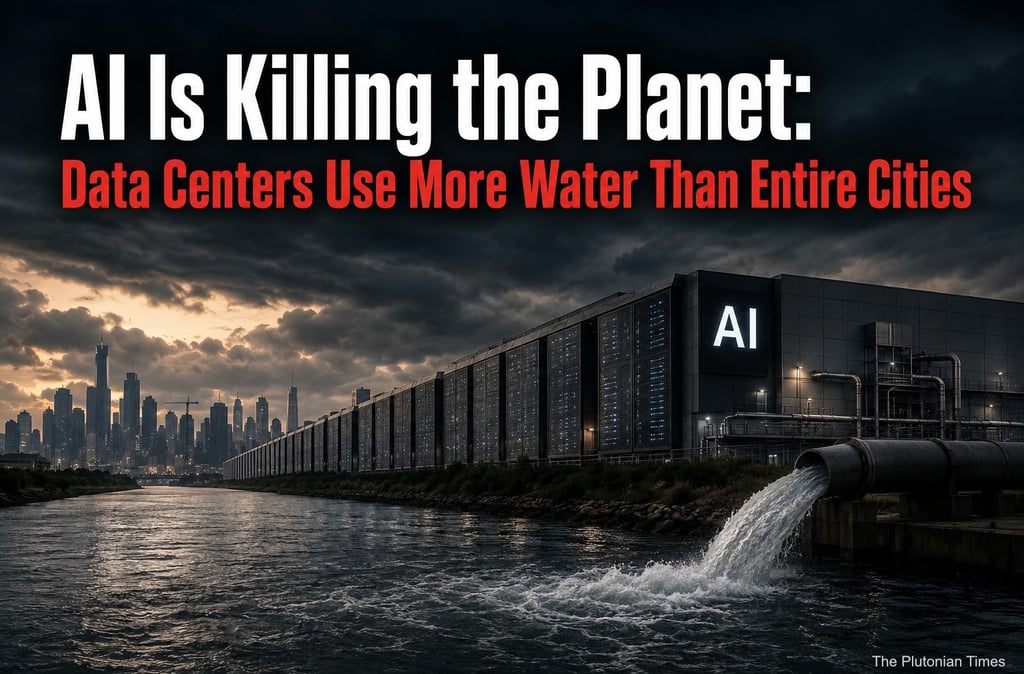
Cooling is essential for data centers to prevent servers from overheating. Many rely on water-intensive evaporative systems. A large data center can use up to 5 million gallons of water per day. This volume is comparable to the daily water needs of a small town with 10,000 to 50,000 residents. Mid-sized facilities may consume 300,000 gallons daily.
Nationwide in the U.S., direct water consumption for cooling is substantial. Projections for AI-related data centers suggest up to 3.7 billion gallons annually in some estimates. Indirect water use tied to electricity generation adds even more. By 2028, AI data centers in the U.S. could require as much as 32 billion gallons of water per year.
Water stress is a particular issue in regions like Northern Virginia, Arizona, and Texas. Local communities often compete with data centers for resources, especially during droughts. Globally, water consumption for data centers was estimated in the hundreds of billions of liters, with significant growth expected.
Carbon Emissions and Climate Effects
Energy use drives carbon emissions. In 2024, data centers produced around 140 to 182 million metric tons of CO2 equivalent. This figure depends on the energy mix powering the facilities. AI growth could add 24 to 44 million metric tons of CO2 annually by 2030. That is roughly equivalent to the emissions from adding 5 to 10 million gasoline-powered cars to U.S. roads each year.
Many operators procure renewable energy credits to offset consumption. However, actual grid reliance often includes fossil fuels, especially during peak demand. Emissions from data centers contribute to broader climate challenges, even as the industry aims for net-zero targets.
Additional Environmental and Community Impacts
Beyond energy and water, data centers affect land use, noise levels, and local air quality. Construction can disrupt habitats. Backup generators release pollutants linked to respiratory and cardiovascular issues. In some areas, public health costs from these operations have been estimated in the hundreds of millions of dollars annually.
The rapid buildout also raises concerns about electronic waste from servers and hardware with short lifecycles.
Mitigation Efforts and the Path Forward
The industry is pursuing improvements. Power Usage Effectiveness (PUE) metrics have declined in efficient facilities, with some hyperscalers achieving values near 1.1. Innovations include free-air cooling, advanced heat recovery, and siting in cooler climates. Renewable energy procurement has increased, reaching shares around 58 percent in some reports.
Regulatory attention is growing. Some regions are imposing stricter water and energy reporting requirements. Research into more efficient chips, liquid cooling alternatives, and AI-optimized operations offers hope for reducing impacts per unit of computing power.
References
International Energy Agency (IEA) reports on energy and AI (2025).
Lawrence Berkeley National Laboratory studies on U.S. data center energy use.
World Resources Institute insights on data center impacts.
Environmental and Energy Study Institute (EESI) on water consumption.
Various analyses from Grid Strategies, Ceres, and academic sources (2025-2026).