
3I/ATLAS: The Third Interstellar Comet – NASA’s Discovery, Observations, and Planetary Defense Lessons
SCIENCE
Debbie Edwards
4/4/20265 min read
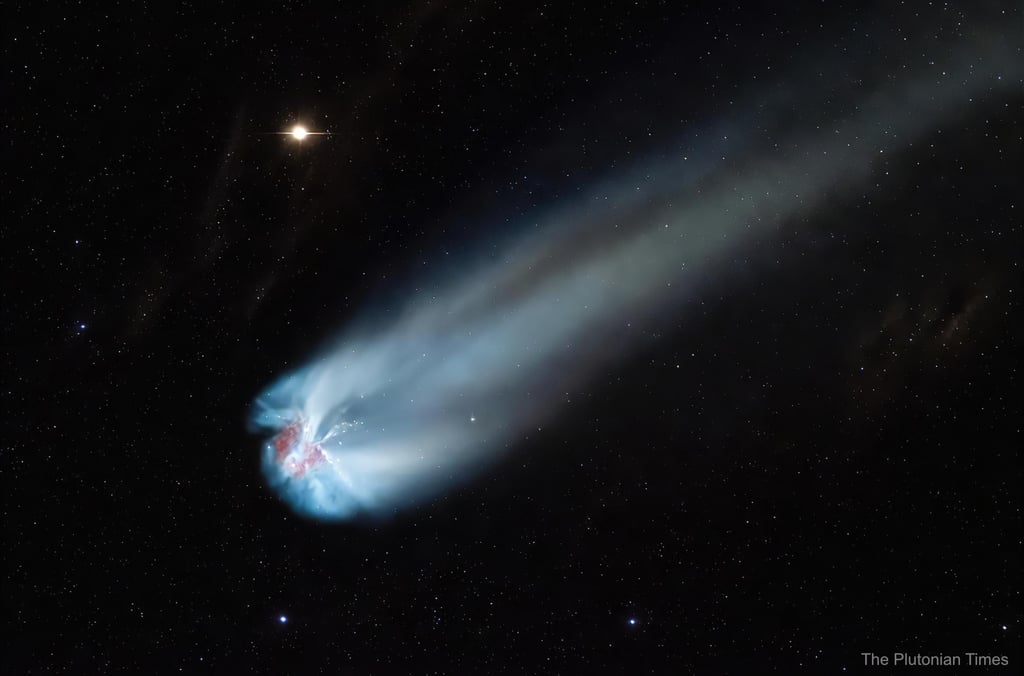
3I/ATLAS, also known as C/2025 N1 (ATLAS), is the third confirmed interstellar object ever detected passing through our solar system. It is an active comet that originated from outside our solar system, making it a rare visitor from another star system. Astronomers discovered it on July 1, 2025, using the NASA-funded Asteroid Terrestrial-impact Last Alert System (ATLAS) survey telescope in Rio Hurtado, Chile. Additional pre-discovery images from earlier dates came from other ATLAS telescopes located in Hawaii, Chile, and South Africa, as well as from Caltech’s Zwicky Transient Facility in California. The object received the official interstellar designation 3I/ATLAS (the third interstellar object found with help from the ATLAS system) and the comet name C/2025 N1 (ATLAS).
What makes 3I/ATLAS special and easy to understand
Imagine a snowball from another star system traveling at extremely high speed through our neighborhood. Most comets and asteroids in our solar system formed with the Sun and planets billions of years ago and move in predictable, closed orbits. In contrast, 3I/ATLAS follows a hyperbolic path, which means it came from interstellar space, swung around the Sun once, and will leave our solar system forever, never to return.
Its speed relative to the Sun was roughly 58 to 61 kilometers per second, about 130,000 to 136,000 miles per hour, before our Sun’s gravity affected it. This is much faster than typical objects in our solar system. It approached from the direction of the constellation Sagittarius, near the plane of our Milky Way galaxy, and its orbit has a nearly retrograde inclination almost 175 degrees, meaning it traveled in the opposite direction to most planets.
Key timeline of its journey through our solar system:
It passed relatively close to Mars, about 0.19 astronomical units, in early October 2025.
It reached its closest point to the Sun (perihelion) around October 29-30, 2025, at a distance of approximately 1.4 astronomical units, roughly 130 million miles or 210 million kilometers, which is just inside the orbit of Mars.
It made its closest approach to Earth on December 19, 2025, at about 1.8 astronomical units, around 170 million miles or 270 million kilometers. This distance is safe and posed no threat whatsoever to our planet.
It passed near Jupiter in March 2026 before heading out into deep space permanently.
Astronomers continued observing it into early 2026 as it faded while moving away from the Sun. It remained visible with small telescopes in the pre-dawn sky for some time and provided a valuable window for study.
Size, appearance, and composition
The solid icy core (nucleus) of 3I/ATLAS is estimated to be no larger than about 5.6 kilometers (3.5 miles) across, and it could be as small as a few hundred meters. Hubble Space Telescope images showed a teardrop-shaped cloud of dust around it, along with hints of a dust tail. After perihelion, it developed a noticeable gas and dust tail that stretched up to 5 million kilometers in some reports. It displayed jets and activity even when far from the Sun, which is typical for comets driven by the sublimation (turning directly from ice to gas) of volatile materials.
Spectroscopic observations revealed it is unusually rich in carbon dioxide (CO₂) compared to water ice. It also contained water vapor, carbon monoxide (CO), organic molecules, cyanide, and traces of other compounds such as nickel in some spectra. The high CO₂ content and certain depletions in other molecules set it apart from many solar system comets. Its overall color appeared reddish, similar to the previous interstellar comet 2I/Borisov. Scientists noted it was releasing large amounts of water vapor, equivalent to many Olympic-sized swimming pools per day in some estimates, with much of it directed sunward.
Its likely origin is the thick disk of the Milky Way, possibly from an ancient, low-metallicity star system that could be 7 to 14 billion years old.
Government projects and programs tied to 3I/ATLAS
Several U.S. government-led initiatives, primarily through NASA, played central roles in discovering, tracking, and studying this comet. These efforts fall under planetary defense of protecting Earth from potential impacts, and solar system science. No dedicated spacecraft flew to rendezvous with it due to its high speed, but existing missions contributed observations opportunistically.
ATLAS Survey (Asteroid Terrestrial-impact Last Alert System): This is the NASA-funded program that directly discovered the comet. ATLAS consists of robotic telescopes including sites in Hawaii, Chile, and South Africa, that scan the night sky every night to detect fast-moving objects such as asteroids and comets. Its main purpose is to provide early warnings for any objects that might pose an impact risk to Earth, giving days to weeks of notice depending on size. The discovery of 3I/ATLAS was a routine part of its operations, and the system has found hundreds of near-Earth objects over the years.
NASA Planetary Defense Coordination Office (PDCO) and Center for Near-Earth Object Studies (CNEOS) at the Jet Propulsion Laboratory: These teams quickly assessed the comet’s orbit after discovery and confirmed it presented no danger to Earth. They handle trajectory calculations and public notifications for potentially hazardous objects. The PDCO oversees surveys like ATLAS and coordinates responses to any future threats.
Multi-mission observation campaign: NASA directed many of its existing spacecraft and telescopes to observe 3I/ATLAS as it passed through the inner solar system. This coordinated effort used assets across the solar system for both scientific study and to gather data useful for planetary defense techniques. Key participants included:
Hubble Space Telescope (for size estimates, dust structures, and re-observations).
James Webb Space Telescope (JWST; for detailed infrared spectroscopy of gases and ices).
SPHEREx (infrared observations of dust, water, organics, and CO₂).
TESS (wide-field observations, including pre-discovery data and later activity/rotation studies).
Other missions such as Swift, Parker Solar Probe, PUNCH, Psyche, Lucy, Europa Clipper, Mars rover Perseverance, Mars Reconnaissance Orbiter, MAVEN, and the joint ESA/NASA SOHO spacecraft.
A temporary U.S. government shutdown in late 2025 delayed the release of some images and data, but observations continued and results were later shared publicly.
International Asteroid Warning Network (IAWN) observing campaign: Coordinated by NASA’s PDCO under the United Nations Committee on the Peaceful Uses of Outer Space, this was the 8th IAWN planetary defense exercise. Running from late November 2025 into January 2026, it used 3I/ATLAS as a practice target for global observatories involving more than 20 nations. The goal was to improve techniques for measuring the precise positions using astrometry of comets, which are fuzzier and harder to pinpoint than asteroids. This exercise helps prepare the worldwide community for better tracking of any future hazardous objects. It was explicitly a training drill for planetary defense, not because the comet posed any risk.
Trajectory and projection work: The Minor Planet Center under the International Astronomical Union and NASA’s CNEOS refined the comet’s orbit using data from ATLAS, ground-based telescopes, and spacecraft including those near Mars for better triangulation. NASA’s “Eyes on the Solar System” interactive tool allowed the public to follow its path in real time. Projections were updated continuously as new data arrived.
Broader international contributions and future concepts: The European Space Agency contributed through missions such as JUICE which attempted observations, ExoMars, and SOHO. No rapid-response interceptor mission was launched for 3I/ATLAS, but its passage helped test ideas for future missions to study interstellar objects, including concepts like Solar Oberth maneuvers. Some congressional interest including inquiries from members of Congress, and scientific white papers, discussed improving frameworks for studying future interstellar visitors.
All collected data is available in public NASA archives for ongoing research. Scientists generally agree that 3I/ATLAS is a natural comet, though some researchers including Harvard’s Avi Loeb highlighted unusual features such as its composition, size estimates, or non-gravitational effects and called for continued scrutiny. Radio and spectral data supported its icy, cometary nature. There is no connection to any classified military or unidentified aerial phenomena programs; assessments confirmed it as a purely scientific object.
This rare event provided an excellent opportunity to practice planetary defense techniques while learning about material from another star system. Observations and analysis continue even as the comet fades into the distance.
For the most up-to-date information, visit the official NASA page at science.nasa.gov/solar-system/comets/3i-atlas/ or use NASA’s Eyes on the Solar System tool.